
“Why, in my day . . .”

Growing up, I recall elders recounting tales about life before some innovation. Today, the advent of artificial intelligence (AI) is a hinge moment like so many technological advances I’ve experienced in the last 40 years. I look back on past breakthroughs with wonder and nostalgia. I’m trying to come to terms with current developments.

1984 – Desktop Computers

I roll my eyes when young volunteer coordinators enquire if I’m comfortable with computers. In 1984, my boss handed me boxes for an Apple IIe desktop computer and an amber monitor (orange type on a black screen) and told me to set them up so I could write marketing and training materials. 

1989 – Internet

Today, that old setup is quaint and humorous—a one-color monitor, 5¼ inch diskettes, a computer that didn’t connect to the Internet . . . because the World Wide Web wasn’t mainstream until 1989-90.

When the Internet became commonplace, we used painfully slow telephone dial-up modems with their crackling static and rubber band sound. Modems meant I no longer had to courier work product files to my customers on diskettes, which had shrunk to 3½ inches. 

1994 – 2001 – Search Engines and Websites

In the mid-1990s, search engines like Yahoo, AOL, and Netscape came on the scene and Search Engine Optimization (SEO) helped people, products, and businesses get found. Google started in 1998. It’s hard to imagine a time before Google, when research meant visiting a brick and mortar library to use printed resources that might be checked out to someone else.

As websites grew common, having one for my business became important. A friend and I designed and rolled out mine in 2001. Several versions followed until I retired it several years ago.

1996 – Cell Phones 

For me, the next technological cliff came around 1996 or 1997 when small cell phones arrived. They made calls. That’s it. If you had the patience to tap number buttons repeatedly, you could eke out texts. No camera. No Internet. No email. No music. No maps. Next, I owned a different dumb phone that opened to a qwerty keyboard. Around 2005, I acquired a fancier flip phone with a camera. Woohoo! Before long my 35mm digital camera was obsolete.

2007 – Smartphones

The world shifted dramatically again when the iPhone was introduced in 2007—the best of the available smartphones. Cell phones had enabled me to keep up on client calls and emails seamlessly when I was away from my home office—in other words, an early version of remote work. Staying connected with family became immensely simpler too.

2007 – 2008 – Facebook & Twitter

The advent of social media—Facebook and Twitter along with their many step-children—has transformed the world. How we discover, understand, and consume news. How we see ourselves and connect with or demonize others. There’s no denying social media’s far-reaching impact. Despite my mixed feelings about Facebook, it’s where a number of readers find our blogs. 

Now – Artificial Intelligence

Evidence of artificial intelligence is everywhere—Siri and Alexa, helpful spelling prompts in texts and emails, blank-eyed, AI-drawn models in ads, and who knows how many AI functions we are unaware of. 

AI makes me uneasy. But I don’t want to be a Luddite, so I’ve told myself I really ought to dig in, try to understand its scope, possibilities, and implications . . . insofar as any non-AI developer can. I’ve begun experimenting with ChatGPT as a research tool (think of all the data it accesses), but it’s never going to be writing my blogs! Count on 100% Ellen, all the time.

Five years from now, when the next technological wonder launches, who knows what we’ll be saying?
We Can Do This … the Saying of Yes

Jody and BethOne month ago, Jody and I flew to Texas for a weeklong RV Fundamentals course. We don’t own an RV. Our goal was to learn the intricacies of RVs and how to maintain a motorhome before buying. Our chance of success would increase, and we’d have much less frustration.
Class A motorhomes look like a large bus, Class B a van, and a Class C has a sleeping area over the cab.

On two occasions we had rented an RV for travel. A 31ft. Class C for a trip to the Grand Canyon and a 30ft. Class C for a trip to Mount Rainier. We learned that we had no idea what the sensors were indicating, where the fuse box was and what to look for if the refrigerator stopped working. We punted. We asked questions of other RVers, found the operator’s manual, and bought a cooler and ice to keep food cold.

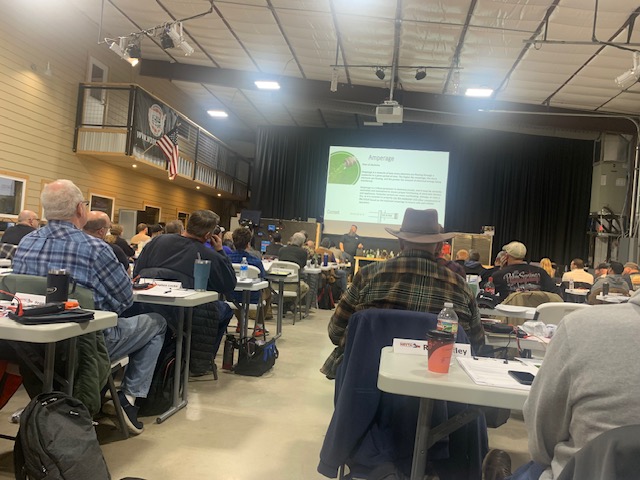
After landing in Dallas, we picked up our rented 24ft. Class C. This would be our home for ten days while we attended classes at the National RV Training Academy (NRVTA) in Athens. The program prepares individuals to apply basic technical knowledge and skills to build, test, inspect, repair, service and maintain recreational vehicles, systems, and interior and exterior components. At the end of the week there was an optional RV Service Technician exam.

Back of ClassWe didn’t sign up for the test. We hid in the back of the class.
At first, our goal was to listen to the lectures, and be active in the labs. Absorb the teachings and feel more competent as yet-to-be RV owners.

We were intrigued to learn being an RVer could lead to a business opportunity.

During the week we attended small business developmental training before the technical training started. The Stepping into Business Success course was compelling. Jody and I could see our way to owning a small business. Our new RV could be a work vehicle and become a tax write-off. Graduates of the school were in business as RV Techs, Inspectors, and some had branched off to other specialties such as air conditioners, refrigerators, generators and solar.

We just needed to find our niche.

Where we landed was the deep cleaning of grey and black tanks. Ms. and Ms. Poo if you must.

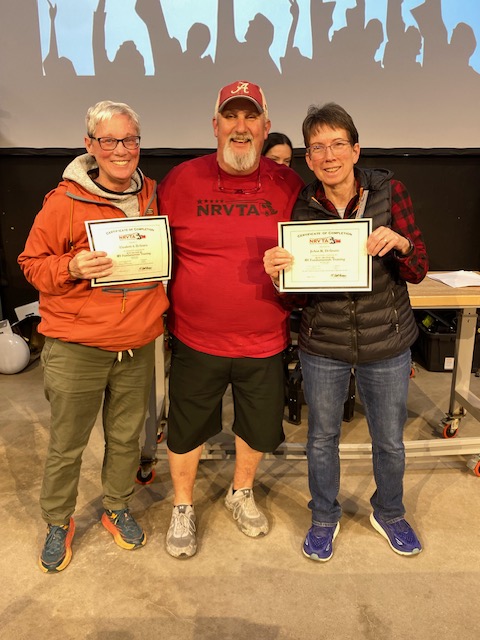
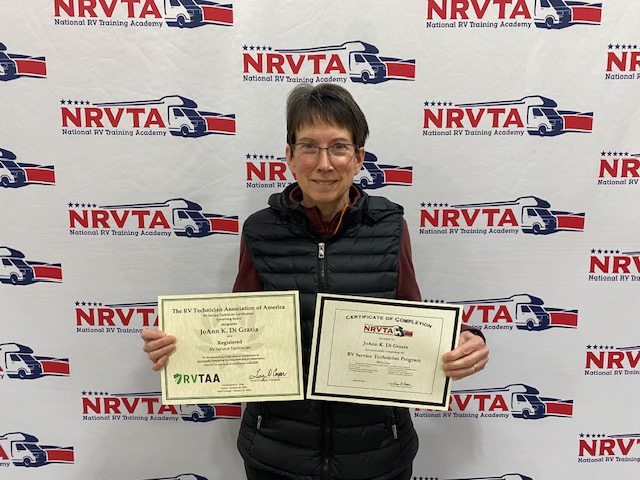
Jody certificatesAt week’s end, Jody and I received an RV Fundamentals Training certificate. In addition, Jody studied for and passed the RV Service Technician exam and became certified.

Still, we didn’t own an RV. Our intention was to buy one from a private owner or dealership while on vacation in Florida in the coming six weeks. Our retirement snapshot was summer at our home in Minnesota and winter in Florida living in an RV.

During one of our breakout lab sessions, Jody and I mentioned that we were looking to purchase an RV. A classmate had an aunt who lived in Farmersville, Texas selling a 2020 Class A 28ft. Winnebago Intent with less than 10,000 miles. Having spent a week crawling into a corner bed and bruising our elbows and shins from the tight space of a 24ft., owning a much larger RV was very appealing. We had never considered a Class A. I kept returning to the fact that we had previous experience with a 30 and 31ft RV. This was just a different style, and the length was only 28ft!

Jody and I drove 1 ½ hours to Farmersville, met the owners, and test drove the Class A. The owners were delightful. It was a motorhome we could be proud of. We signed a bill of sale. Named her Flo.

Back home in Minnesota Jody and I registered two businesses with the State: tankrefreshrv (grey and black tank maintenance) and dogGo (Jody’s dog walking business).

Class A photoWhile we were on a roll, we researched becoming Workampers. Workampers are people who have chosen a lifestyle that combines work with RV camping. RVers are provided a campsite in exchange for service.
During our vacation in Florida, Jody and I secured part-time positions for the coming winter season at an RV resort as activity directors. We will also oversee our small business on the side.

Jody and I have signed up for additional online training to be poo specialists.

We are no longer saying, “We can do this,” we are saying, “We ARE doing this.”

It’s been one month since our RV Fundamentals class. Following the flow, the saying of yes, brought us to this point. The only thing missing is Flo herself. She’s still in Farmersville, Texas. Mid-March, after our vacation in Florida, we’ll fly to Texas to bring her home.

Can’t wait to get to know her.

Love of a Woman

Did you notice many people wearing red February 2 to call attention to the American Heart Association®️ Go Red for Women®️ campaign?  Has anyone mentioned to their doctors the Yale’s Women’s Health Research study on women’s lower outcomes compared to men after coronary artery bypass surgery? Keep in mind that heart disease is the #1 killer of American women and 44% live with some form of it.

February is National Heart Health month. While political theater would keep female eyes focusing on reproductive health as women’s major issue, most of the true state of women’s health is unknown. Not only is there inequality in how the medical community treats women, but less than 11% of the National Institute of Health’s 2020 budget went towards female illnesses or conditions. Staying with heart health challenge, only 29% of cardiac artery bypass surgery is done on women, with a statistically lower success. Heart disease presents different in women and is often ignored. Select surgeons recommend that more female cardiac surgeons need to be trained to care for female patients with additional research and training on female heart disease treatment. 

Not need to worry unless you are a woman or love a woman. That includes daughters, sisters, mothers, partners, special friends. 

The World Health Organization found that although women in the European Union live longer than men, they spend more of their lives in poor health. Prevention is not as high a consideration in women’s health as intervention–waiting until illness has hit, a pregnancy is in trouble, a young mother cannot take care of her family. Research money in pain management is directed toward men—80% of budget while about 70% of women manage long-term pain. 

Women are responsible for 85% of the decisions about their families’ healthcare. Marketers know a lot about women as buyers and users of healthcare. Sophisticated research can be done today by manipulating data. So why doesn’t the healthcare world know more about the differences between men and women’s bodies?

For love of all women, healthcare research and care delivery need to immediately update thinking that treats a five-foot four-inch female standing next to a six-foot male as merely a smaller body. Someone you love might depend on more specific knowledge and care.