When do people become too old to share their homes with a new dog? How do middle-aged dogs and older people find each other?
During his annual vet visit in February 2020, Rocky was found to have a heart murmur. Covid locked down our city before we could take him to a doggie cardiologist. That visit never happened because Rocky continued his happy, boisterous life.
Walk ahead to 2025 when Rocky hit his senior years. Since dogs pack a lot into lives of ten to fifteen years, their aging process is more compact. More dramatic. Medication helped with high blood pressure and easing anxiety due to dementia. A chiropractor supported with home exercises and massage kept his rear legs working. Playing smaller versions of fetch accommodated diminished vision. The adaptation grows.
Over years, not months, so will ours. For Rocky we’re able to be solid caregivers. I am not sure that I will be physically capable of supporting another dog through their final years. But how would we walk away from a beloved future family member because we’re all aging?
Cats and some rodent pets are not options because of allergies. We’ve done fish and snails when kids were young. None of them check any boxes of what I value in a companion creature. Spending the rest of our lives without a furry friend is hard to accept. Foster care is kind of like babysitting a neighbor’s child now and then. Can be physically demanding. Entertaining. Heart-warming. Then the baby or child goes home and there’s no one to talk to at midnight when sleep is elusive.
Maybe there are dog-share programs or lease a pet centers with humane housing for dogs in transition.
Maybe the quiet house will grow on us after Rocky’s life is over.
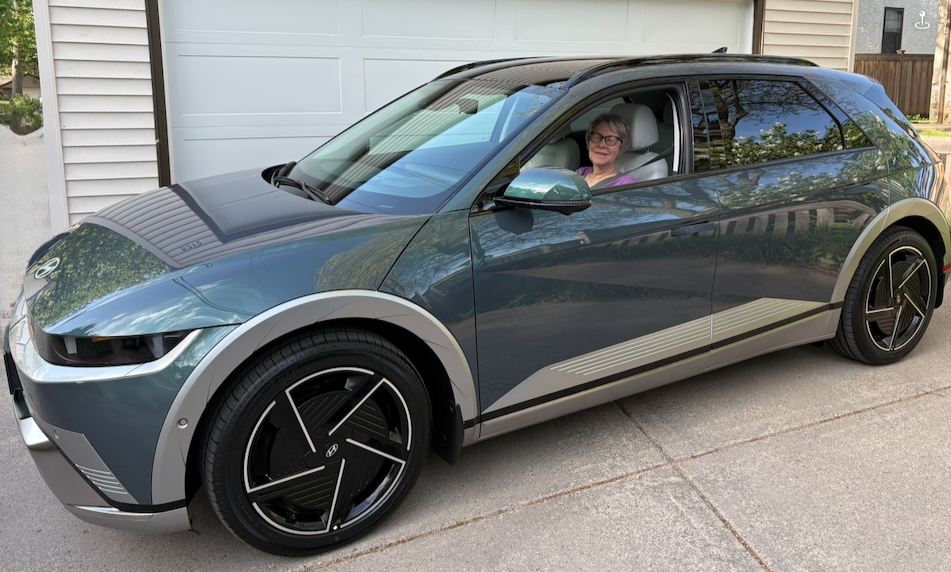
I recently bought an electric vehicle, which we’ll use as our around town car. After much research, we settled on a Hyundai Ioniq 5 because it’s highly rated and has AWD. Owning an EV launched me into a whole new mode of transport. Not exactly a jet pack, but definitely a different way of thinking about getting around.
Some mind shift was inevitable. My RAV4 was 15 years old. Any modern car would have been a shock to my system. But it was time for some upgrades. To use the phone handsfree, I relied on an aftermarket media center we’d installed. Sometimes the tiny microphone and speakers worked. Often the system hissed during calls and wasn’t worth the trouble. I didn’t have a backup camera. In parking lots, I’d learned to swivel my head like a horror movie villain to spot any oblivious people walking behind my car.
The Ioniq 5 is a beauty! Gray green with light gray interior. Sleek and modern looking. It has good pickup and handles well. It also has a million systems and functions I’m only beginning to understand.
Fob + push button start. Keys were easy to remember. They were integral to unlocking and starting the RAV, but now there’s no reason for the fob to leave my purse. After decades of obsessively managing keys, this is a disconnect—one of many.
My phone can open the car. Until my husband (thank goodness I’m married to a very patient tech genius!) reconfigured it, the car unlocked whenever I walked by with my phone in my pocket. That’s OK in my garage. Not OK in parking lots. Eventually it would lock up again, but the uncertainty made me uneasy. Now I touch a magic spot on the door handle to lock and unlock the car.
My car knows me (and likes me, I’m sure). When I open the door, it adjusts the seat and mirrors to my exact preferences. It greets me when my phone syncs. Nice, but a bit of overkill. My RAV never spoke to me (it was more of a humble workhorse), and adjusting the seat wasn’t an issue since no one else drove it.
Finding good driving tunes can be a lot. Now I have AM/FM plus Apple Tunes and Sirius. And way too many ways to change from an annoying song to something better. Toggle controls on the steering wheel up and down. Or press Star for Favorites. Or slide through 3-4 screens on the electronic control panel and push buttons. Whoa! Maybe I’d better pull over to do that. Thanks to the Tech Genius, I now can get from the local NPR station to Bluesville on Sirius and back. One day I may even figure out how to play a podcast. What I don’t hear is road noise. Only the EV hum.
There are endless ways to fuss with the temperature. The car is engineered so my comfort and the front seat passenger’s are paramount. Each of us can specify our preferences. Probably there are ways to enhance backseat passengers’ comfort (one day I’ll figure that out).
I can choose AC, fan/no fan, or I could even open the windows. The car also has air-cooled seats. (Wh a a a t?? Crazy, but good.) If I mindlessly set my temp at 71, the car will do everything in its power to keep it there including turning on AC without asking. If I turn off the AC, the fan will come on full blast in attempt to maintain 71 degrees. Wait, I didn’t mean it! 73 degrees with the window open a little is fine.
Let’s not overlook the obvious—battery instead of gas tank. In the olden days, when the RAV was down to a quarter tank, I refilled. I got approximately 22 mpg, and a tank lasted about two weeks, since I just drove around town. Fill-ups ranged from $36 to $48.
When I get in, the battery may be at 80%. Or 61%. The question remains: how much battery do I need for my ordinary trips? I. Do. Not. Want. To. Run. Out. That’s not likely since I’m only putting on 70 – 90 miles per week and the car has a range of 280 miles.
How often to recharge is a different learning curve. Before we had a high-speed plugin installed, we charged the slow way, which added about 10% to the battery overnight. I didn’t let the battery get too far down.
Now the high-speed system adds 25% in about 1-1.5 hours and costs $1.06 or $5.25 to charge the battery from 20% to 80% (car batteries last longer if they’re not charged to 100%). Hmmm. $5.25 for electricity every two weeks vs. an average of $42 for a tank of gas. Even I can do that math, and I love reducing the role of fossil fuels in my life.
No more oil changes. It took a minute to register maintenance will be very different. No engine, so no lube and oil. No exhaust, so no muffler system. Now maintenance is the mothership computer talking to my computer on wheels. I’ll still need tire rotations and a filter or two. (Wait, how will I get my car washed if I never go to the gas station?)
Although the technology surprises and baffles me sometimes, eventually I’ll master the major systems. I’m brave. I’m fierce. I’m doing this . . . with help from the Tech Genius. Most days I really enjoy this brave new world of transport.
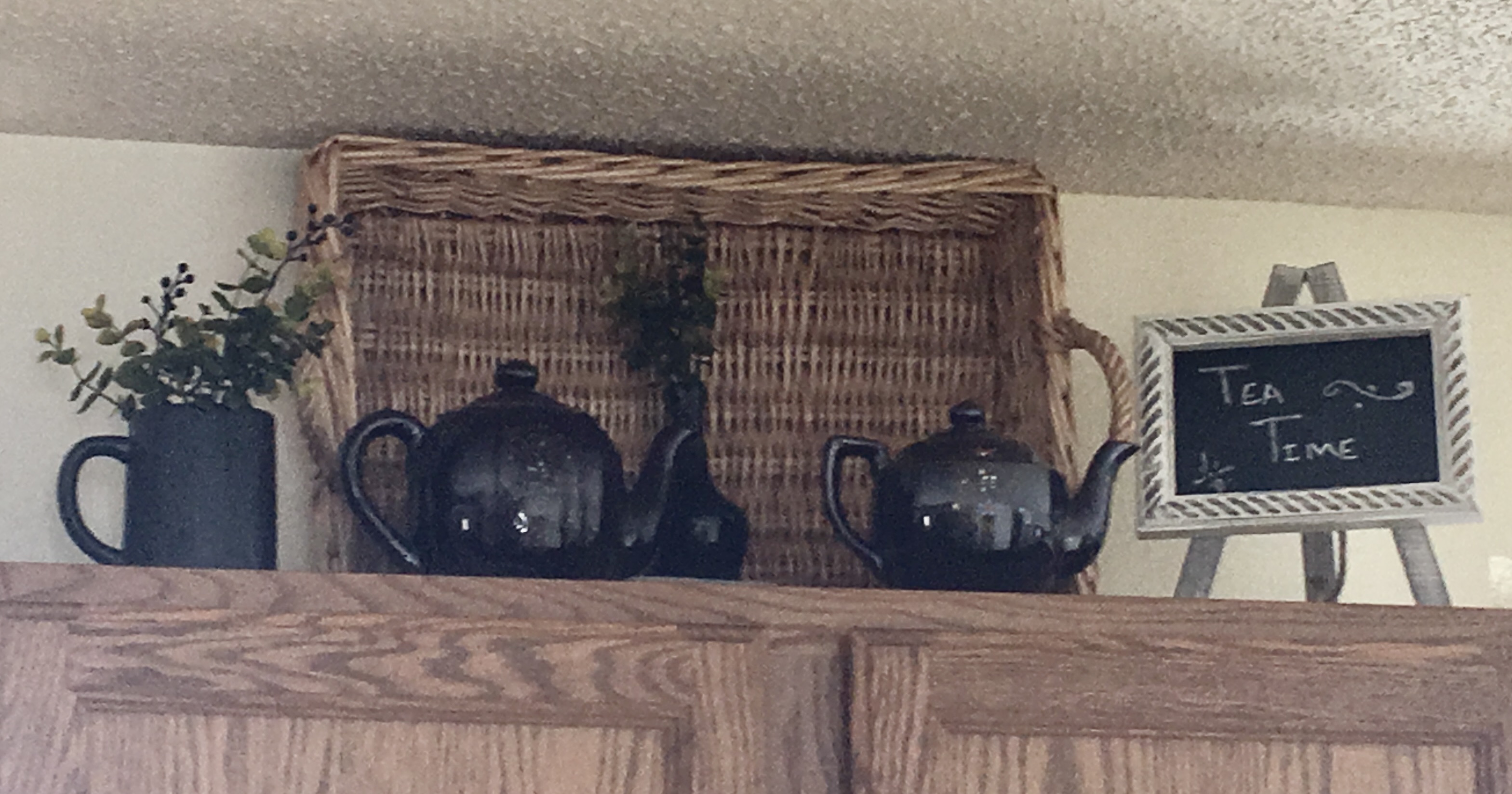
I have a collection of teapots, accumulated over more than 40 years, that I love and that have always given me joy. The earliest in the collection is a Japanese tea set I bought while I was in college. I loved the way I could cradle the thick handless cups in my palms, “too hot to touch, too hot to drink.” The set travelled with me from Grand Rapids to New Orleans, to Minnesota, back to Michigan. The super-glued lid, cracked during one of its many moves, is now part of its charm, a repaired flaw that doesn’t detract from its beauty.
My most prized possession in the collection is a Japanese “Brown Betty” that belonged to my mother. Well-loved and often used, it sat on our kitchen counter for years. Before sitting down to dinner every night, my mother would put two Lipton tea bags in the pot and fill it with boiling water from the kettle she had on the stove as she cooked. The tea would steep as the seven of us ate our baked chicken and biscuits, or fresh-caught salmon fried to perfection, or meatless Friday meals of macaroni and cheese or potato soup. As she cleared our plates, mom would pour a cup for her and my dad and we’d sit and talk as they sipped their tea, often long after the meal was finished.
I don’t remember when I acquired this treasure. Probably after dad died and mom sold our family home, auctioning off all the memories that wouldn’t fit into her one-bedroom apartment at the Senior Estates.
As often happens when you have a collection, mine grew over the years, added to by pieces I bought myself and by gifts from family and friends. I displayed these treasures on my kitchen soffits, the empty space between the top of the cabinets and the ceiling. I changed the displays by season, swapping out Brown Betty with a bright red Waechtersbach teapot and snowmen sets at Christmas time, adding pops of yellow in the spring. The three or four times I changed the décor every year were always satisfying, even as it got more difficult for me to climb on top of the kitchen counters to reach the void below the ceiling.
When we sold our four-bedroom house in Minnesota and moved to a townhome in Michigan, some of my collection went to Goodwill or were gifted to family or friends. My new compact kitchen has fewer cabinets, but the vaulted ceiling in our great room provides a spacious backdrop for the most treasured of my collection that remains. My teapots once again held a place of honor in my home.
This fall, I took a day to climb the heights and change out the decorations, adding pumpkins and sunflowers and other tchotchkes to complement the featured teapots. For the first time in years, however, I didn’t decorate for Christmas because we spent our first winter in the desert Southwest, a much-needed respite from the ice and snow. When I came back for a visit in February, I took down all the fall décor, leaving a few random pieces that looked lonely and sad, but that I planned to add to when we returned in the spring.
As is often the case at this phase of our lives, our return wasn’t quite as planned. My mother was dying, so I rushed home to be with my siblings for her final days. The next month was a flurry of activity: hospice workers, many laughs and tears with my four siblings, a funeral, cleaning out my mom’s assisted living apartment, poring through hundreds of pictures and memorabilia, finding my footing as a 67-year-old motherless child.
A month later, when the day came to finally fill the empty spaces above my kitchen cabinets, I found I no longer had it in me. I’m relatively healthy, but, like my mother, I have some balance issues that make it seem imprudent to climb a ladder and teeter on a kitchen counter to reach over my head and place porcelain vessels in an arrangement that is pleasing to me but likely not meaningful to anyone else.
So instead, I dragged the step ladder into the kitchen for perhaps the last time and took everything down. The Brown Betty is now on a shelf next to old pictures of my mom and dad. The rest are carefully wrapped and in a Sterlite tub in my storage room. In each teapot, I placed a note with the details of when I got it and its significance to me.
My soffits are naked for the first time in my adult life. The look matches the modern architecture of our new home, clean and uncluttered. I know the teapots are there if I should ever change my mind. I also know that my daughter would gladly help me decorate if I asked. For now, however, I’m trying to enjoy the new look and save my physical and mental effort for something else like walking with my husband, creating photo albums, writing. Still, it feels like a loss in a season full of loss.
While a practical decision, was it premature? Am I unnecessarily adding to my emotional burden while removing a physical one?