Category: history

  • Choosing to Believe

    A few weeks ago, I visited Pearl Harbor and the USS Arizona memorial. I wasn’t sure what to expect. My father was in the Navy during WWII at Normandy and later in the Pacific. I wanted to honor his service and the legacy of my parents’ generation who sacrificed and died to preserve our democracy.

    I stared into the water at the rusting sunken ship, which is a gravesite for more than 900 sailors. I wondered if they were young like Dad who signed up at 21, or if they had any idea what they were getting into when they joined the Navy. Pearl Harbor was a large naval base, but in 1941, it probably seemed like they were in the middle of nowhere, doing nothing important. Until it was bombed.
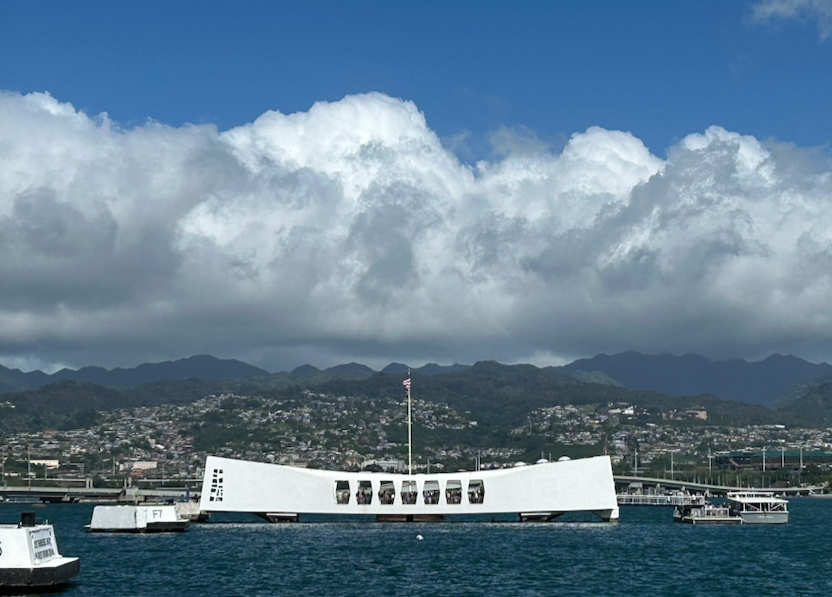
    USS Arizona Memorial

    In his later years, Dad said matter-of-factly, “War is hell.” He didn’t favor patriotic parades or ever make a big deal out of his service. Much as he hated war, he was also profoundly committed to preserving democracy. 

    Standing on deck of the memorial with the breeze rippling the water and lifting my hair, I didn’t feel a deep connection to Dad. Instead I felt frustrated, angry, and deeply sad that 85 years later, our country’s democracy is crumbling. I want to apologize to all the people who sacrificed and died so we wouldn’t see a day when the Current Occupant would engage us in a senseless war, trash our relationships with our international allies, and run roughshod over citizens’ constitutionally protected rights.

    I am worried about our country’s future. We certainly weren’t perfect 10 years ago or 20 years ago, but at least democracy was viable and mostly functioning then.

    More recently, I heard Yo-Yo Ma perform with the Minnesota Symphony Orchestra, and the music was as exceptional and moving as I expected. When he came out to play an encore, he alluded to Minnesota’s ordeal with ICE and our impressive community spirit. The audience clapped long and loud, grateful to be seen and acknowledged. Ma described the piece by Pablo Casals he intended to play. He said the music gets so quiet it almost disappears and there is fragility in the moment, but the music grows and fragility becomes strength.

    I am choosing to believe that as fragile as our democracy is right now, too many of us believe in it to let it disappear, so it will grow strong again.

  • “Why, in my day . . .”

    Growing up, I recall elders recounting tales about life before some innovation. Today, the advent of artificial intelligence (AI) is a hinge moment like so many technological advances I’ve experienced in the last 40 years. I look back on past breakthroughs with wonder and nostalgia. I’m trying to come to terms with current developments.

    1984 – Desktop Computers

    I roll my eyes when young volunteer coordinators enquire if I’m comfortable with computers. In 1984, my boss handed me boxes for an Apple IIe desktop computer and an amber monitor (orange type on a black screen) and told me to set them up so I could write marketing and training materials. 

    1989 – Internet

    Today, that old setup is quaint and humorous—a one-color monitor, 5¼ inch diskettes, a computer that didn’t connect to the Internet . . . because the World Wide Web wasn’t mainstream until 1989-90.

    When the Internet became commonplace, we used painfully slow telephone dial-up modems with their crackling static and rubber band sound. Modems meant I no longer had to courier work product files to my customers on diskettes, which had shrunk to 3½ inches. 

    1994 – 2001 – Search Engines and Websites

    In the mid-1990s, search engines like Yahoo, AOL, and Netscape came on the scene and Search Engine Optimization (SEO) helped people, products, and businesses get found. Google started in 1998. It’s hard to imagine a time before Google, when research meant visiting a brick and mortar library to use printed resources that might be checked out to someone else.

    As websites grew common, having one for my business became important. A friend and I designed and rolled out mine in 2001. Several versions followed until I retired it several years ago.

    1996 – Cell Phones 

    For me, the next technological cliff came around 1996 or 1997 when small cell phones arrived. They made calls. That’s it. If you had the patience to tap number buttons repeatedly, you could eke out texts. No camera. No Internet. No email. No music. No maps. Next, I owned a different dumb phone that opened to a qwerty keyboard. Around 2005, I acquired a fancier flip phone with a camera. Woohoo! Before long my 35mm digital camera was obsolete.

    2007 – Smartphones

    The world shifted dramatically again when the iPhone was introduced in 2007—the best of the available smartphones. Cell phones had enabled me to keep up on client calls and emails seamlessly when I was away from my home office—in other words, an early version of remote work. Staying connected with family became immensely simpler too.

    2007 – 2008 – Facebook & Twitter

    The advent of social media—Facebook and Twitter along with their many step-children—has transformed the world. How we discover, understand, and consume news. How we see ourselves and connect with or demonize others. There’s no denying social media’s far-reaching impact. Despite my mixed feelings about Facebook, it’s where a number of readers find our blogs. 

    Now – Artificial Intelligence

    Evidence of artificial intelligence is everywhere—Siri and Alexa, helpful spelling prompts in texts and emails, blank-eyed, AI-drawn models in ads, and who knows how many AI functions we are unaware of. 

    AI makes me uneasy. But I don’t want to be a Luddite, so I’ve told myself I really ought to dig in, try to understand its scope, possibilities, and implications . . . insofar as any non-AI developer can. I’ve begun experimenting with ChatGPT as a research tool (think of all the data it accesses), but it’s never going to be writing my blogs! Count on 100% Ellen, all the time.

    Five years from now, when the next technological wonder launches, who knows what we’ll be saying?

  • The Fierce Urge to Tell Our Stories

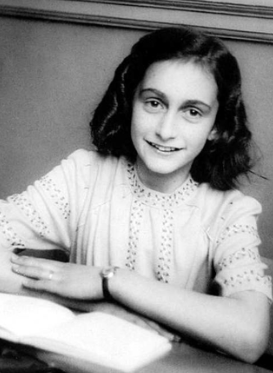
    Anne Frank was a vivacious teenager and a keen observer of human nature. She wrote well and her diary often includes deft characterizations of schoolmates, family, and the other people in hiding with her family. When I recently reread her famous diary in preparation for visiting her family’s hiding place in Amsterdam, I was impressed by her lively mind.

    Initially, she wrote to sort out her feelings—the same impulse that has prompted me to keep a journal off and on since I was a teenager. Putting my feelings into words helps me understand them. Airing out something on the page calms me and enables me to move on. 

    At first, Anne Frank meant her diary to be private. When she was 15, she heard a radio broadcast about a Dutch official who wanted to collect war stories and experiences, so she edited her diary in hopes it might be published one day. Unlike Anne Frank, I don’t want my journals shared with others. They’re histories of cranky confusion, and without context, they would likely distress family or friends once I’m gone and can’t explain.

    After her family went into hiding, her diary also served as a record of how they lived—what their space looked like, what their meals were, and what their daily schedule was. As the war intensified, she recorded bombing raids and news updates.

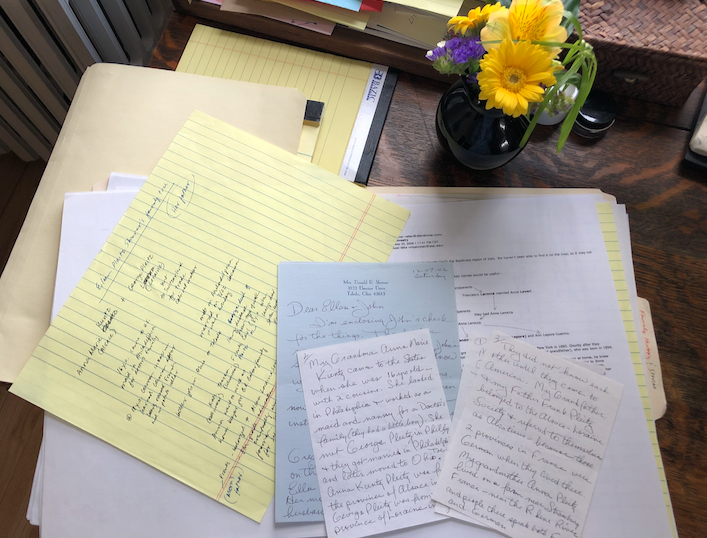
    Shortly after I finished the Anne Frank book, my sister asked me to refresh her memory about our great great grandmother—Katherine O’Tanney Feeley who emigrated from Ireland in the late 1800’s. To answer, I searched handwritten notes from my mother and father—a story here, a date and detail there. Some of the notes are sketchy and incomplete, but I decided I would make sense of them in a Word document so others in my family will have a record.

    Anne Frank’s story has touched millions all over the world in the decades since she wrote it. I have no such expectation for the family record I’m assembling. All I have are snippets of stories, not much to go on. Perhaps a few family members will have a mild interest. Hearing about people you never knew (even if they’re related to you) can be boring. 

    I’m fascinated by the urge to write journals and record family histories. Beyond that is the widespread wish to share the content of our days on social media or like I’m doing with this blog. People across all eras and cultures have felt this fierce need to tell our stories and understand who we are and who we came from. Sometimes we’re saying, “Here’s what happened.” Other times the wish to share is a way of saying, “I’m here. I matter.”

    Anne Frank could not have imagined how much her story would matter or how many readers would be touched by her words.

    Although my intentions and hopes for my writing differ from Anne Frank’s, I feel a kinship with that young woman born almost a century ago.