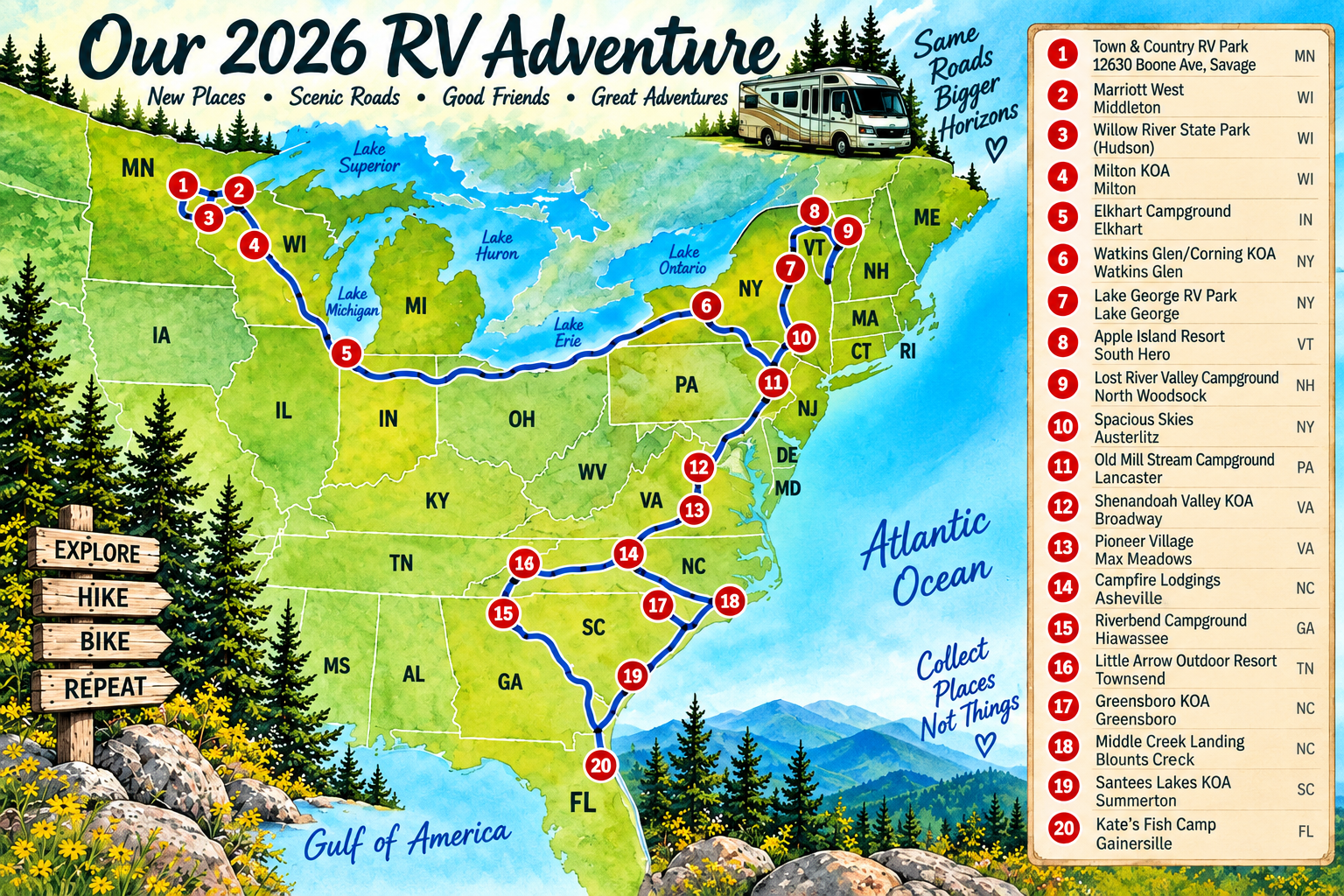
Sitting here in our living room on the eve of leaving for Minnesota, I feel the hum of something ending and something beginning. Jody and I are selling our Minnesota home of twenty-five years, and we are ready to lovingly pass it to another family.
I look around our Florida home and it no longer feels like an Airbnb, as it did at the beginning of the season. Jody and I have made it ours. Nothing has changed, really—the same living room pieces, the same dining room table, the same buffet—but everything has changed because it is lived in. Claimed. Ours.
We’ve hosted many poker games here. New friends who became old friends. Laughter in the kitchen, cards sliding across felt, stories told and retold.
Jody and I are standing between two homes: one built over twenty-five years through labor, parenting, maintenance, memories, and endurance; the other built through choice, community, friendship, play, and reinvention. Neither house is the true source of belonging. Jody and I are. We made both homes alive. We can do it again anywhere.
Even traveling the summer months in our RV.
We’ve learned home is not a place we keep—it is something we create, carry, and recreate.
And, how are the children? At twenty-four, with a degree in environmental science under her belt and an apprentice electrician’s card in his pocket, they are forging their own path
How are the adults?
Dang—we are hitting the road.
After building a life for others, this is the season Jody and I built one for ourselves.
Quality sleep generally suffers when serious, worrisome, or sad things press on daily life. And here we are with a horrible cacophony of such news screaming across the media, in grocery store lines, and casual conversations as friends and family look for some tiny assurance that the world, our country, or at least a personal circle could be okay.
Driving through rural areas in late winter, bags hang from trees ready to tap maple sap. Other trees might also be tapped, but maple trees are the largest producers. Tubing might zig-zag through a larger tree stand instead to gather sap into larger lines and run to collection tanks. For a small syrup maker, the sap will fill bags or pails which will be collected then carried to the sugar house location.
Forty gallons of sap are needed to make one gallon of maple syrup. The sap is boiled over an open flame until extra fluid is gone, then foam is removed and the syrup filtered. The process is time consuming with possibilities for accidents like burns and back strains.
Some syrup seasons snow still stands in the woods. As kids we filled small bowls with snow then bothered adults until syrup was poured over it. We learned how putting the maple candy in your mouth too quickly could painfully burn a tongue and how hot maple syrup splatter hurt on bare flesh. Regardless of age, we walked around the tubing, hot fires or equipment. No running for so many reasons.
If weather affects trees or harvest happens too late, the sap might be cloudy or bitter wrecking a season. If sap is undercooked or overcooked the syrup will be of lower quality. If deer and bears mess with piping the sap may drain onto the ground instead of filling the collection tank. Many things can reduce production from 20 gallons to a few or nothing.
The world seems to operate with the similar equations as maple syrup. A whole lot of good raw material or information may be required to produce a small amount of awesome happiness. There are many ways to interfere with delivery of the good and deliver serious, worrisome, or sad results. Maybe when sleep is disrupted, the thought of breakfast including fresh maple syrup can sweeten dreams or at least make the night hours pass easier. Forty gallons of springtime sap into a few tablespoons of delight.
What a twelve-year-old learns to survive sometimes becomes the skill she uses decades later at a poker table.
Lying didn’t come naturally to me. I was twelve when I realized, quite suddenly, that I wouldn’t survive my family’s chaos if I didn’t learn how.
I stood in front of the assistant principal, heat climbing up my neck and into my face. I could feel the redness spreading across my cheeks. The corners of my mouth twitched. My eyes kept sliding away from his.
He asked the question again.
I tried to answer, but the truth was written all over me. My breathing had changed. My hands shifted at my sides. My face burned like a signal light.
I remember thinking: This is a problem.
That afternoon, when I got home, I went straight into the bathroom and closed the door behind me. I turned on the light and stood in front of the mirror. I shut the household noise off and stared at my reflection.
I knew exactly what to do.
I looked into my own eyes and said the words out loud.
“I didn’t do it. I wasn’t there. It wasn’t me. I don’t know how that happened.”
My face flushed immediately. My mouth tightened. My eyes shifted away.
So I tried again.
And again.
I practiced until the red stopped rising in my face. Until my breathing stayed steady. Until I could hold my own gaze without flinching. I practiced until my shoulders relaxed and my voice sounded ordinary.
I practiced until my body stopped betraying me.
That was the day I learned that unless someone actually saw me do something, I could lie convincingly.
When I was nineteen, I had a different realization.
I was mowing the lawn on a nice summer day. I paused, looked to the sky, and watched the clouds drift.
And it hit me.
I was exactly where I had said I would be.
No excuses. No stories. No explanations.
Just the truth.
There was freedom in that.
A lightness.
I remember thinking: This is better. I have no reason to lie anymore. I’m safe.
I went back to the mirror. I stood there looking at myself and said, quietly at first, “I love me.”
My eyes slid away from my own reflection.
So I said it again.
“I love me.”
I stayed there repeating it until I could look myself straight in the eyes without my gaze moving off the mirror.
“I love me. I love me. I love me.”
It felt strange. Uncomfortable.
Slowly the words settled.
I believed me.
Today, I still practice with a mirror.
Before a poker tournament starts, I give myself the same quiet talk.
“I love me. I’ve beaten everyone at this table before. I can beat them today. Play my cards. Trust myself.”
Poker is about many things—math, probability, timing—but there is another part of it people don’t always talk about.
Control.
At the poker table, I can keep my emotions exactly the same whether I’m holding a seven and a two or a pair of aces. My breathing stays steady. My hands rest in the same place. My face doesn’t give anything away.
No tells.
Sometimes I think about that twelve-year-old girl standing in the bathroom mirror, practicing how not to show the truth on her face. She didn’t know it then, but she was learning something about herself, about discipline, about control, about surviving difficult moments without falling apart.
Poker uses those same muscles.
But it also asks for something more.
It asks me to stay present.
Every hand is a surprise. Every card an unknown. Sometimes the deck gives you everything. Sometimes it gives you nothing.
And when it gives me nothing, that’s okay too.
I can push my chair back, smile across the table, and say,
“Nice game, ladies.”
Because the real victory happened long before the cards were dealt.
It happened the day I learned to look at myself in the mirror and tell the truth.
A few weeks ago, I visited Pearl Harbor and the USS Arizona memorial. I wasn’t sure what to expect. My father was in the Navy during WWII at Normandy and later in the Pacific. I wanted to honor his service and the legacy of my parents’ generation who sacrificed and died to preserve our democracy. I…
“Crystel’s carrying the dining room table out of the house!” Jody said, a note of panic in her voice. “Now the chairs!” Quietly, I felt proud of Crystel. She was going ahead with gumption, emptying our house while we were in Florida, not asking permission, not making a fuss. Jody kept tabs on the coming…
Comments?