Category: technology

  • My New Rocket

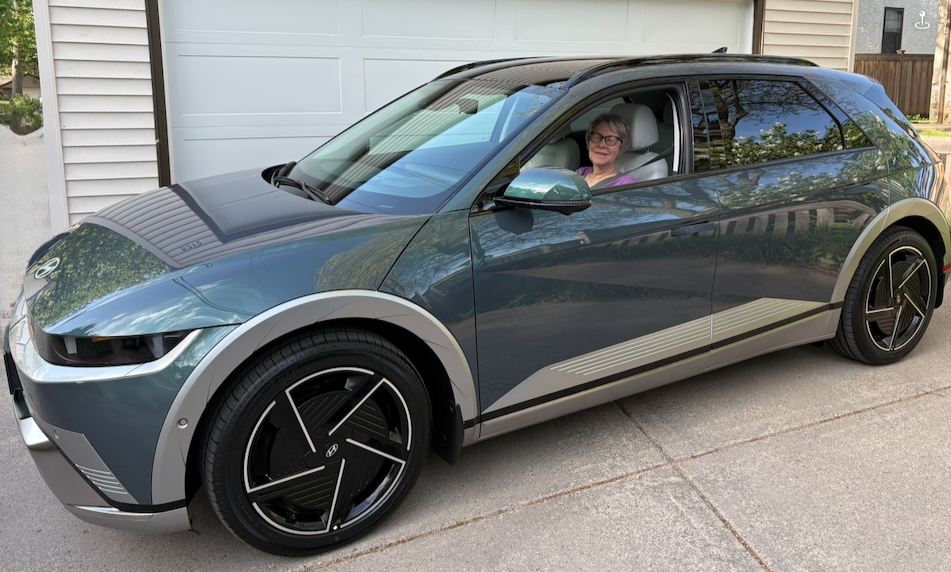
    I recently bought an electric vehicle, which we’ll use as our around town car. After much research, we settled on a Hyundai Ioniq 5 because it’s highly rated and has AWD. Owning an EV launched me into a whole new mode of transport. Not exactly a jet pack, but definitely a different way of thinking about getting around.

    Some mind shift was inevitable. My RAV4 was 15 years old. Any modern car would have been a shock to my system. But it was time for some upgrades. To use the phone handsfree, I relied on an aftermarket media center we’d installed. Sometimes the tiny microphone and speakers worked. Often the system hissed during calls and wasn’t worth the trouble. I didn’t have a backup camera. In parking lots, I’d learned to swivel my head like a horror movie villain to spot any oblivious people walking behind my car.

    The Ioniq 5 is a beauty! Gray green with light gray interior. Sleek and modern looking. It has good pickup and handles well. It also has a million systems and functions I’m only beginning to understand.
    Fob + push button start. Keys were easy to remember. They were integral to unlocking and starting the RAV, but now there’s no reason for the fob to leave my purse. After decades of obsessively managing keys, this is a disconnect—one of many. 

    My phone can open the car. Until my husband (thank goodness I’m married to a very patient tech genius!) reconfigured it, the car unlocked whenever I walked by with my phone in my pocket. That’s OK in my garage. Not OK in parking lots. Eventually it would lock up again, but the uncertainty made me uneasy. Now I touch a magic spot on the door handle to lock and unlock the car.

    My car knows me (and likes me, I’m sure). When I open the door, it adjusts the seat and mirrors to my exact preferences. It greets me when my phone syncs. Nice, but a bit of overkill. My RAV never spoke to me (it was more of a humble workhorse), and adjusting the seat wasn’t an issue since no one else drove it. 

    Finding good driving tunes can be a lot. Now I have AM/FM plus Apple Tunes and Sirius. And way too many ways to change from an annoying song to something better. Toggle controls on the steering wheel up and down. Or press Star for Favorites. Or slide through 3-4 screens on the electronic control panel and push buttons. Whoa! Maybe I’d better pull over to do that. Thanks to the Tech Genius, I now can get from the local NPR station to Bluesville on Sirius and back. One day I may even figure out how to play a podcast. What I don’t hear is road noise. Only the EV hum. 

    There are endless ways to fuss with the temperature. The car is engineered so my comfort and the front seat passenger’s are paramount. Each of us can specify our preferences. Probably there are ways to enhance backseat passengers’ comfort (one day I’ll figure that out). 

    I can choose AC, fan/no fan, or I could even open the windows. The car also has air-cooled seats. (Wh a a a t?? Crazy, but good.) If I mindlessly set my temp at 71, the car will do everything in its power to keep it there including turning on AC without asking. If I turn off the AC, the fan will come on full blast in attempt to maintain 71 degrees. Wait, I didn’t mean it! 73 degrees with the window open a little is fine.

    Let’s not overlook the obvious—battery instead of gas tank. In the olden days, when the RAV was down to a quarter tank, I refilled. I got approximately 22 mpg, and a tank lasted about two weeks, since I just drove around town. Fill-ups ranged from $36 to $48.

    When I get in, the battery may be at 80%. Or 61%. The question remains: how much battery do I need for my ordinary trips? I. Do. Not. Want. To. Run. Out. That’s not likely since I’m only putting on 70 – 90 miles per week and the car has a range of 280 miles. 

    How often to recharge is a different learning curve. Before we had a high-speed plugin installed, we charged the slow way, which added about 10% to the battery overnight. I didn’t let the battery get too far down. 

    Now the high-speed system adds 25% in about 1-1.5 hours and costs $1.06 or $5.25 to charge the battery from 20% to 80% (car batteries last longer if they’re not charged to 100%). Hmmm. $5.25 for electricity every two weeks vs. an average of $42 for a tank of gas. Even I can do that math, and I love reducing the role of fossil fuels in my life.

    No more oil changes. It took a minute to register maintenance will be very different. No engine, so no lube and oil. No exhaust, so no muffler system. Now maintenance is the mothership computer talking to my computer on wheels. I’ll still need tire rotations and a filter or two. (Wait, how will I get my car washed if I never go to the gas station?)

    Although the technology surprises and baffles me sometimes, eventually I’ll master the major systems. I’m brave. I’m fierce. I’m doing this . . . with help from the Tech Genius. Most days I really enjoy this brave new world of transport.

  • “Why, in my day . . .”

    Growing up, I recall elders recounting tales about life before some innovation. Today, the advent of artificial intelligence (AI) is a hinge moment like so many technological advances I’ve experienced in the last 40 years. I look back on past breakthroughs with wonder and nostalgia. I’m trying to come to terms with current developments.

    1984 – Desktop Computers

    I roll my eyes when young volunteer coordinators enquire if I’m comfortable with computers. In 1984, my boss handed me boxes for an Apple IIe desktop computer and an amber monitor (orange type on a black screen) and told me to set them up so I could write marketing and training materials. 

    1989 – Internet

    Today, that old setup is quaint and humorous—a one-color monitor, 5¼ inch diskettes, a computer that didn’t connect to the Internet . . . because the World Wide Web wasn’t mainstream until 1989-90.

    When the Internet became commonplace, we used painfully slow telephone dial-up modems with their crackling static and rubber band sound. Modems meant I no longer had to courier work product files to my customers on diskettes, which had shrunk to 3½ inches. 

    1994 – 2001 – Search Engines and Websites

    In the mid-1990s, search engines like Yahoo, AOL, and Netscape came on the scene and Search Engine Optimization (SEO) helped people, products, and businesses get found. Google started in 1998. It’s hard to imagine a time before Google, when research meant visiting a brick and mortar library to use printed resources that might be checked out to someone else.

    As websites grew common, having one for my business became important. A friend and I designed and rolled out mine in 2001. Several versions followed until I retired it several years ago.

    1996 – Cell Phones 

    For me, the next technological cliff came around 1996 or 1997 when small cell phones arrived. They made calls. That’s it. If you had the patience to tap number buttons repeatedly, you could eke out texts. No camera. No Internet. No email. No music. No maps. Next, I owned a different dumb phone that opened to a qwerty keyboard. Around 2005, I acquired a fancier flip phone with a camera. Woohoo! Before long my 35mm digital camera was obsolete.

    2007 – Smartphones

    The world shifted dramatically again when the iPhone was introduced in 2007—the best of the available smartphones. Cell phones had enabled me to keep up on client calls and emails seamlessly when I was away from my home office—in other words, an early version of remote work. Staying connected with family became immensely simpler too.

    2007 – 2008 – Facebook & Twitter

    The advent of social media—Facebook and Twitter along with their many step-children—has transformed the world. How we discover, understand, and consume news. How we see ourselves and connect with or demonize others. There’s no denying social media’s far-reaching impact. Despite my mixed feelings about Facebook, it’s where a number of readers find our blogs. 

    Now – Artificial Intelligence

    Evidence of artificial intelligence is everywhere—Siri and Alexa, helpful spelling prompts in texts and emails, blank-eyed, AI-drawn models in ads, and who knows how many AI functions we are unaware of. 

    AI makes me uneasy. But I don’t want to be a Luddite, so I’ve told myself I really ought to dig in, try to understand its scope, possibilities, and implications . . . insofar as any non-AI developer can. I’ve begun experimenting with ChatGPT as a research tool (think of all the data it accesses), but it’s never going to be writing my blogs! Count on 100% Ellen, all the time.

    Five years from now, when the next technological wonder launches, who knows what we’ll be saying?

  • My First Attempt at AI-Powered Writing

    Artificial intelligence is all the rage, so I decided to use it to generate my February Word Sisters post.

    My request: write a rhyming poem for women 50+ about the joys of aging (though I also briefly considered “the realities of aging”).

    First I tried anyword.com, but didn’t love what it generated, so I turned to chatGPT. In less than 30 seconds, here’s what I received.

    As we age, we gain wisdom and grace

    Our wrinkles are lines that tell our life’s pace

    We’ve lived through hardships and moments so sweet

    And we’ve learned that life is a journey, not a defeat

    We no longer chase fleeting trends

    Instead, we embrace our truest friends

    Our bodies may change, but our spirits stay strong

    And we continue to sing life’s sweetest song

    We relish in the simple things

    Like watching the sun set, and what the day brings

    We find joy in a book or a warm cup of tea

    And appreciate the beauty in things we see

    We know that time is fleeting and precious

    So we take moments to pause and reflect, never reckless

    We find beauty in the moments we share

    And embrace every opportunity to show we care

    So let’s embrace this new chapter with pride

    And enjoy the joys of aging with every stride

    For we know that with each passing day

    We become wiser, kinder, and better in every way

    As a career writer, I’m still pondering how I might use AI-powered writing, but there is one thing I do know: I couldn’t have written a poem so quickly. And while I don’t think it’s a great or even a good poem, I do believe there’s value in not having to start with a blank page.

    Have you experimented with AI-powered writing? If so, what tools have you used and what’s been your experience?