• How A Bullet Journal Helps Ease My Anxiety

    I started keeping a (modified) bullet journal in January 2017, and I’ve recorded almost every day since. Not that I’ve written every day, but I’ve almost always gone back and recreated days I miss.
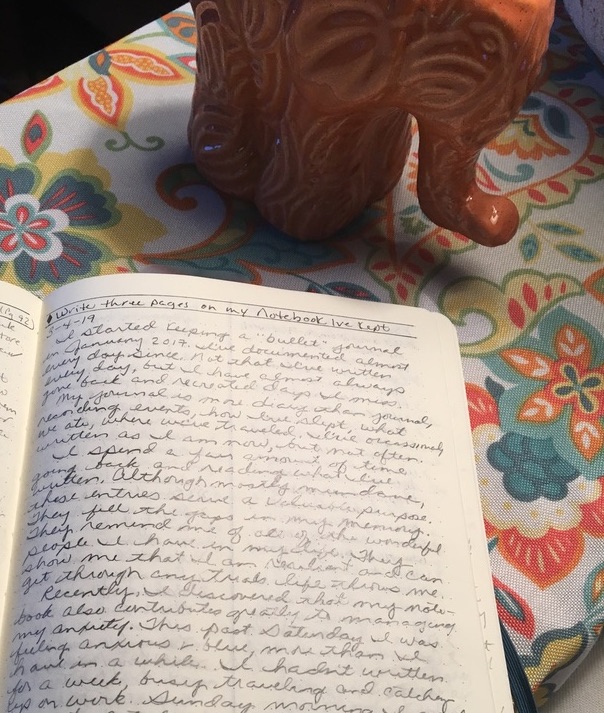
    My journal is more diary than journal, recording events, how I’ve slept, what we ate, where we’ve traveled, things to do. I’ve occasionally written longer forms (this post started as handwritten pages in my bullet journal), but not often.

    Lately, I’ve discovered that my notebook contributes greatly to managing my anxiety. On a recent Saturday I was feeling anxious and blue, more than I had in a while. It had been an emotional week. I’d seen my Uncle Don for the first time in years. I’d visited my 90-year-old mother in Michigan and found it difficult to leave her to return home. My husband’s sister was in the hospital with a life-threatening health crisis.

    With all of the travel and activity, I hadn’t written in my journal. Sunday morning I made time to catch up on my entries for the week. As I wrote, I could feel the anxiety melting away. Nothing had changed, but the act of documenting my days seemed to be the panacea for my disquiet.

    journal with micron penI realized that writing down these events ensures that I’ll have a record of them, that I won’t forget. But my journal also is a container for the challenging events in my life. I can close my journal, snap the elastic band around the cover and my emotions are safe, caught within the margins.

    I spend a fair amount of time going back and reading what I’ve written in my notebook. Although mostly mundane, these entries serve a valuable purpose. They fill the gaps in my memory. They remind me of all of the wonderful people I have in my life. They show me that I’m resilient and can make it through any trials life throws me.

    Unlike other journals I’ve kept, my bullet journal provides structure and order, two things I crave in my life. I often joke that I have “control issues.” But it’s not really a joke. I need to feel that I can have some control or influence over everything in my life. When I don’t, I get anxious. In a small way my bullet journal gives me that control. If I can put the words on paper, I can get them out of the endless worry loop playing in my head. I know I can always go back to my journal if I need to.

    Another thing I love about my bullet journal is that there are no rules. (That seems a little contradictory to the previous paragraph, doesn’t it?) I can use it however I want. I control the contents. (Ah, there it is.) I can put a calendar on a page if I want one there, I’m not confined to the page with the pre-imposed date.

    I’ve always loved calendars, but I can’t even count how many planners/diaries I’ve abandoned in my life because I’ve missed days or weeks and can’t tolerate the taunting of all those blank pages. This notebook is the perfect solution. Every page is full of ideas, events, thoughts, emotions, and yes, a calendar if I want one.

    My favorite pages in my notebook are probably my version of the Calendex. I create small calendars across the top of the page using the grid, with a blank column beneath. Throughout the month I document the highlights (dinners out, parties, major purchases or repairs, writing groups attended and missed). At a glance I can recreate a week or month. I can then go to the date in my journal for the details.

    Calendex
    (Note for BUJO purists: I don’t use my Calendex for future planning. Eddy Hope explains how he created this concept in case you’re curious.)

    I’ve learned that I prefer a “dot” notebook with a light grid on the page (Luechtturm1917 is my current favorite brand). I keep a ruler in my notebook and use my favorite pens (Micron-black) to draw lines to section off the page and create calendars and lists. (Lists! How I love a good list.) But I always write in pencil, I like to be able to make changes.

    Recently I’ve decided that I want my journal to be more than just an accounting of days. So I’ve started adding sections periodically for “mood” and “observations.” I’m trying to be a little more thoughtful each day and use my notebook for inspiration and creativity. I usually journal early in the morning, when the house is quiet and I’m calm. I realize that it’s probably this time that I gift myself for quiet reflection that contributes most to my emotional state.

    My bullet journal is the talisman that allows me to bring together the things that matter most to me – creativity, structure, order, inspiration – to live together in one place. The blank pages aren’t daunting. They’re beautiful and calm, waiting for me to use them.


    2 responses to “How A Bullet Journal Helps Ease My Anxiety”

    1. Barbie Beaton Avatar

      This is so inspiring! Thank you!

    2. Eliza Waters Avatar

      A very useful and inspiring post, Jill! I’m not all that organized and this sounds like a great idea to help that.

  • The Real Reward

    I help teach English to adult immigrants. Recently, the teacher I work with asked what kind of gift card I’d prefer as a thank you gift for volunteering. I didn’t want to make a fuss—I know the gift card is well-intentioned—so I chose one. But the truthful answer was that I didn’t want a reward.

    What’s weird is that if I were a volunteer coordinator, I would think it was very important to acknowledge and thank volunteers. Finding a suitable way to please a disparate group would be hard. I would probably land on gift cards, too. I’m not criticizing the gift options or the school’s impulse to thank me.

    I think my discomfort has more to do with how I was raised. My parents set an example with their many volunteer activities—they did far more than I ever do. Their outlook was that you’re supposed to pitch in and help. It’s just what you do.

    Another value that my parents conveyed was that it’s even better if you donate your time or money without any public acknowledgement. For years, they were secret angel donors for the parish grade school and the church choir. If kids didn’t have money for supplies or a field trip, or if the choir needed more funds for a tour, the principal and the choir director knew my parents would cover it. Hardly anybody knew my parents did this. My father mentioned it to me once, and the scope of their contributions only came to light when they died.

    What I had trouble putting into words when asked about the gift card is that volunteering is as much about my needs as it is about theirs. The world at large can be dismissive of people who are 60 and beyond—assuming that we’re clueless, set in our ways, etc., etc. Volunteering is a way of reminding myself that I’m knowledgeable and have something valuable to contribute. I feel seen, useful, and appreciated. That’s what makes volunteering worthwhile.

    I don’t think I deserve a medal (or a gift card) for putting in a few spare hours a week. Corny as it sounds, acknowledgement comes every week in the form of students who make a point to thank me at the end of class. Also gratifying are the students who return after completing the class to share their excitement about landing a better job—one requiring good English skills. Plus, the teacher often asks my opinion about her proposed lesson plans and always thanks me for coming. That’s good. That’s plenty.

    , ,

    6 responses to “The Real Reward”

    1. LaVonne Harrer Avatar
      LaVonne Harrer

      Well said, Ellen. As you mentioned, most of us feel like the rewards of volunteering come from seeing where we can make a difference in people’s lives. The organization I volunteer for hosts a picnic and a few smaller events throughout the year for volunteers -food and opportunities to get together with other volunteers and staff are great rewards.

      1. Ellen Shriner Avatar

        Thanks, LaVonne! Glad you understand.

    2. Eliza Waters Avatar

      Finding ‘something to do’ after retirement isn’t always easy, but can definitely give us a boost and a sense of contribution. We’re too young and valuable to sit around all day! 😉

    3. Paulie Avatar

      Before retiring it was always my intention to take up some kind of volunteer work. I just recently retired and I still intend to do some volunteer work. And to be honest I would do paid work if it were for a non-profit that I support.
      My first inclination was to work for a presidential candidate. That’s off the table now. While I think that being politically aware is important I think my time would be better spent working for an organization that actually helps people directly.
      Being a Boomer, I can relate to your stories and I enjoy them immensely.

      1. Ellen Shriner Avatar

        Thank you so much for your comments! I’m sure you’ll find the activities that are right for you—I had to experiment.

  • A Home for Everybody

    In Door County, Wisconsin privilege, middle income and poverty share zip codes. Average annual income across the area is artificially inflated by a significant population of retired individuals, many with healthy pensions. Average annual median income is under $40,000 reflective of an economy dependent on tourism and agriculture. Thirty to forty percent of school kids  are eligible for free breakfast even with many parents reluctant to apply.Poverty may not be obvious like in disadvantaged city neighborhoods, but signs in gas stations offering free gift cards to those who can’t afford travel for doctor appointments tells the story.

    I grew up in Door County’s neighboring county in a skinny old house on Main Street in one of those farming communities. My father had a good job, my mother worked seasonally. Our grade school didn’t charge for hot lunch. That tells the same story.

    Affordable housing is a pressing issue. On an average annual median income of $40,000 minus expenses like healthcare or a car payment, ideal rent is $600. Traditional calculations for how much house a $40,000 income covers suggests less than $100,000. Good luck finding either of those. Homelessness is not visible, but people do live in buildings never meant to be housing, in trailers without water or power, in crowded apartments with too many roommates, or rotate through campgrounds from May through October.

    At an informational meeting one township presented purchasing a land tract for about $2 million with intention to develop part into affordable housing. In the packed room emotion and fact clashed. A housing builder wanted first dibs on the space promising $340,000 “affordable” units. Neighbors shared what they were promised about the vacant land when they purchased their homes. More than one person asked why affordable housing was taxpayers’ responsibility.

    A social worker and a skilled craftsperson spoke of their inability to find places to live or house their families. One thirty-something white collar professional said he has lived in thirteen places in about ten years, most of them crap holes. His employer often loses employees after they spend months looking for any kind of apartment. He reminded everyone that affordable housing does not only mean home ownership, but also decent apartments. There are jobs to be filled here, but not places to live. Business owners are nervous about being able to keep their doors open.

    Privilege, middle-class, and poverty share this zip code. No telling who in the blue jeans and t-shirt crowd shared a two bedroom former cottage with five or more people, commuted one hundred fifty miles daily, or lived alone in 3,000 square feet. Dictionary.com defines community as a social group of any size whose members reside in a specific locality, share government, and often have a common cultural and historical heritage. If this township, rooted in European ancestry, cannot accept responsibility for the need to house its members, what is its future?

    For someone whose primary home is in a city with homeless individuals living in tent villages, sleeping on mass transit, or huddled in too few shelters, this feels like a no brainer. Taxes support communities, communities are made of members residing in a specific locality, localities require teachers, shop owners, EMTs, shop workers, builders, children to have a future. And all those people need healthy places to live. This is why we live in community.

    Blog May 2019


    , , , , , ,


Recent Posts

  • My Summer in Bugs

    June’s magical fireflies blink “love me, love me.” Disappearing sparks. Late July’s crickets’ chorus a shimmery soundtrack for evenings on the porch.  By the time I hear mosquitoes’ whining buzz, I’m in trouble and smack my neck. My hand comes back with blotched with blood. Maybe mine.  Cicadas drone in August, their whining dirge signals…

  • The Company of Others

    Six of us sitting around a table in a nice restaurant. Maybe as much as twenty years difference between the youngest and oldest. We don’t ask about age. Fish tacos, salads, a burger ordered. A few look tired, most are having a good day. One open chair because someone had to work. Serious personal challenges…

  • Easing into Fall with the Minnesota State Fair

    Buzzing cicadas signal summer’s last gasp. Cooler days and school are ahead and soon summer will officially be over. The sun is still warm but a hint of melancholy drifts in with fall’s cool breezes. Yet another summer is gone and I haven’t done everything I meant to do. But the exuberant excess of the Minnesota State Fair next…