• The Fierce Urge to Tell Our Stories

    Anne Frank was a vivacious teenager and a keen observer of human nature. She wrote well and her diary often includes deft characterizations of schoolmates, family, and the other people in hiding with her family. When I recently reread her famous diary in preparation for visiting her family’s hiding place in Amsterdam, I was impressed by her lively mind.
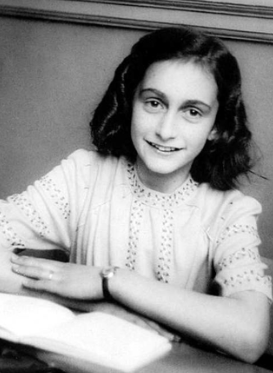
    Initially, she wrote to sort out her feelings—the same impulse that has prompted me to keep a journal off and on since I was a teenager. Putting my feelings into words helps me understand them. Airing out something on the page calms me and enables me to move on. 

    At first, Anne Frank meant her diary to be private. When she was 15, she heard a radio broadcast about a Dutch official who wanted to collect war stories and experiences, so she edited her diary in hopes it might be published one day. Unlike Anne Frank, I don’t want my journals shared with others. They’re histories of cranky confusion, and without context, they would likely distress family or friends once I’m gone and can’t explain.

    After her family went into hiding, her diary also served as a record of how they lived—what their space looked like, what their meals were, and what their daily schedule was. As the war intensified, she recorded bombing raids and news updates.

    Shortly after I finished the Anne Frank book, my sister asked me to refresh her memory about our great great grandmother—Katherine O’Tanney Feeley who emigrated from Ireland in the late 1800’s. To answer, I searched handwritten notes from my mother and father—a story here, a date and detail there. Some of the notes are sketchy and incomplete, but I decided I would make sense of them in a Word document so others in my family will have a record.
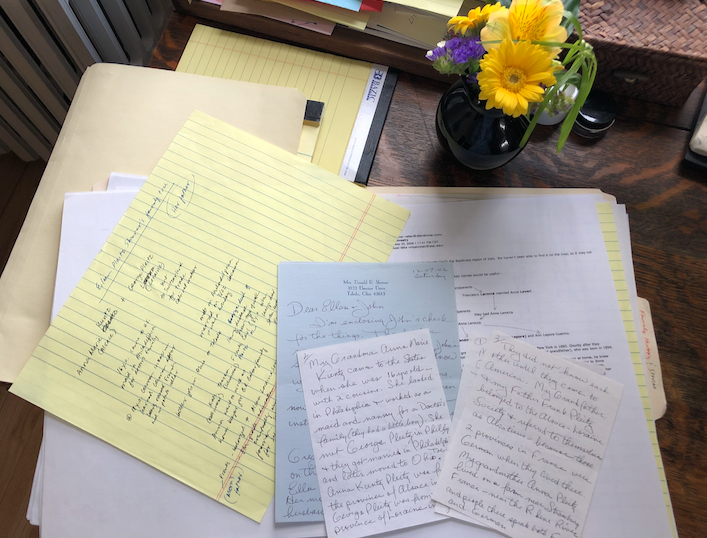
    Anne Frank’s story has touched millions all over the world in the decades since she wrote it. I have no such expectation for the family record I’m assembling. All I have are snippets of stories, not much to go on. Perhaps a few family members will have a mild interest. Hearing about people you never knew (even if they’re related to you) can be boring. 

    I’m fascinated by the urge to write journals and record family histories. Beyond that is the widespread wish to share the content of our days on social media or like I’m doing with this blog. People across all eras and cultures have felt this fierce need to tell our stories and understand who we are and who we came from. Sometimes we’re saying, “Here’s what happened.” Other times the wish to share is a way of saying, “I’m here. I matter.”

    Anne Frank could not have imagined how much her story would matter or how many readers would be touched by her words.

    Although my intentions and hopes for my writing differ from Anne Frank’s, I feel a kinship with that young woman born almost a century ago. 

    , , , , , ,

    11 responses to “The Fierce Urge to Tell Our Stories”

    1. Luanne Avatar

      I think a lot of people, especially anyone who has ever written or kept a diary or journal or even pocket notes, can relate to Anne. There are so many personal recordings like this that are so valuable to humanity. Letters, too. Have you ever read The Maimie Papers. One of my favorite books! All letters written by a very intelligent woman (“shop girl”) forced by circumstances into prostitution over 100 years ago.

      1. Ellen Shriner Avatar

        Thanks for the suggestion about the Maimie Papers!

    2. Ann Coleman Avatar

      I think you’ve hit the nail on the head. All humans want to be heard, understood, and feel as if they matter. So many of our society’s problems occur when people aren’t able to feel that way. But the good thing is that we can learn so much from other people’s stories if we’re willing to listen (or read.)

    3. Karen Seashore Avatar

      Ellen — you and Karensdescant seem to be on a parallel track recently — you might check out our recent “dialogue” which also focuses on the importance of stories as legacy…

      1. Ellen Shriner Avatar

        A good connection— thanks!

    4. Eliza Waters Avatar

      Memoirs are a popular writing theme, it seems. I think it is for all the reasons you described– sorting out feelings and memories, as well as saying ‘we were here and we matter.’ All good reasons to write to express ourselves. Whether it will be of anyone else is secondary.
      When are you headed to Europe? I’m a bit envious!

      1. Ellen Shriner Avatar

        We left last week. Home tomorrow! Anne Frank house, Vermeer exhibit, and Keukenhof gardens (tulip wonderland!) were highlights.

        1. Eliza Waters Avatar

          Ooh, tulips, yes! I hope you post some shots for us to drool over!

    5. Karen Martha Avatar

      Even incomplete stories add to the understanding of our heritage. I love the way you contrasted your own experience with Anne Frank. Great post.

  • Mortal

    Daffodils and forsythia are in bloom here. Egrets and ducks have returned to the pond. We all made it through another winter, a difficult season with plenty of cold, snow, and ice. 

    When I was in my forties, I wrote a short story about a woman whose first serious high school boyfriend was drafted to serve in Vietnam. He would die in battle and be remembered as perpetually nineteen. She went on to college, married, had children. As her son prepares for junior prom, she is reminded of Bernie. On the anniversary of his death, she writes him a letter about what it has been like to age decades beyond her teens.

    Late in 2022, I prepared for serious surgery. The surgeon called me a ‘low risk’ patient and young for my physical age. Tests showed no other options. All was successful, except emotionally I landed in part of the world described in Atul Gawande’s Being Mortal.  He writes that we tend to consider aging a failure, or weakness, rather than a normal process. As we live longer and longer, medical processes becomes part of our experience. Doctors know how to preserve life, but not how to help patients cope with how life continually changes.

    Like most surgery nothing looks different to others, but I know where the scars are and what each means. I know the medications that support carrying me through a normal life expectancy. I am also learning their downsides. I haven’t returned to tap dancing because the studio floor is slippery, and I am still fighting to return to my prior rock-solid balance. Down dog is back on my aspirational list, but for different reasons than undeveloped muscles.

    In the weeks between the first time a doctor said, “maybe six months, certainly not more than a couple of years,” and the night before surgery, I thought about not seeing my granddaughters grow up, about the writing projects that might not be published, about my unwillingness to let life go. When I stopped pushing to be the person folks expect, my fatigue was immense. With surgery on the schedule, I slept a lot, read a lot, thought even more. Because I am used to being productive, I labeled that week practicing recuperation. 

    I have had friends die of cancer without the medical miracle surgery offered me. I am humbled and so respectful of how they faced the eventuality of their passing. 

    This spring I wonder how to make these next many years meaningful. A wise friend told me the body needs at least six months to recover from major surgery then encouraged me to give my emotions the same time. A good plan. I’ll enjoy the daffodils and forsythia, then the tulips and lilacs. The demands of regular life are close enough.

    With love to my brother, Darrell J. Frisque, who passed too young on April 14, 2007.

    , , , , , , ,

    2 responses to “Mortal”

    1. Jan Wenker Avatar

      Well said Cindy! I wondered how you were doing. If you ever want to chat……I am close. I think that just aging brings some of that thinking out.
      Take care ❤️
      Jan

    2. Amanda Le Rougetel Avatar

      An eloquent reminder to pay attention to the ordinary moments of our daily life — including our body and our emotions and all that they do for us in that daily life. Thank you.

  • On the Day after International Women’s Day—Recent Immigrants’ Thoughts about Gender Inequality

    Yesterday, the adult immigrants I tutor were discussing an article about pay inequality and education disparities in some countries. The article stated, “In the US, women can expect to earn about 80% of their male counterparts’ salaries.” After a quick online search, I found the specifics in a Government Accountability Office report. In 2021, women working full-time had an estimated median pay that ranged from $0.69 to $0.85 for every dollar earned by men. The pay range depended on what sector women worked in.

    Other countries have different cultural dynamics and economic opportunities, so the students offered a variety of views. I silently noted the range of perspectives could also be found among people born in the U.S. Here’s a cross-section of what the students said:

    “In my home country, women get paid less than men, but I didn’t think that happened in the U.S. Are you sure?”

    “Men need to make more money since they’re supporting a family, and the women take care of the children and the house.”

    “School isn’t free in my home country. My parents had a big family and couldn’t pay school fees for all of them. So they paid for the boys’ schooling, since they’ll have to support a family.”

    “I know pay differences between men and women happened in the past. You’re telling me it’s still going on?”

    “In my culture, mothers and daughters are supposed to cook, clean, and take care of children. Fathers and sons don’t. They earn the money.”

    “My mother wasn’t educated because her family didn’t have the money. My grandfather thought she didn’t need an education since she’d marry and have a husband taking care of her. But my father became disabled, and it was hard for my mother to support eight kids.”

    “International Women’s Day? What—we only get one day?”

    , , , , , ,

    5 responses to “On the Day after International Women’s Day—Recent Immigrants’ Thoughts about Gender Inequality”

    1. Luanne Avatar

      Interesting range of perspectives. I think we tend to forget that immigrants bring many other cultural mores into the United States, and that as a result this country will constantly be changing and stretching to fit, just as the immigrants themselves will change and stretch to fit.

      1. Ellen Shriner Avatar

        Exactly. I was surprised so many students thought wage inequality was a thing of the past. I also didn’t realize schooling isn’t free in a number of countries, so educating girls isn’t a given.

        1. Luanne Avatar

          That is a horrifying finding. (the second)

    2. Eliza Waters Avatar

      Yes, the inequality goes on… part of the problem is women accepting the status quo. We have to speak up!

      1. Ellen Shriner Avatar

        It was so interesting to me to hear my young students thinking the problem was solved already.


Recent Posts

  • Borrowed Time

    Rain hammered the passenger van, rattling the metal like gravel tossed against a tin roof. Each burst sounded closer, louder, as if the storm were trying to break its way in. Why today, of all days, when Juan was visiting his birth family? We had planned it so carefully. We’d even had a kind of…

  • From Minneapolis

    …they have cost children the life of their mother….

  • A Few of My Favorite Things

    When I feel world-weary, I actively try to turn away from the world’s troubles and focus on the many good things in my life. In addition to my family and friends, here are some things I enjoyed this past year—art, books, nature. Sorry, no raindrops on roses! When I saw this painting I wanted to…