Roadblock

A screeching, beeping monster clawed a mountain of dirt from my front yard, pirouetting in a repetitive mechanical dance.

In a surprising moment of consideration, the monster’s keepers preserved my ratty, overgrown boulevard garden, which fringed the gaping hole where sidewalk used to be. As if that garden is worth the care they gave it! They didn’t know I’d gladly be rid of the hosta and daylilies.
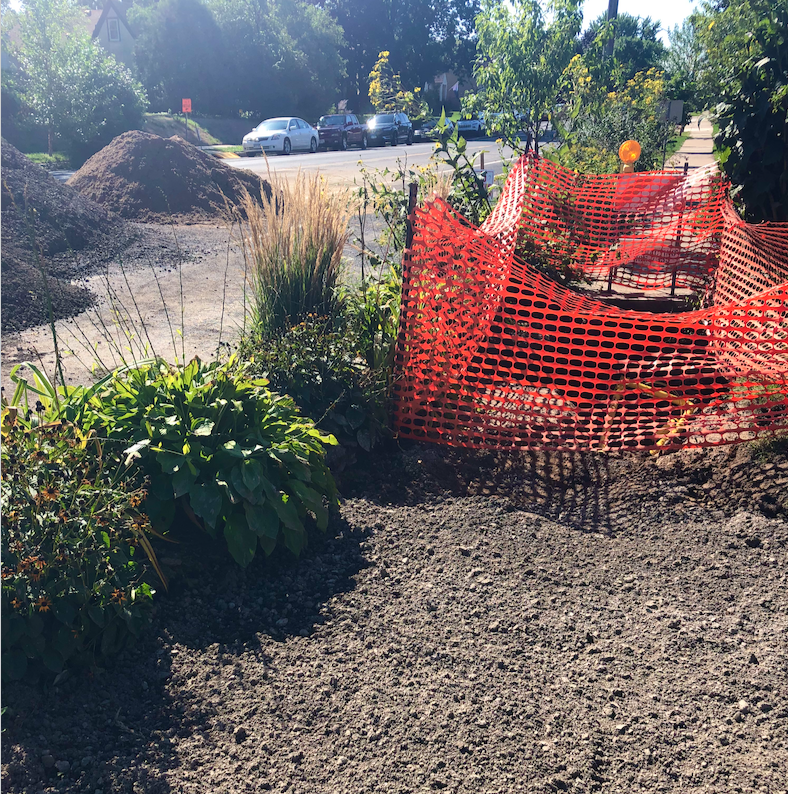
Workers in neon green coveralls appeared waist deep in the front yard. Urban prairie dogs. Do they like standing in holes, dirty and damp? Being where the rest of us don’t go? Searching for a pipe—hidden—but not exactly a treasure. 

Weeks later, cars still charge up to the roadblock in disbelief, apparently thinking, You can’t stop me, I’ll get through. Some seem to contemplate launching à la Thelma and Louise over the one-foot precipice into the scraped dirt and escaping, only to accept reality, veer into a nearby parking lot, and cut through the alley. Back on their way.

That’s how this summer, or really this whole year, has felt because of COVID. We’ve hurried toward the life we wanted, only to see—again—not here, not now. Go around, adapt, try again.

At night it’s peaceful. No clattering buses driving by. No thumping bass from passing cars or snatches of song from cyclists.

Silent orange hazard lights blink like fireflies.

Ditch and Run

I didn’t think dropping Crystel off at college would be hard. I’m really good at ditch and run.

Often Jody will say to the person that she’s talking to at a party, “Oh, I guess we are going now,” after I’ve tapped her shoulder on my way to the car. There’s no stop in me. I’m done now, my whole body is saying. When Jody wants to socialize at an event, we drive separately. Later, after a party, I’ve had people tell me, “We didn’t see you leave. You were just gone.”

I couldn’t tap into my own experience of being dropped off at college. I’m not even sure who drove me to my dorm in Menomonie, Wisconsin from Ellsworth. What I do recall is a few weeks later my mother telling me not to come home anymore. There wasn’t any room for me. I no longer lived there.

Crystel was able to move in early at the University of Minnesota because of her involvement with Multicultural Center for Academic Excellence (MCAE). I helped her pack the van. A refrigerator, clothes, plants, hangers, and more plants. At the dorm it was my job to hang her clothes in a certain direction on the hanger. Jody made her bed. Two hours later, I had only finished one suitcase. She had that many shirts! I couldn’t believe that I would patiently undertake this miniscule tedious task. I mentioned that. We had just enough time to drive to Target for more hangers and a few items before joining MCAE for their parent and family kickoff event.

I accompanied Crystel into the large banquet hall. Jody was waiting in the car for my help to locate parking. I asked Crystel if she was okay for me to leave her. Above her mask I could see her stricken eyes. I hurried to the car to ask Jody to find parking herself. 

The banquet hall filled up. Dinner was served. Speeches started. I looked over at Crystel. Shook my head at each possibility that came to mind. There would be no ditch and run. She needed her moms.

I cried when we got home. I was already missing her. In the following days, I realized that for her, going to college is a step towards an independent life. I’ve texted and talked with her frequently. She’s getting settled. Meeting new friends and old. Involving herself in activities. Studying. My heart is with her. Hers with me. Where we intersect is home. There’s always room.

Fifty Years of Technology

My first public relations job after college came with a workstation equipped with an IBM Selectric Mag Card Executive machine. In the 1970s this was the equivalent of leaving a simple bicycle outside only to find a stick shift European automobile locked to the bike rack on your return. 

Marquette University’s College of Journalism still used manual typewriters. The Milwaukee Journal where I did stringer reporting had manuals. I saw a few electronic typewriters, maybe even Selectric, during an internship. My first, professional job was with an engineering company owned by a husband and wife. I was their first PR department. The executive secretary presented with this $3,000 or more marvel said she would leave before she used the thing. Of course, the new college graduate was the logical place to stash a purchase that didn’t work out. 

The machine had a selection of font balls, so it was possible to jazz up a document. It had a magnetic storage card to store what seemed like an amazing amount of work, about one printed page. There was a correction ribbon. Overall, the start of desktop publishing. Except no one knew that phrase. 

I battled that machine for almost a year. Learning engineering lingo and understanding the company’s products was a steep curve for someone used to covering suburban governments for a newspaper or writing press releases and speeches for a healthcare nonprofit. The wife-owner was my manager, and she had all kinds of uses for the fancy typewriter including menus for her garden club, invitations for fundraising dinner parties, their son’s class papers. I spent hours and hours teaching myself how to use the fancy Selectric. I hated the machine, and the job.

Through decades of desktops and laptops, of cables and wi fi and Bluetooth, I’ve figured how to use the next generation of technology. I probably master about ten percent the capability of each computer, printer, or apps.

Last month I turned away from replacing a fitness tracker with another fitness tracker and bought an Apple Watch. It is an unbelievable piece of technology. I can receive and answer phone calls, text messages, alerts. It pings when it is time for me to breath, stand, move. I know the current temperature, air quality, and UV. Eventually I’ll figure out how to turn off some of those amazing, but useless, features and figure out why I can’t change to other albums in my account or listen to audiobooks when I walk. No rush. 

Grudgingly I should probably thank my first employer who threw me overboard into technology without a life jacket.