Holding the Lantern High

When I first suggested that the WordSisters should road trip to Michigan in Beth’s still-a-dream motorhome, I didn’t really think it would happen. But now, more than a year later, I pull into the campground five miles from my new home in Michigan to see Beth sunbathing in front of a 28’ Winnebago. With the help of her wife, Jody, they’ve driven 10 hours from Minneapolis to visit me in tiny Byron Center, Michigan. Soon Ellen and Brenda emerge from the rig and I’m near tears. They’re here. They’re really here. The power of a 20+ year friendship is made manifest.

L: Sunbathing, R: Beth & Jody

A lot has happened over the two decades that we’ve known one another (no one can say precisely when we first met). I came to the writing group last (as I remember, but it might have been Brenda). There were other writers in the group then, friends and fellow writers who went their separate ways over time until the four of us remain, bonded by the love of writing, a mutual respect for the craft, and compassion for one another’s lives. We’re no longer just writing group acquaintances, but friends. Through our writing we’ve exposed ourselves to one another in ways we don’t to others. 

A lot has happened, too, since that day in May 2023 when the idea of a road trip first took root. My husband and I emotionally dismantled three decades of living in our Minnesota home to move to a townhome in my home state. Ellen became a grandmother. Brenda’s daughter (who we met when she was an infant) successfully navigated her first year of high school. And Beth and Jody bought a motor home, which now sits before me in all its glory.

During the past year I also read Tom Lake (stay with me here) and had the privilege of seeing Ann Patchett at the Fitzgerald Theater in St. Paul, Minnesota, talk about the book, writing, and life with Kerri Miller for MPR’s Talking Volumes Series. At the end of the night, Miller surprised the audience by bringing Kate DiCamillo on stage. For a group of writers and readers, a surprise visit by the hometown star was, I suspect, the same feeling that music fans had back in the day when Prince used to show up unexpectedly at First Avenue. The crowd roared.

The dedication to Tom Lake reads: “To Kate DiCamillo who held the lantern high.” Patchett explained that while writing the book she and DiCamillo would exchange a short email in the morning and again at night. “She would always say, ‘I’m going down the rabbit hole. Good luck in the orchard today,’ and at the end of the day she would say, ‘It’s time to come out of the orchard. I’m holding the lantern up. Just walk towards the light.’ ” 

I sat in the balcony of the Fitzgerald next to my book club members (another group of wonderful women I’ve known for over 15 years) and fought back tears. All I could think of then were Ellen, Beth, and Brenda standing at the edge of my proverbial orchard for two decades guiding me with their light. It’s who we are and what we do for one another as writers. So, on the last night of our way-too-short visit, we sit in my sunroom, and I give each of them a lantern. I want them to remember me, which I really don’t fear will be an issue. And I want to remind them to always “hold the lantern high.” I’ve bought one for myself as well, to hold for them as they make their way out of Guatemala, or the ER, or a spiritual labyrinth or one of the many places our life journeys will take us. I want them to know that I will always be there for them holding the light.
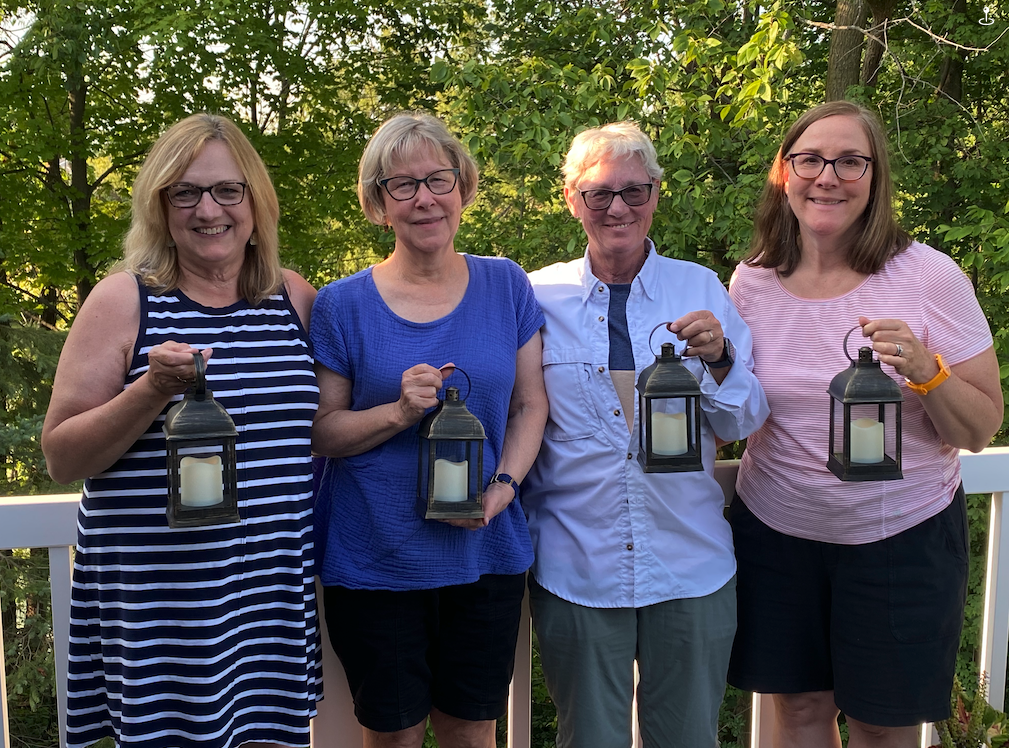
Jill, Ellen, Beth, Brenda

The Blue Notebook

I wrote my first novel when I was 10, in a royal blue spiral notebook I’m sure was meant for my math homework. The story was what you might expect of someone that age. The protagonist was an angst-ridden fifth grader whose family didn’t understand her.

I have other notebooks from those days, mostly filled with bad rhyming poetry and rants about my sisters. But the blue notebook is gone. I think, but I don’t know for certain, that I destroyed it in a fit of frustration. This was long before Anne Lamott wrote Bird by Bird, and I understood the value and necessity of a shitty first draft. I just thought I was a bad writer because I couldn’t resolve the plot in a meaningful way. I was 10.

Since then, I’ve written pages and pages, too many words to count. More bad, unpublished poetry. An op-ed about athletes getting more recognition than scholars that was published in the Midland Daily News when I was in high school. A speech that won an award from Optimist International.

After high school I channeled my writing energy into professional writing: news releases, promotional copy, employee newsletters. I don’t remember much creative prose in the early days of my career, but most of my jobs involved writing.

Years later, driving home from a family reunion in Barnesville, Minnesota, my two kids and my mom strapped in the back of our minivan, I decided to go to graduate school for creative writing. There I became the writer I always dreamed I’d be.

I spent the next seven years learning about the craft I’ve loved since I was 10. I was introduced to Anne Lamott, Joan Didion, Janet Burroway, and a host of others who helped me learn that writing is a process and a passion. Sometimes the words flow easily and land on the page perfectly formed. Most of the time, however, it’s a wrestling match, moving words around until they strike the perfect pose or are pinned to the page in beautiful submission.

Now, two decades later, I turn to Julia Cameron, who encourages me more than any of the others to just write. Every day. In a notebook. Longhand.

***

I go to my local office supply store (some still exist post-pandemic, although my favorite has closed) and shop for two notebooks. I pick a college-ruled notebook for my daily pages. I want a different color for the novel I’m going to write. This will be my third novel if you count the abandoned manuscript from childhood. I rifle through the messy piles in the bins of the store searching for the perfect one. I stack the notebooks neatly back on the shelves, turning them right side out until at the bottom of the bin I find it. I can’t say why it’s “the one,” but it is.

I clutch the two notebooks to my chest and head to the cash register. I lay the two side-by-side on the counter, marveling at the possibilities. The black cover will be for my morning pages. And the other—the one with the vaguely familiar royal blue cover—will hold the novel I’m about to begin.

How A Bullet Journal Helps Ease My Anxiety

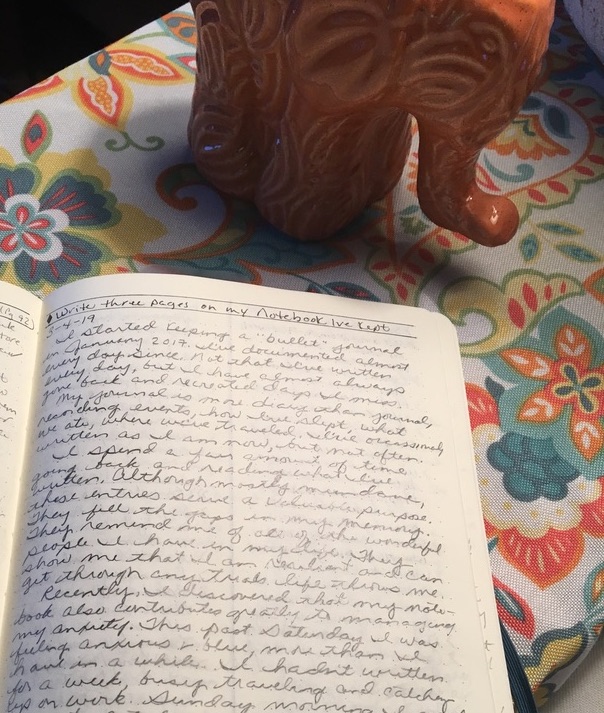
I started keeping a (modified) bullet journal in January 2017, and I’ve recorded almost every day since. Not that I’ve written every day, but I’ve almost always gone back and recreated days I miss.

My journal is more diary than journal, recording events, how I’ve slept, what we ate, where we’ve traveled, things to do. I’ve occasionally written longer forms (this post started as handwritten pages in my bullet journal), but not often.

Lately, I’ve discovered that my notebook contributes greatly to managing my anxiety. On a recent Saturday I was feeling anxious and blue, more than I had in a while. It had been an emotional week. I’d seen my Uncle Don for the first time in years. I’d visited my 90-year-old mother in Michigan and found it difficult to leave her to return home. My husband’s sister was in the hospital with a life-threatening health crisis.

With all of the travel and activity, I hadn’t written in my journal. Sunday morning I made time to catch up on my entries for the week. As I wrote, I could feel the anxiety melting away. Nothing had changed, but the act of documenting my days seemed to be the panacea for my disquiet.

journal with micron penI realized that writing down these events ensures that I’ll have a record of them, that I won’t forget. But my journal also is a container for the challenging events in my life. I can close my journal, snap the elastic band around the cover and my emotions are safe, caught within the margins.
I spend a fair amount of time going back and reading what I’ve written in my notebook. Although mostly mundane, these entries serve a valuable purpose. They fill the gaps in my memory. They remind me of all of the wonderful people I have in my life. They show me that I’m resilient and can make it through any trials life throws me.

Unlike other journals I’ve kept, my bullet journal provides structure and order, two things I crave in my life. I often joke that I have “control issues.” But it’s not really a joke. I need to feel that I can have some control or influence over everything in my life. When I don’t, I get anxious. In a small way my bullet journal gives me that control. If I can put the words on paper, I can get them out of the endless worry loop playing in my head. I know I can always go back to my journal if I need to.

Another thing I love about my bullet journal is that there are no rules. (That seems a little contradictory to the previous paragraph, doesn’t it?) I can use it however I want. I control the contents. (Ah, there it is.) I can put a calendar on a page if I want one there, I’m not confined to the page with the pre-imposed date.

I’ve always loved calendars, but I can’t even count how many planners/diaries I’ve abandoned in my life because I’ve missed days or weeks and can’t tolerate the taunting of all those blank pages. This notebook is the perfect solution. Every page is full of ideas, events, thoughts, emotions, and yes, a calendar if I want one.

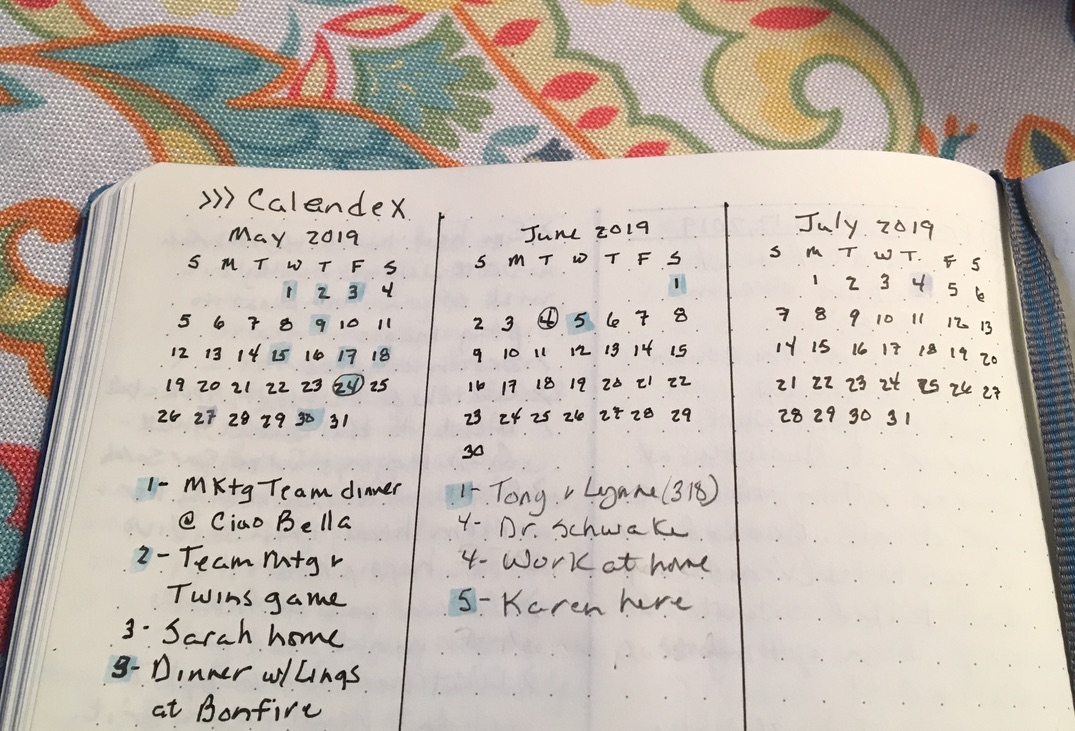
My favorite pages in my notebook are probably my version of the Calendex. I create small calendars across the top of the page using the grid, with a blank column beneath. Throughout the month I document the highlights (dinners out, parties, major purchases or repairs, writing groups attended and missed). At a glance I can recreate a week or month. I can then go to the date in my journal for the details.

Calendex

(Note for BUJO purists: I don’t use my Calendex for future planning. Eddy Hope explains how he created this concept in case you’re curious.)

I’ve learned that I prefer a “dot” notebook with a light grid on the page (Luechtturm1917 is my current favorite brand). I keep a ruler in my notebook and use my favorite pens (Micron-black) to draw lines to section off the page and create calendars and lists. (Lists! How I love a good list.) But I always write in pencil, I like to be able to make changes.

Recently I’ve decided that I want my journal to be more than just an accounting of days. So I’ve started adding sections periodically for “mood” and “observations.” I’m trying to be a little more thoughtful each day and use my notebook for inspiration and creativity. I usually journal early in the morning, when the house is quiet and I’m calm. I realize that it’s probably this time that I gift myself for quiet reflection that contributes most to my emotional state.

My bullet journal is the talisman that allows me to bring together the things that matter most to me – creativity, structure, order, inspiration – to live together in one place. The blank pages aren’t daunting. They’re beautiful and calm, waiting for me to use them.


Opposing Thumbs

In 1975, as I sat in Miss Bloom’s typing class, I never thought that one day I’d be typing primarily with my thumbs. I’m sure Miss Bloom, ancient even then, couldn’t have imagined a keyboard so tiny that even the end of her thumb would be too large to hit just one key.

I picture myself in her class, feet planted firmly on the floor, my skirt pulled down over my knees, fingers curled over the keys of the IBM Selectric in front of me. Four rows of eight desks neatly lined the room. The only sounds were the soft squish of Miss Bloom’s orthopedic shoes on the linoleum floor as she paced up and down the rows checking our posture, and the hum of the newly purchased typewriters in front of us. (What a marvel those electric typewriters were. How much easier than the 1928 Smith Corona I used at home.)

What were my lonely thumbs doing then? They were relegated to the space bar, waiting for the opportunity to create a void between words. Only my right thumb ever got any business, the left thumb dangled uselessly while all of the other digits pounded away at 65 words per minute.

No wonder that now my thumbs have trouble finding the letters when I answer e-mails or send my daughter a text message from my iPhone. They’re not conditioned for this kind of work. Now they’re front and center, the rulers of the written word while my fingers curl around the back of my handheld device, providing support, but little else.

Occasionally my right index finger can’t stand the pressure and it says to its friends on my left hand “Take over. I’m going in!” as it darts from behind the screen to hunt and peck for the letters, thinking itself faster than my clumsy thumbs.

But even this is unsatisfying, because my right index finger doesn’t know the keyboard any better than my thumbs. The only familiar keys are y, u, h, j, n and m. And what can you spell with only those letters? Eventually, my index finger gives up and returns to its friends behind the screen, letting the thumbs take over because they at least can work together, doubling the speed of my messaging.

Gone are the days of 65-75 words per minute. My thumbs are lucky if they can get in 20. So they’re less creative. A reply that once might have been “I’d love to join you on Saturday evening. A trip to the theatre sounds like fun,” becomes “K” or more likely a thumbs up emoji, but rarely anything longer. It’s just too slow, too cumbersome, too demoralizing to spend so much time pecking for the keys and constantly backspacing to correct mistakes.

I’d like to say my thumbs are happy, that they’re glad for the opportunity to carry the torch after all these years. But I don’t think they are. I think they miss the days of working in tandem with my fingers, resting lightly on the space bar while the fingers searched for just the right sequence of letters. I think they’re lonely out there in front by themselves. Who knows? I could ask them, but they’d probably just reply, “IDK, may b. U D cide.”


Guest blogger and WordSister Jill W. Smith is a Twin Cities’ writer. Her work has appeared in the anthologies Here in the Middle: Stories of Love, Loss, and Connection from the Ones Sandwiched in Between; A Cup of Comfort for Parents of Children with Autism; and Siblings: Our First Macrocosms, in the online journal Mothers Always Write, and occasionally on her blog, The Autism Fractal, which she co-authors with her oldest daughter.