Author: Jill Wilbur Smith

  • Naked Soffits

    I have a collection of teapots, accumulated over more than 40 years, that I love and that have always given me joy. The earliest in the collection is a Japanese tea set I bought while I was in college. I loved the way I could cradle the thick handless cups in my palms, “too hot to touch, too hot to drink.” The set travelled with me from Grand Rapids to New Orleans, to Minnesota, back to Michigan. The super-glued lid, cracked during one of its many moves, is now part of its charm, a repaired flaw that doesn’t detract from its beauty.

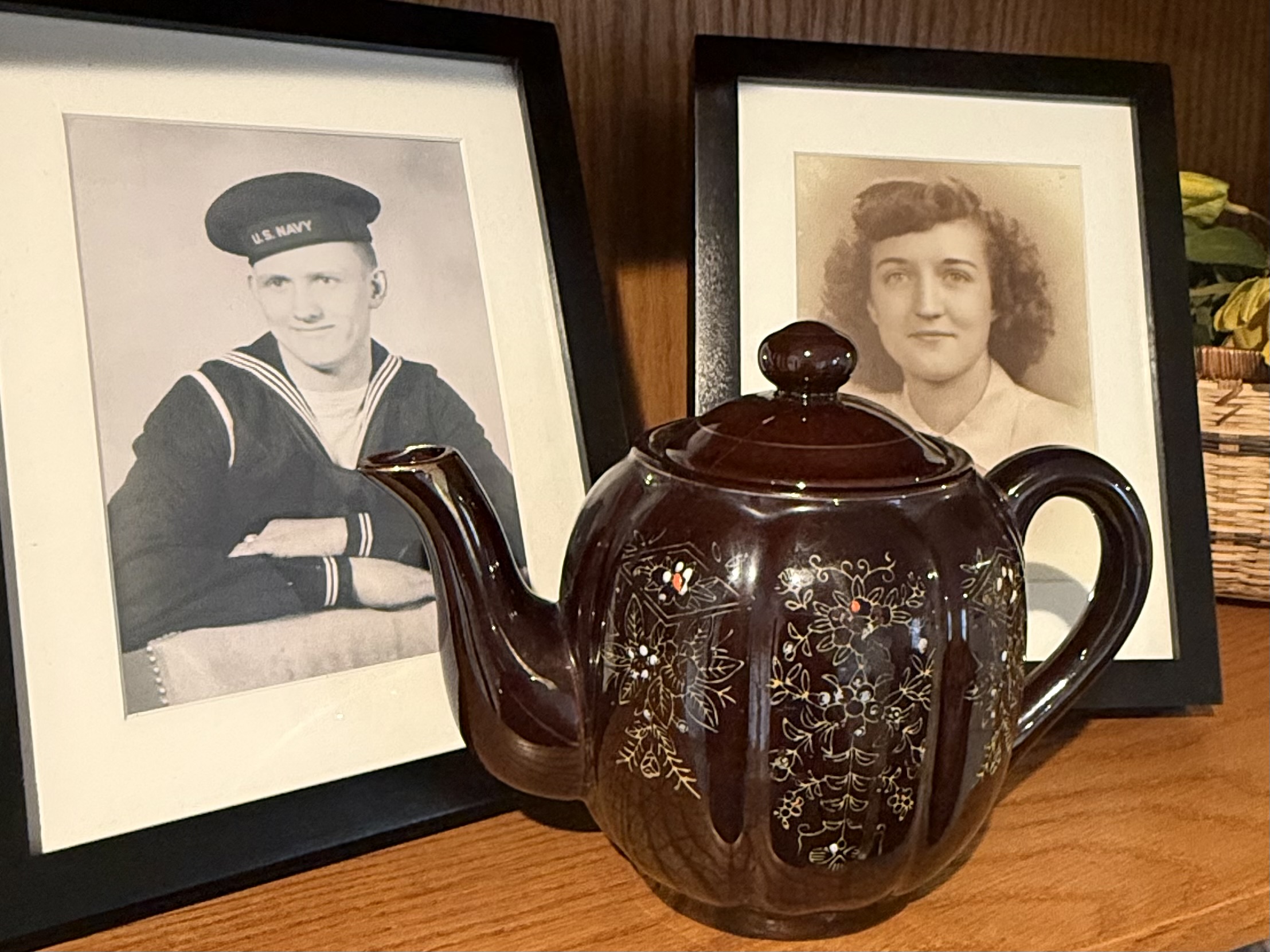
    My most prized possession in the collection is a Japanese “Brown Betty” that belonged to my mother. Well-loved and often used, it sat on our kitchen counter for years. Before sitting down to dinner every night, my mother would put two Lipton tea bags in the pot and fill it with boiling water from the kettle she had on the stove as she cooked. The tea would steep as the seven of us ate our baked chicken and biscuits, or fresh-caught salmon fried to perfection, or meatless Friday meals of macaroni and cheese or potato soup. As she cleared our plates, mom would pour a cup for her and my dad and we’d sit and talk as they sipped their tea, often long after the meal was finished.

    I don’t remember when I acquired this treasure. Probably after dad died and mom sold our family home, auctioning off all the memories that wouldn’t fit into her one-bedroom apartment at the Senior Estates.

    As often happens when you have a collection, mine grew over the years, added to by pieces I bought myself and by gifts from family and friends. I displayed these treasures on my kitchen soffits, the empty space between the top of the cabinets and the ceiling. I changed the displays by season, swapping out Brown Betty with a bright red Waechtersbach teapot and snowmen sets at Christmas time, adding pops of yellow in the spring. The three or four times I changed the décor every year were always satisfying, even as it got more difficult for me to climb on top of the kitchen counters to reach the void below the ceiling.
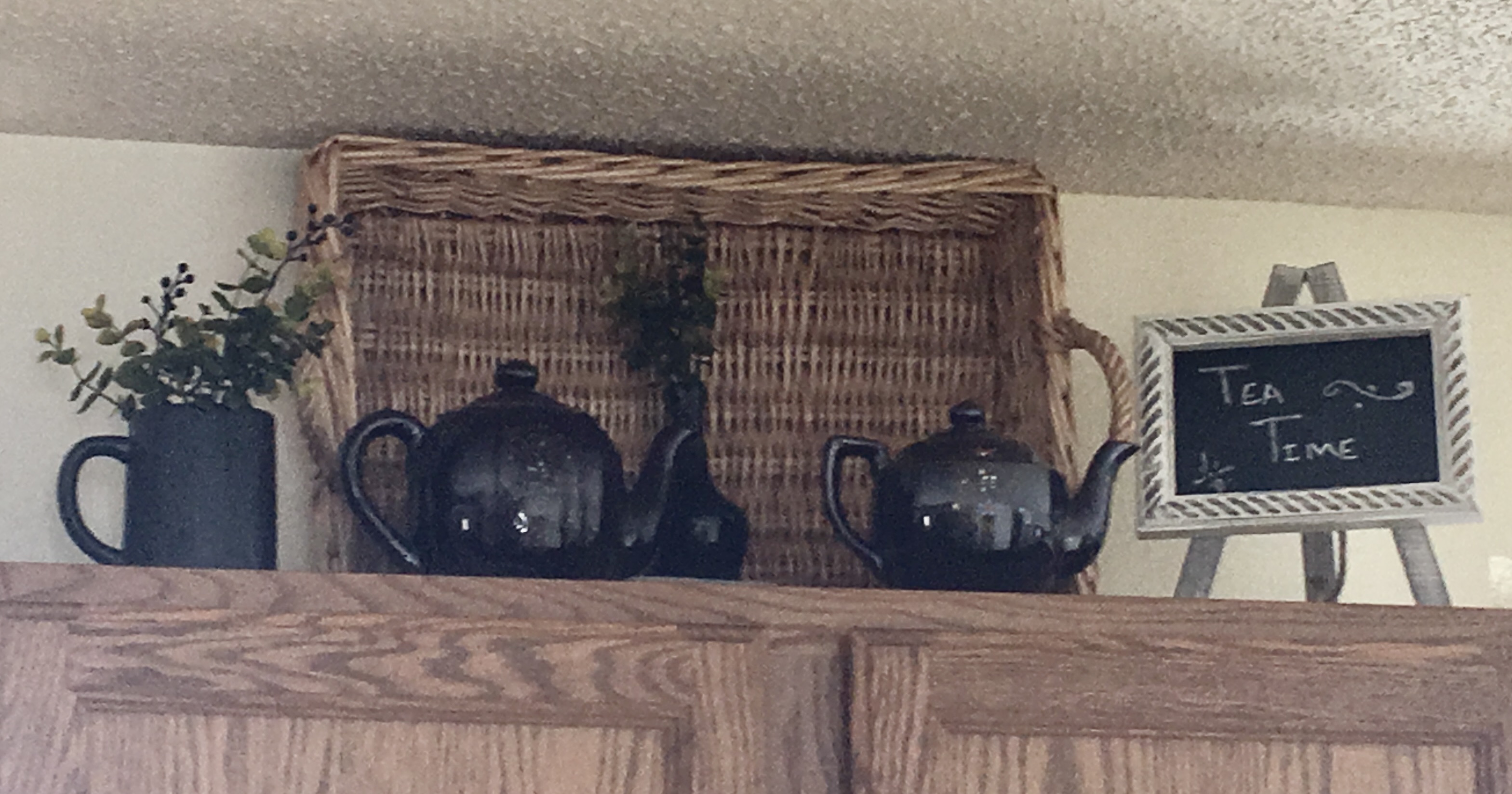
    When we sold our four-bedroom house in Minnesota and moved to a townhome in Michigan, some of my collection went to Goodwill or were gifted to family or friends. My new compact kitchen has fewer cabinets, but the vaulted ceiling in our great room provides a spacious backdrop for the most treasured of my collection that remains. My teapots once again held a place of honor in my home.

    This fall, I took a day to climb the heights and change out the decorations, adding pumpkins and sunflowers and other tchotchkes to complement the featured teapots. For the first time in years, however, I didn’t decorate for Christmas because we spent our first winter in the desert Southwest, a much-needed respite from the ice and snow. When I came back for a visit in February, I took down all the fall décor, leaving a few random pieces that looked lonely and sad, but that I planned to add to when we returned in the spring.

    As is often the case at this phase of our lives, our return wasn’t quite as planned. My mother was dying, so I rushed home to be with my siblings for her final days. The next month was a flurry of activity: hospice workers, many laughs and tears with my four siblings, a funeral, cleaning out my mom’s assisted living apartment, poring through hundreds of pictures and memorabilia, finding my footing as a 67-year-old motherless child.

    A month later, when the day came to finally fill the empty spaces above my kitchen cabinets, I found I no longer had it in me. I’m relatively healthy, but, like my mother, I have some balance issues that make it seem imprudent to climb a ladder and teeter on a kitchen counter to reach over my head and place porcelain vessels in an arrangement that is pleasing to me but likely not meaningful to anyone else.

    So instead, I dragged the step ladder into the kitchen for perhaps the last time and took everything down. The Brown Betty is now on a shelf next to old pictures of my mom and dad. The rest are carefully wrapped and in a Sterlite tub in my storage room. In each teapot, I placed a note with the details of when I got it and its significance to me.
    My soffits are naked for the first time in my adult life. The look matches the modern architecture of our new home, clean and uncluttered. I know the teapots are there if I should ever change my mind. I also know that my daughter would gladly help me decorate if I asked. For now, however, I’m trying to enjoy the new look and save my physical and mental effort for something else like walking with my husband, creating photo albums, writing. Still, it feels like a loss in a season full of loss.

    While a practical decision, was it premature? Am I unnecessarily adding to my emotional burden while removing a physical one?

    I don’t know. I think I need to let it steep.  

  • Holding the Lantern High

    When I first suggested that the WordSisters should road trip to Michigan in Beth’s still-a-dream motorhome, I didn’t really think it would happen. But now, more than a year later, I pull into the campground five miles from my new home in Michigan to see Beth sunbathing in front of a 28’ Winnebago. With the help of her wife, Jody, they’ve driven 10 hours from Minneapolis to visit me in tiny Byron Center, Michigan. Soon Ellen and Brenda emerge from the rig and I’m near tears. They’re here. They’re really here. The power of a 20+ year friendship is made manifest.

    L: Sunbathing, R: Beth & Jody

    A lot has happened over the two decades that we’ve known one another (no one can say precisely when we first met). I came to the writing group last (as I remember, but it might have been Brenda). There were other writers in the group then, friends and fellow writers who went their separate ways over time until the four of us remain, bonded by the love of writing, a mutual respect for the craft, and compassion for one another’s lives. We’re no longer just writing group acquaintances, but friends. Through our writing we’ve exposed ourselves to one another in ways we don’t to others. 

    A lot has happened, too, since that day in May 2023 when the idea of a road trip first took root. My husband and I emotionally dismantled three decades of living in our Minnesota home to move to a townhome in my home state. Ellen became a grandmother. Brenda’s daughter (who we met when she was an infant) successfully navigated her first year of high school. And Beth and Jody bought a motor home, which now sits before me in all its glory.

    During the past year I also read Tom Lake (stay with me here) and had the privilege of seeing Ann Patchett at the Fitzgerald Theater in St. Paul, Minnesota, talk about the book, writing, and life with Kerri Miller for MPR’s Talking Volumes Series. At the end of the night, Miller surprised the audience by bringing Kate DiCamillo on stage. For a group of writers and readers, a surprise visit by the hometown star was, I suspect, the same feeling that music fans had back in the day when Prince used to show up unexpectedly at First Avenue. The crowd roared.

    The dedication to Tom Lake reads: “To Kate DiCamillo who held the lantern high.” Patchett explained that while writing the book she and DiCamillo would exchange a short email in the morning and again at night. “She would always say, ‘I’m going down the rabbit hole. Good luck in the orchard today,’ and at the end of the day she would say, ‘It’s time to come out of the orchard. I’m holding the lantern up. Just walk towards the light.’ ” 

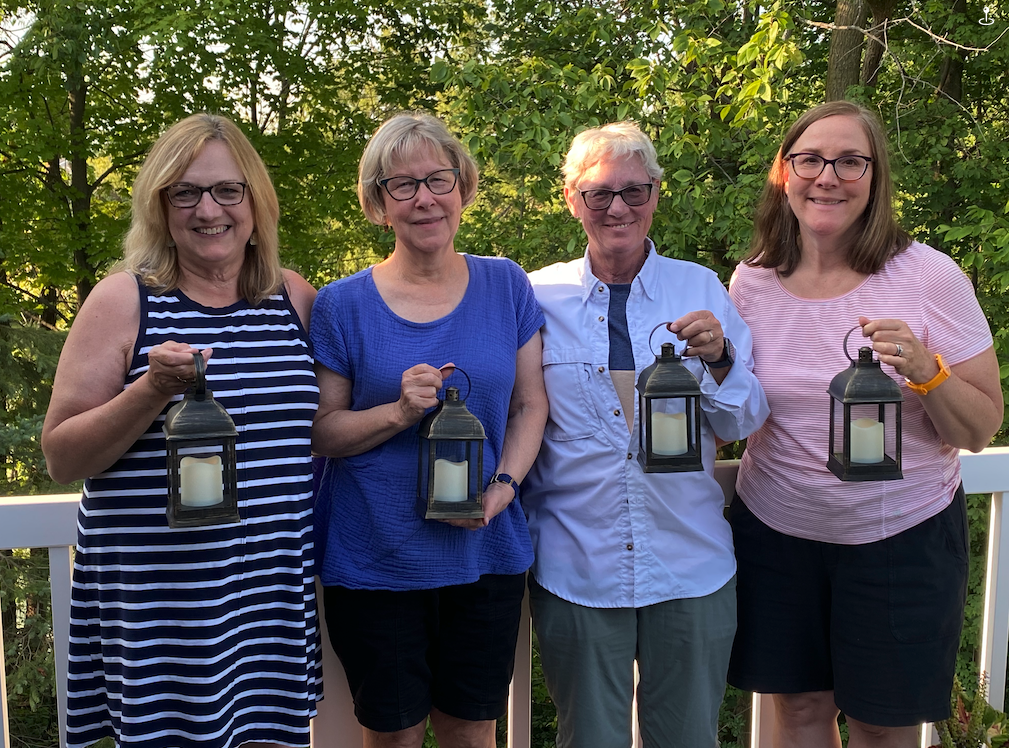
    I sat in the balcony of the Fitzgerald next to my book club members (another group of wonderful women I’ve known for over 15 years) and fought back tears. All I could think of then were Ellen, Beth, and Brenda standing at the edge of my proverbial orchard for two decades guiding me with their light. It’s who we are and what we do for one another as writers. So, on the last night of our way-too-short visit, we sit in my sunroom, and I give each of them a lantern. I want them to remember me, which I really don’t fear will be an issue. And I want to remind them to always “hold the lantern high.” I’ve bought one for myself as well, to hold for them as they make their way out of Guatemala, or the ER, or a spiritual labyrinth or one of the many places our life journeys will take us. I want them to know that I will always be there for them holding the light.

    Jill, Ellen, Beth, Brenda
  • The Blue Notebook

    I wrote my first novel when I was 10, in a royal blue spiral notebook I’m sure was meant for my math homework. The story was what you might expect of someone that age. The protagonist was an angst-ridden fifth grader whose family didn’t understand her.

    I have other notebooks from those days, mostly filled with bad rhyming poetry and rants about my sisters. But the blue notebook is gone. I think, but I don’t know for certain, that I destroyed it in a fit of frustration. This was long before Anne Lamott wrote Bird by Bird, and I understood the value and necessity of a shitty first draft. I just thought I was a bad writer because I couldn’t resolve the plot in a meaningful way. I was 10.

    Since then, I’ve written pages and pages, too many words to count. More bad, unpublished poetry. An op-ed about athletes getting more recognition than scholars that was published in the Midland Daily News when I was in high school. A speech that won an award from Optimist International.

    After high school I channeled my writing energy into professional writing: news releases, promotional copy, employee newsletters. I don’t remember much creative prose in the early days of my career, but most of my jobs involved writing.

    Years later, driving home from a family reunion in Barnesville, Minnesota, my two kids and my mom strapped in the back of our minivan, I decided to go to graduate school for creative writing. There I became the writer I always dreamed I’d be.

    I spent the next seven years learning about the craft I’ve loved since I was 10. I was introduced to Anne Lamott, Joan Didion, Janet Burroway, and a host of others who helped me learn that writing is a process and a passion. Sometimes the words flow easily and land on the page perfectly formed. Most of the time, however, it’s a wrestling match, moving words around until they strike the perfect pose or are pinned to the page in beautiful submission.

    Now, two decades later, I turn to Julia Cameron, who encourages me more than any of the others to just write. Every day. In a notebook. Longhand.

    ***

    I go to my local office supply store (some still exist post-pandemic, although my favorite has closed) and shop for two notebooks. I pick a college-ruled notebook for my daily pages. I want a different color for the novel I’m going to write. This will be my third novel if you count the abandoned manuscript from childhood. I rifle through the messy piles in the bins of the store searching for the perfect one. I stack the notebooks neatly back on the shelves, turning them right side out until at the bottom of the bin I find it. I can’t say why it’s “the one,” but it is.

    I clutch the two notebooks to my chest and head to the cash register. I lay the two side-by-side on the counter, marveling at the possibilities. The black cover will be for my morning pages. And the other—the one with the vaguely familiar royal blue cover—will hold the novel I’m about to begin.