
Living Like You Are Dying

When the buds begin to show in springtime, I think of my mother. It was the season she learned that she was dying. I wonder what it would be like to learn that you won’t be present by year’s end, yet there is the promise of life all around you. A promise in the buds on fruit and maple trees, woodpeckers drumming, and robins with pieces of grass or a beakful of mud. Crocus with its purple and white flowers peeking out of the ground on the sunny side of the house and in the air the smell of rain, soil, and grass.

In a way, I do know. I didn’t think that I would live to be twenty-five. I didn’t have any hope for the future. I’m still surprised that I created a loving family. A safe home. And, my children and their friends, teens in their own right, still want to hang with the moms for a game or two of Monopoly.

Though that time of turmoil, chronicled in House of Fire, is long gone, I still live as if I’m going to die.

I make a great effort to live with no regrets. I’m already planning our families next Guatemala vacation in June of 2018. It will be our 5th visit to Juan Jose’ and Crystel’s birth country. I have my sight set on a sailboat river tour of the Rio Dulce, Lake Izabal, and Livingston before spending time anchored alongside an island jungle and beach.

Fortunately, Jody saves for the future. She packs away items from one holiday to the next. If it was up to me I’d just go out and buy the same thing year after year.

It’s helpful to live like you are dying. I’m at every track and cross country meet with the kids that I can attend. Though, I did hold back from going to their Nordic ski events. Somehow, I didn’t think that I’d regret standing in the cold waiting for them to come to the finish line. Maybe, next year.

The lilacs haven’t bloomed yet. But, they will. Their green bud promises us that.

The robins will strengthen their nest with mud. I’ll do the same showing up for my kids.


Opposing Thumbs

In 1975, as I sat in Miss Bloom’s typing class, I never thought that one day I’d be typing primarily with my thumbs. I’m sure Miss Bloom, ancient even then, couldn’t have imagined a keyboard so tiny that even the end of her thumb would be too large to hit just one key.

I picture myself in her class, feet planted firmly on the floor, my skirt pulled down over my knees, fingers curled over the keys of the IBM Selectric in front of me. Four rows of eight desks neatly lined the room. The only sounds were the soft squish of Miss Bloom’s orthopedic shoes on the linoleum floor as she paced up and down the rows checking our posture, and the hum of the newly purchased typewriters in front of us. (What a marvel those electric typewriters were. How much easier than the 1928 Smith Corona I used at home.)

What were my lonely thumbs doing then? They were relegated to the space bar, waiting for the opportunity to create a void between words. Only my right thumb ever got any business, the left thumb dangled uselessly while all of the other digits pounded away at 65 words per minute.

No wonder that now my thumbs have trouble finding the letters when I answer e-mails or send my daughter a text message from my iPhone. They’re not conditioned for this kind of work. Now they’re front and center, the rulers of the written word while my fingers curl around the back of my handheld device, providing support, but little else.

Occasionally my right index finger can’t stand the pressure and it says to its friends on my left hand “Take over. I’m going in!” as it darts from behind the screen to hunt and peck for the letters, thinking itself faster than my clumsy thumbs.

But even this is unsatisfying, because my right index finger doesn’t know the keyboard any better than my thumbs. The only familiar keys are y, u, h, j, n and m. And what can you spell with only those letters? Eventually, my index finger gives up and returns to its friends behind the screen, letting the thumbs take over because they at least can work together, doubling the speed of my messaging.

Gone are the days of 65-75 words per minute. My thumbs are lucky if they can get in 20. So they’re less creative. A reply that once might have been “I’d love to join you on Saturday evening. A trip to the theatre sounds like fun,” becomes “K” or more likely a thumbs up emoji, but rarely anything longer. It’s just too slow, too cumbersome, too demoralizing to spend so much time pecking for the keys and constantly backspacing to correct mistakes.

I’d like to say my thumbs are happy, that they’re glad for the opportunity to carry the torch after all these years. But I don’t think they are. I think they miss the days of working in tandem with my fingers, resting lightly on the space bar while the fingers searched for just the right sequence of letters. I think they’re lonely out there in front by themselves. Who knows? I could ask them, but they’d probably just reply, “IDK, may b. U D cide.”


Guest blogger and WordSister Jill W. Smith is a Twin Cities’ writer. Her work has appeared in the anthologies Here in the Middle: Stories of Love, Loss, and Connection from the Ones Sandwiched in Between; A Cup of Comfort for Parents of Children with Autism; and Siblings: Our First Macrocosms, in the online journal Mothers Always Write, and occasionally on her blog, The Autism Fractal, which she co-authors with her oldest daughter.

It’s A Different World

A few weeks ago, my job was expanded to include another plant under my human resources umbrella. I introduced myself to the General Manager and the office and production employees. I started with the personal.

“My partner and I have two children. They are 14 years old. We adopted them from Guatemala as infants.”

I shared my philosophy of human resources. I view my human resources department as a service to employees. I explained how they would see me on the manufacturing floor. I welcomed them to stop me and ask for a W2 form, address change form, vacation slip, etc.

Their eyes lit up when they understood that I would come to them instead of them having to come to me.

I marveled that I could bring me to them. The all of me. Specifically, having a partner.

It wasn’t that long ago that I never mentioned the word ‘partner’ at work. I kept the personal to myself. I wanted people to judge my human resources style not my personal life.

What changed for me was that same sex marriage became legal in Minnesota on August 1, 2013.

I am legitimate. I don’t need to hide behind unspoken words. I don’t need to say anything about my personal life. Or, I can.

This past January, Jody accompanied me to a work outing. I introduced her to the President, Vice President and others as my partner.

It’s been 4 years of living in a different world.

It’s a good thing for all of us.

Resisting Assumptions

The last time I gave blood, a tech named Dakota took care of me. When she introduced herself, I didn’t expect we’d have much in common. She was in her 20’s and had full sleeves of tattoos and several facial piercings, while I look like the middle-aged, mom-ish person I am. However, she surprised me.

She made a real effort to talk to me, which I appreciated because giving a pint of blood takes about half an hour and you’re tethered to a gurney the whole time. You can stare into space, listen to music and daydream or play with your phone, which is what I was doing when she tried for a second time to start a conversation. I apologized and set my phone aside. She sympathized and said she’d recently read an article about how involvement with cell phones can put a damper on actual conversations. Her comments sounded like something I would say, not something I expected of someone her age. It was a minor moment, but it reminded me how difficult it is to resist making assumptions.

Making assumptions is natural and necessary.

Every day we receive such an onslaught of information—online, at work, and during casual personal encounters at a coffee shop, gas station, or wherever—that our brains simplify and categorize it. We have to. Otherwise, we’d be paralyzed by making sense of the input. The downside of this tendency is stereotyping.

It’s a wonder people ever make genuine connections! And yet, I’m committed to trying.

Resisting stereotypes about age, race, gender, politics and so forth, takes a lot of energy. The situation is made doubly difficult because whomever I’m encountering has his or her own set of biases to overcome. But in a culture that’s rife with hateful stereotypes, I’m trying harder to see each person I meet as the individual she or he is.

At its most basic level, my efforts consist of looking strangers in the eyes and smiling. Just seeing them and looking friendly. Some people don’t return my smile, but a lot of them do. It occurs to me that I may look like a smiling idiot—a dotty lady on the loose—but I’m willing to take the risk.

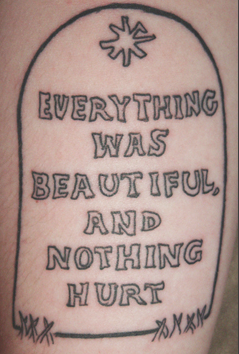
In Dakota, I found an interesting woman who wants to be a nurse, while I’ve worked for hospitals off and on throughout my career. We’d both lived in Morris, Minnesota, although decades apart. As she described what her tattoos meant to her, it was clear her body is her canvas. I mentioned an ironic tattoo I like that’s in the shape of a tombstone and reads, “Everything was beautiful, and nothing hurt,” a quote from Kurt Vonnegut’s Slaughterhouse Five. Turns out we both like Vonnegut.

Next time I have a chance to make a casual acquaintance, I’ll try to be the one who initiates conversation.