On Giving

Recently, I became acquainted with a young Afghan refugee who has been resettled in the US. She’d only been in the US a few days when I met her on a bitterly cold day in February. I had no idea what she might have or need, so I brought a scarf and warm mittens, some toiletries, tea and snacks. The resettlement agency had given her appropriate winter clothes. Within a few weeks they’d found an apartment for her and given her basic furnishings.

Despite our age difference (she’s 24 and I’m in my sixties), we got on well. She had worked with the US embassy and her English is good. I’ve tutored immigrants learning English for years and am aware of some common cultural disconnects. So much of teaching English involves explaining American history and culture as well as grammar and punctuation. My intention is to be a friend, someone she can trust with questions about confusing customs.

When I mentioned meeting her, a number of women I knew immediately asked what household items she might need. Like me, they’ve accumulated a lot of stuff over the years and would be happy to give it to someone who can use it. We all have so much. We’d never miss an extra end table, coffeepot, or winter coat. I had the same impulse, but thought I’d wait to see what she wanted and needed. 

Her apartment’s furnishings seem sparse by American standards, but she was delighted by her things. She’s accustomed to sharing the kitchen with several families and told me she’s never had so many clothes. I recalibrated my instinct to offer her a bunch of stuff. Should I push my aesthetic on her? Maybe she prefers simplicity. Would the donations from my friends and me make her feel inadequate or signal that she seems poor by American standards? 

I’m aware I often overthink things. Maybe she’d love to have more for her apartment. The simple generous reaction friends have had—how can I help—is a good one. Why wouldn’t we help when we have so much? Shouldn’t we?

Yet I know the dynamic between givers and receivers can feel unbalanced. Uncomfortable for the recipient. I’ve already seen my new friend’s deep sense of hospitality. When I visited her and another Afghan family she’s friends with, they insisted on serving me a full meal. Although I wasn’t hungry, I knew it would be rude to refuse, so I ate with them. Similarly, when I gave her the handful of things culled from my closet and kitchen at our first meeting, she gave me a new pair of earrings she had, something I suspect she’d bought for herself.

I try to think how I’d feel if the roles were reversed. Would I simply be grateful, because I needed things and someone cared enough to help? Or would I feel awkward about the charity? In time would my pride be pricked so I became resentful? Trying to be sensitive, not stingy is confusing.

Unexpected Joy

Trips are an adventure.

I plan. I research.

And yet…anything could happen. In the not knowing moments, the unplanned, I feel the most alive.

I often don’t do enough research to understand that I should be afraid. Such as driving to Whitefish, Montana for a family Christmas ski holiday with friends. Whiteout conditions forced us to spend extra days in a hotel. There was dog sledding, snowmobile driving, and skiing Whitefish Mountain. Those activities seemed tame. Checking off the boxes. The drive itself was the adventure. Funniest was the holiday mix-up where I didn’t receive a gift. Names had been drawn. Presents packed for the trip. Obviously, someone forgot they had my name and thought they had someone else. Life is funny like that sometimes. Hands you an unexpected letdown and how will you respond? For me, an opportunity to be gracious and see the humor in the unexpected all while moving through a range of emotions.

Our family has made many trips to Guatemala. I planned the paintball outing in the mountains but not the deep circular bruise in the middle of my forehead. I forgot to research protective gear and the speed of paintballs. On this same trip, to disembark from a boat in a squall, I threw myself on a swaying homemade dock in the pelting rain when the a lancha got near. That’s how you arrive in port in a secluded Mayan village. I’ll never forget that. I’ll also remember my son reaching his hand out time and time again to help me climb the mountain above Santa Cruz La Laguna to reach the next village. He became a man that day, looking after his mother.

I plan. I research. Yet, sometimes, I’m not even aware of the task I’m taking on. I just go forth. Bringing my family with me.

Backing our rented 32 ft. RV into the driveway after arriving home from the Grand Canyon, I thought to myself, “What chutzpah Jody and I have.” To think we could rent an RV and drive it to the Grand Canyon having never driven anything bigger than an SUV. This feeling of triumph trumped the planned Grand Canyon helicopter tour and mule trip down the canyon.

I certainly didn’t research the driving fear factor on our trip to Mount Rainier National Park and Crystal Mountain Resort. The drive required us to drive at a height of 6,681 ft. with no guardrails. While driving, I came to view our RV as a weapon that could kill us all with one wrong move. Later, one of our dogs tumbled down a cliff. This was unplanned. When we figured out he was going after rocks that were being kicked off the hiking path, we walked more carefully.

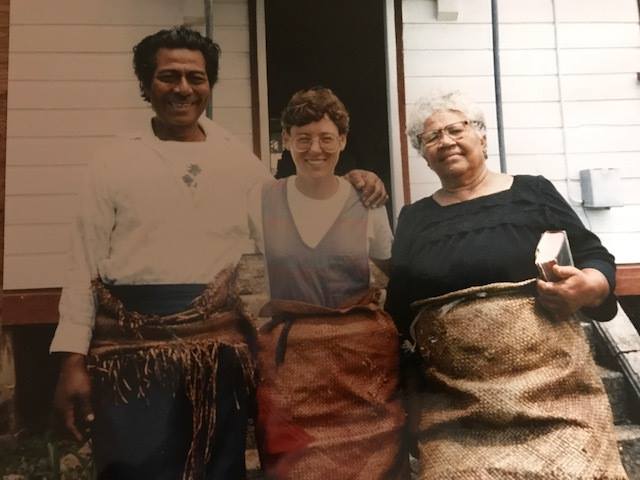
Our five-week stay in Florida brought me unexpected deep joy. When I was in Tonga in the South Pacific for the Peace Corps, the ocean scared me. I couldn’t figure out how that tiny island stayed afloat. I was familiar with the solid earth of Wisconsin cornfields. I never did get comfortable in Tonga. But in Florida, I stared for hours at the ocean, losing myself in the sound and strength of the water.

Our family has an upcoming trip to Yellowstone and to Maui.

I’ll research. I’ll plan.

It’s the unexpected that will touch me.

Peace Corps Volunteer. Tonga, South Pacific

Cultivating Hope

Lately, I have been struggling to feel optimistic. The Ukraine invasion is heavy on my mind. In the big world, there are many other pressing problems (you know the list). Yet I want to be hopeful. In fact, I kind of insist on it. 

I have been heartened by the astonishing global reaction to the Russian invasion. 

I also remind myself that historically, when cataclysmic events have changed the world order, sometimes positive change happens too. It may be that having been through something terrible, people vow, “Never again,” as the Greatest Generation did after WWII. Their commitment to preventing more world wars held for decades, not perfectly, but mostly. Taking the long view gives me hope.

I strive for perspective and balance. I remind myself my own life is fine. But sometimes I backslide into overwhelm: How can we find lasting peace, address the climate crisis, shore up our democracy, and so much more? It all feels insoluble. What can one person do? 

What I finally come to is, what other choice do we have? We have to keep trying to change and improve the world. And that means hoping.

Howard Zinn, in “The Optimism of Uncertainty” expresses what I believe better than I can—

To be hopeful in bad times is based on the fact that human history is a history not only of cruelty, but also of compassion, sacrifice, courage, kindness. If we see only the worst, it destroys our capacity to do something. 

If we remember those times and places—and there are so many—where people have behaved magnificently, this gives us the energy to act, and at least the possibility of sending this spinning top of a world in a different direction. 

And if we do act, in however small a way, we don’t have to wait for some grand utopian future. To live now as we think human beings should live, in defiance of all that is bad around us, is itself a marvelous victory.