When it Comes to Downsizing, Fire is Not the Answer

Have you read “How to Get Rid of Stuff: The Survey Says…”?

Published on Next Avenue, the article features an interview with David J. Ekerdt, author of Downsizing: Confronting Our Possessions in Later Life.

Although I’m too busy confronting my own mountain of stuff to read Ekerdt’s book, the article brought me face-to-face with my own struggle to take control of my possessions.

One line in particular stood out to me. It referred to the “magical thinking” approach to downsizing, which can be summed up as wishing a fire would “take care of” all one’s possessions.

I’ve been guilty of such thinking. In fact, more than a decade ago, I fantasized about this exact thing with my friend Maery Rose.

Last week my fantasy almost came true.

That’s when I came home from a socially distanced visit with my aunt Caroline to a smoke-filled bedroom.  

It started because of my hair.

I haven’t had it cut or colored since the pandemic began, and it’s been driving me crazy. I wanted to give it a bit of TLC from all angles, so I plugged in a curling iron in my bedroom, where I could adjust the mirrored bifold doors of my closet to get a 360-degree view of my hair.

Though I didn’t love what I saw, a figured a few quick curls just before walking out the door would get me to “good enough.”

But in the middle of making those curls, I got distracted by a call and forgot to turn the curling iron off. What’s worse, while I was gone, it slipped from the radiator onto my bed, where I had a pile of clothes I’d been debating about whether to keep or giveaway.

By the time I returned home, the curling iron had burned through the clothes, as well as a treasured handmade afghan, my down comforter and my sheets. Even my mattress was beginning to burn.

I’m lucky I came home when I did. The damage could have been much worse. And while I certainly hope I never accidentally set another thing on fire, there’s one positive that came out of that day: I’m finally, after years of talking about doing so, letting go of those things that don’t fit my future self.

In fact, in the week since the fire, I’ve donated two carloads of boxes and filled my dining room with dozens more.

And thanks to this tweet by Angela Giles Klocke, I’m able to see some humor in the fact that the universe had to light a fire in my bed in order for me to finally take downsizing seriously.
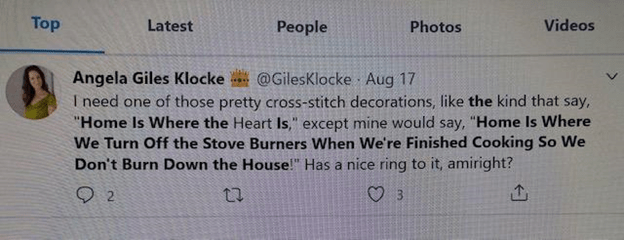
Inspired by Angela, I’m now cross-stitching my own aphorism: “Home Is Where We Unplug Curling Irons So We Don’t Burn Down the House!”

Angela is right, it does have a nice ring to it, one I hope will keep both my home and hers fire-free from now on.

Parallel Reality

Guest blogger Rosemary Ann Davis is a memoirist, poet, travel writer, photographer, and member of the original WordSisters writing group. 

It started with a cough.

As the numbers of those sick and dying from Covid 19 mount, I continue to have flashbacks to a different time. Forty years ago, another health crisis was just beginning in America and I found myself drawn to the chaos and denial. Having just left San Francisco, I began to hear about a “gay cancer,” and started warning my men friends back in the Bay Area to be careful.

The panic I felt that morning reading the sketchy details about HIV AIDS in the Star Tribune is similar to the disturbing feelings I had when going into quarantine for the coronavirus this past March in Minneapolis. The similarities don’t end. 

While uncertainty gripped me in the early 1980s; I learned more about HIV AIDS with time, and many visits back out West. As I learned how HIV was spread, I modified my sexual behavior; and now in 2020, I wear a mask, wash my hands, and keep 6 feet of distance.

Protests then and now have echoes of familiarity. Current marches around the world about government responses to Covid 19 remind me of San Francisco and D.C. marches in the states long ago. Dr. Fauci was in a key leadership position both times, now putting his AIDS work on hold to wrestle with the coronavirus. I remember AIDS marches where the doctor was vilified because the science wasn’t working fast enough for a cure. At one point I flew to Washington, D.C. to participate in a die-in at the White House. Laying on that hard ground surrounded by like-minded folks from across the country gave me a safe place to reflect on and mourn the one thousand young men who had died in my San Francisco neighborhood in one year.

People dying in both health emergencies remained isolated. AIDS patients were abandoned by parents in droves because of their gayness, while Covid patients’ friends and relatives are kept out of hospitals to avoid infection. If they were lucky, people with AIDS were taken care of by their lovers’ mothers, the ones who were accepting. These days, some dying of the current virus can speak on the phone or other electronic media with their family members if medical people have the time to accommodate them.

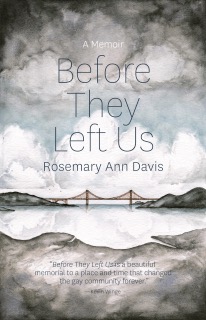
I’m still grieving my friends who have died, and wrote a book, Before They Left Usto honor them and those times before and after AIDS took them. Although there have been many improvements in the fight against AIDS, I still donate to the cause, attend memorial events, and deliver food on the holidays some 40 years later. My friends are still with me, whenever I visit the Bay Area, am back in the Midwest, or wherever I am. That’s the kind of effect the AIDS crisis had and continues to have on me.


While we are now nearing 175,000 dead of the pandemic in the U.S., I’m sure that these losses will also affect the surviving families for years to come. Grandparents, middle-aged parents, even children, have all died from this. What changed the direction of my life and turned me into an AIDS activist, perhaps will change theirs as well. Loss can do that to you.

Our federal government has been at odds with its citizens during both of these epidemics. In the 80s, the President wouldn’t even say the word “AIDS,” much less address it. Now, it feels as if we are being told it is more important to get the economy going than to concentrate on lowering the infection and death rates.  What good will the economy be if hundreds of thousands of us are dead?

So, what can we learn from all of this? To a large extent it is up to us to change our behavior to avoid getting the infection and transmitting it. We can also encourage others to do the same. Speaking truth to power—whether it be engaging in conversations or protesting in the streets, can be a form of influence.  Most importantly, we can show compassion particularly to those with the virus, those who are grieving, those who want to honor the dead, those who are working towards a just and healthy society, and even those who are not.


Dear Dr. Rajender . . .

Dear Dr. Shyamala Rajender,

The University of Minnesota and the Rajender Consent Decree are probably far from your thoughts. Most of the time they are far from mine, too. However, recently I realized that it’s been 40 years since the decree bearing your name helped me.

I’m writing to thank you.

Your courage fighting gender discrimination changed my perceptions of the world and set me on a feminist path that informed the rest of my life—how I see myself and thought about my career, how my marriage works, and how I raised my sons.

Forty years ago, I was a Freshman Composition instructor at the University of Minnesota-Morris, my first professional job. In the spring of 1980, I got in trouble with the all-male senior faculty in the English department, because I wanted to present a noncredit lecture about women’s literature for a Continuing Education series.

Several of the senior faculty reacted with a policy that stated, “. . . instructors in English should not participate in off-campus events, either formal instruction or informal presentations, which, in effect, call for a person who has been judged expert in the teaching of English literature.” In other words, I wasn’t supposed to talk about literature even though I had an M.A. in English Literature. The policy was odd and confusing. Several of the literature professors at UMM had been tenured with only a Master’s degree. But my credentials—which were the same as what some of them had—were suspect.

At first, I was more scared than angry (anger came later). The Continuing Education director and the EEOC officer knew I was afraid I’d damage my career by fighting the policy, so they informed the academic dean about my dilemma. The dean and others were aware of your gender bias case against the Chemistry department on the main campus. Consequently, the dean insisted the English department rescind their policy, and I was allowed to give the lecture.

Later that year, a number of faculty members, including me, received a $2,000 raise as a result of the Rajender Consent Decree. It’s hard to imagine now, but increasing my salary from $12,000 to $14,000 per year was a meaningful raise then. In general, it’s hard to convey to younger people just how crazy the late 1970s and early 1980s were for professional women.

Your decision to fight the University of Minnesota had a lasting impact on my life.

At 25, I learned gender discrimination was as real and insidious as the fatherly men in the English department, who didn’t see me as their equal and wanted to limit my opportunities. That experience didn’t drive me away from academia, but like you, I left the academic world several years later.

Your career was exemplary (first a Ph.D. in Chemistry, later a law degree). Mine was much more ordinary, but I was always aware of the example I set as a woman in the workplace. Your determination to fight gender bias had a far-reaching effect on me and so many other women. I want to acknowledge your heroic contributions.

Thank you again for your courage.

Sincerely,

Ellen Shriner