• Paying Attention: The Importance of Being Present

    We live in a world full of distractions. From our smartphones to our busy schedules, it’s easy to get caught up in the hustle and bustle of everyday life. But what happens when we’re so preoccupied that we fail to notice what’s right in front of us?

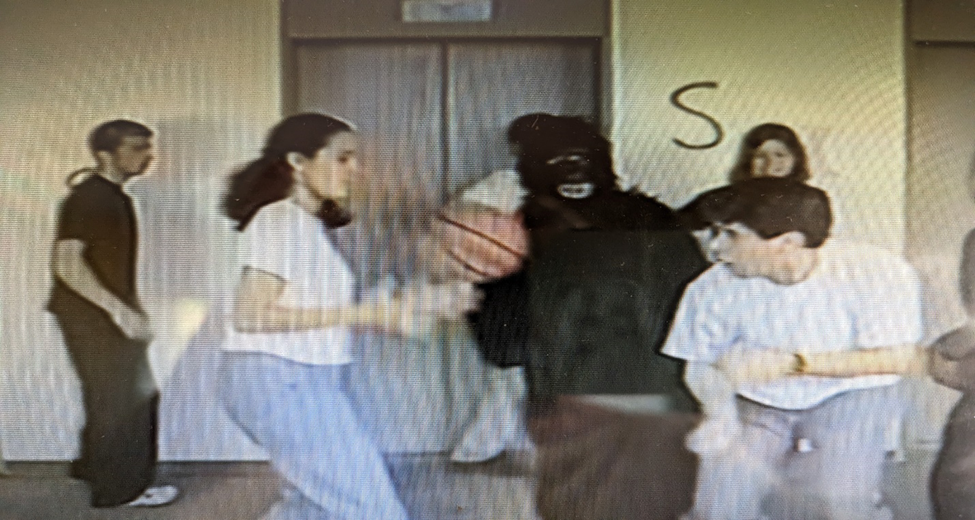
    In this now-famous experiment, a group of participants is asked to pass a basketball to one another while counting the number of times they pass it. In the midst of all the action, a person in a gorilla suit walks through the scene, but only a tiny percentage of participants actually notice. Participants were so focused on their assigned tasks, counting the passes, few noticed the gorilla.

    The experiment serves as a powerful reminder that we can be so focused on completing our solo tasks, formulating an answer, or on our desire to succeed that we fail to take the opportunity to laugh at the gorilla in the room. The gorilla could just as well have been a child smiling at us, an oriole landing outside our office window. There’s a time to focus and a time to look up and enjoy life and each other.

    It’s not just about noticing gorillas, though. Being present and paying attention can have a significant impact on our relationships, our work and our overall well-being. When we’re not fully engaged with the people and things around us, we miss out on opportunities to connect, learn and grow.

    So, how can we cultivate a greater sense of presence and awareness in our lives? Here are a few tips my friends and colleagues have found helpful:

    • Put down your phone. We’ve all heard this one before, but it’s worth repeating. Our phones can be a major source of distraction, pulling us away from the present moment, the book we are reading and the people we are with.
    • Be mindful. Even just a few minutes of mindfulness meditation each day can make a big difference in our ability to stay focused and present.
    • Take breaks. It’s easy to get caught up in the go-go-go of modern life, perhaps even easier now that I’m working less than full-time and have a more erratic schedule. But taking a quick walk around the block or spending a few minutes concentrating on my breath makes it easier to pay attention.
    • Embrace life’s transitions. Life is a series of transitions, and that’s especially true as we age. We go from being a student to working full-time, from being single to having kids and grandkids, from being a parent to becoming an empty-nester, from focusing on our work to enjoying retirement.
    • Prioritize self-care. Taking care of ourselves becomes especially important as we age so we need to dedicate time to nurturing our physical, mental and emotional well-being, whether that’s meeting a friend for dinner, taking a bath or spending time in nature.

    At the end of the day. Paying attention is about more than just noticing gorillas. It’s about being fully present in our lives in the world around us. When we’re able to do that, we open ourselves up to new experiences, deeper connection and a greater sense of fulfillment. And what could be better than that?

    4 responses to “Paying Attention: The Importance of Being Present”

    1. Ann Coleman Avatar

      Excellent advice! Too often, we don’t even notice what’s right in front of us!

      1. cmkraack Avatar
        cmkraack

        Thanks, Ann.

    2. Ellen Shriner Avatar

      Good stuff—thanks for the tips!

    3. writers70pocket Avatar

      100% agree. I love being focused, but also love those breaks to notice.

  • Hesitations

    Scratchy eyes, stuffed noses and sneezes mark the official leaf out of trees for many with allergies. In the upper Midwest climate change is warming our falls and appears to be cooling April and May. Typical years would have 12 April days with high temps of between 55 and 70 degrees. For two years we have had half of that. And trees need warmer temps on a steady schedule in April to grow leaves by May 1. Not only do we have slow moving weather, but Alberta wildfire smoke that blocks blue skies. 

    Ducks have been surveying our backyard, ignoring a small noisy dog, for the right place to lay their eggs. For two days they try the mulch under pine trees. Another day they sit in the middle of the lawn. Then they disappear.

    Our little granddaughter is able to race around the house holding onto one finger of an adult’s hand. For a few days she managed to travel the same track independently with a huge smile and laughs. After a few days of going solo, she returned to walking with someone. A week later she ran to greet us.

    Nature hesitates. The trees are quite healthy, the ducks will probably settle someplace under a neighbor’s deck, our granddaughter will travel on her own today or tomorrow. The world keeps spinning during these brief respites during transitions. Planets don’t collapse, rules of gravity remain intact, global population increases. 

    What I need to take away from nature is the difference between hesitation and procrastination. It’s okay to push back a haircut for a whole lot of reasons, but not so good to ignore a mammography or eye test. The choice between sloppy joes or pork chops for dinner can be delayed until right before I leave the grocery store. If I forget, there are scrambled eggs for dinner. 

    Hesitation has been given a bad rap. “He hesitated” implies a less than enthusiastic response to a question or opportunity. The elevator hesitated takes a story a whole different direction. She stepped on the gas and the car hesitated might mean a substantial repair bill. 

    Yet hesitations can be like a “could” instead of a “should” in a day if we lean into the luxury of rolling lesser decisions forward. In a life directed by dreaded to do lists, I hope I can leave paint swatches up on the wall another week to study how they look in the sun and light. A friend of mine did that for the entire holiday season including her husband’s staff party. Why not? 

    , ,

    2 responses to “Hesitations”

    1. Suzanne Earls Avatar
      Suzanne Earls

      Nice share of thoughts to encourage us to slow up a bit and not call it procrastination! I admit I like to savor some choices.

      1. cmkraack Avatar
        cmkraack

        Thanks for reading!

  • In the Company of Mothers

    “You are such a good mom.” Ah, I leaned in, these words meaning more to me than my friend could know.

    I had been talking about the latest challenges with my young teen, where everything felt new, unfamiliar, and uncomfortable. I took a minute to let the words sink in. It was the kind of thing my mom used to tell me.

    My mom and I talked frequently when my baby was a baby, me needing to hear the calm of her voice, steadied by years of mothering. She seemed to meet with ease all the challenges of raising four kids close in age. Or at least that’s the way it seemed to me.

    By the time I became a mother, my mom had been a grandparent to nine already, the oldest in college and the youngest just into the double digits. I was late to the game and met motherhood with a fair amount of hand-wringing. Those early days were especially fraught-filled. Was my baby sleeping enough? Eating enough? Hitting all the right growth markers? There was so much to worry about.

    My mom didn’t always know how anxious I was, but I would call her just to hear her voice. In my postpartum funk, I couldn’t tell her I was scared and lonely—I don’t know why—but I might instead give her a mundane update of how the day was going with my infant, hoping she could intuit my struggles. I was afraid of my own fear and questioned everything I did.

    As my child grew, my mom was a steady source of reassurance and always wanted to know what my little one was up to. I would tell her some tale of my busy toddler, then preschooler, then elementary student. The stories were mostly amusing, but sometimes I was exasperated or uncertain. “You’re doing a good job, Brenda,” she would say. I’d always think, “Really?” It never felt that way. But she knew what I needed to hear.

    ~

    I miss that. My mom is no longer here to comfort or commiserate, to offer hope for parenting through the teen years. She passed away right before the pandemic and right as my child was entering the tween years. Now I find myself among the many motherless daughters out there, feeling my way along. While I know that I am lucky to have had my mom for as long as I did, I still miss her and her unconditional support. And I really want to know how she made it through parenting four kids from infancy to adulthood—especially through the teen years.

    The author and her mom Lois.

    She used to say that she had a lot of help, especially from my dad when we were all younger. And that having a lot kids close together was just what people were doing at the time. Now she would probably tell me she did the best she could and that she was far from perfect. And that she was also buoyed by a loose network of family, friends, neighbors, and others.

    ~

    I wonder now what she would say about the precocious child who has turned into a strong and independent teenager. I imagine telling her of the latest tale and hearing her say, “Oh, Brenda,” lowering her voice on the “Oh” to add to the sense that she knew it was hard. Or maybe she’d shake her head and murmur words of commiseration. My child is much like one of my siblings, whose teenage years were punctuated by frequent conflict with my parents. Would my mom tell me she could understand the challenges of parenting an iron-willed but sensitive child? Or would she think of herself as a teenager, wishing that she had been nicer to her own mother? I never imagined my mom as a teenager but only as my mom and was surprised when she told me she regretted clashing with her own mom when she was young.

    So perhaps this tells me that we never quite get it right and despite the anxiety, the self-doubt, the struggles, and even the loneliness, we are making it through.

    My mother leaned on her own sisters, neighbors, friends, colleagues, and I am, too. I am banking on the collective wisdom of this vast community of mothers I am part of. They look like the friend who laughs with me and the one who offers a listening ear or a word of advice and then the one who just tells me I’m doing a good job.

    , , , , , , , , , , , , , ,

    One response to “In the Company of Mothers”

    1. Karen Martha Avatar

      I depended a lot on books. Parents as Teachers, Children the Challenge, Parent Effectiveness Training, etc.


Recent Posts

  • Borrowed Time

    Rain hammered the passenger van, rattling the metal like gravel tossed against a tin roof. Each burst sounded closer, louder, as if the storm were trying to break its way in. Why today, of all days, when Juan was visiting his birth family? We had planned it so carefully. We’d even had a kind of…

  • From Minneapolis

    …they have cost children the life of their mother….

  • A Few of My Favorite Things

    When I feel world-weary, I actively try to turn away from the world’s troubles and focus on the many good things in my life. In addition to my family and friends, here are some things I enjoyed this past year—art, books, nature. Sorry, no raindrops on roses! When I saw this painting I wanted to…