Category: Perspective

  • Compliment Activation (or Geeky Fun with Words)

    This has been a tough week in the world, so I thought you might like a little diversion.

    Sometimes I hear interesting words or phrases that pique my curiosity. These three phrases suggested meanings, but when I checked, I discovered the real meanings were very different.

    Compliment activation – What I hope will happen after I get my hair cut or if I’m showing off a new pair of shoes.

    When I first heard this term at a medical conference in a previous life, I was delighted. After all, I’m a writer and love expressive language. But if you spell this the scientific way —“complement activation,” you get the real meaning:

    The complement system includes 20+ protein molecules that circulate in the blood. When the body senses a pathogen (the cooties that cause disease), the complement system is activated and a sequence of events occurs to fight infection. So either kind of complement activation can be good for you.

    Antisense – Sounds like a good description for current events. Also might describe what the chipmunks in my yard are saying.

    “Antisense” just covers so many situations. Turns out, it also has a scientific meaning: Having a sequence of nucleotides complementary to (and hence capable of binding to) a coding sequence, which may be either that of the strand of a DNA double helix that undergoes transcription, or that of a messenger RNA molecule (Dictionary.com).

    Whaaaat?

    After more research, I learned that the concept of antisense evolved into a therapy for genetic disorders. When a particular gene is responsible for a disease, a strand of nucleic acid can be bound to the messenger RNA of that gene and effectively switch off the disease-causing gene.

    Regional expression – OK, I think I got this. A regional expression is like “pop” in the Midwest or “soda” on the East coast. Or maybe the way I say, “crick” for “creek” – an Ohio thing. Unless we’re talking about genetics.

    Every gene contains a particular set of instructions that code for a specific protein. Gene expression is the process that enables DNA instructions to be converted into something useful, such as a protein. Where a gene lies in the genome (its region or neighborhood) influences the regulation of gene expression. In other words, gene behavior is influenced by where it hangs out. Hmm. Just like people.

    It can’t hurt to know a bit more about genetics, but I like my definitions better!
  • Resisting Assumptions

    The last time I gave blood, a tech named Dakota took care of me. When she introduced herself, I didn’t expect we’d have much in common. She was in her 20’s and had full sleeves of tattoos and several facial piercings, while I look like the middle-aged, mom-ish person I am. However, she surprised me.

    She made a real effort to talk to me, which I appreciated because giving a pint of blood takes about half an hour and you’re tethered to a gurney the whole time. You can stare into space, listen to music and daydream or play with your phone, which is what I was doing when she tried for a second time to start a conversation. I apologized and set my phone aside. She sympathized and said she’d recently read an article about how involvement with cell phones can put a damper on actual conversations. Her comments sounded like something I would say, not something I expected of someone her age. It was a minor moment, but it reminded me how difficult it is to resist making assumptions.

    Making assumptions is natural and necessary.

    Every day we receive such an onslaught of information—online, at work, and during casual personal encounters at a coffee shop, gas station, or wherever—that our brains simplify and categorize it. We have to. Otherwise, we’d be paralyzed by making sense of the input. The downside of this tendency is stereotyping.

    It’s a wonder people ever make genuine connections! And yet, I’m committed to trying.

    Resisting stereotypes about age, race, gender, politics and so forth, takes a lot of energy. The situation is made doubly difficult because whomever I’m encountering has his or her own set of biases to overcome. But in a culture that’s rife with hateful stereotypes, I’m trying harder to see each person I meet as the individual she or he is.

    At its most basic level, my efforts consist of looking strangers in the eyes and smiling. Just seeing them and looking friendly. Some people don’t return my smile, but a lot of them do. It occurs to me that I may look like a smiling idiot—a dotty lady on the loose—but I’m willing to take the risk.

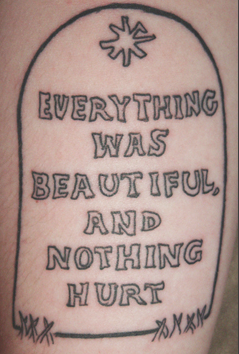
    In Dakota, I found an interesting woman who wants to be a nurse, while I’ve worked for hospitals off and on throughout my career. We’d both lived in Morris, Minnesota, although decades apart. As she described what her tattoos meant to her, it was clear her body is her canvas. I mentioned an ironic tattoo I like that’s in the shape of a tombstone and reads, “Everything was beautiful, and nothing hurt,” a quote from Kurt Vonnegut’s Slaughterhouse Five. Turns out we both like Vonnegut.

    Next time I have a chance to make a casual acquaintance, I’ll try to be the one who initiates conversation.

  • Enlarging My Circle

    cactus-flower-2For years, my husband and sons visited relatives in Green Valley, a retirement community in Arizona. I loved seeing our family and experiencing spring in the desert. But I disliked the way some of the residents had become intolerant of young people and as prickly as the blooming cactus that surrounded us. I vowed that wouldn’t be me. While I was still working for pay, I didn’t have to think about how to make good on that promise. I had friends of all ages among my coworkers. Now that I’m retired, I want to be more intentional about connecting with younger people (younger than a Baby Boomer, that is).

    Though older, I’ll be the seeker, not the sage.

    I’ve learned so much from my sons, so I want to go further and invite more people of other generations into my life. I hope to learn from people who are at different stages of life from mine and understand how they see the world, what their challenges, reactions, and solutions are. To know what they know. To welcome their insights and wisdom.

    Making connections is part of my personal style.

    Networking is one way people connect with strangers and make friends of acquaintances. While I was a freelance writer, I networked for professional reasons. Often the connections I had with clients and colleagues sparked friendships that have lasted 5, 10, or 20 years.

    My plan is more of an outlook than a highly systematic effort.

    My current idea isn’t exactly “networking,” which implies a career emphasis. Instead, I hope to continue to do what I have always done—make and keep friends. The part that requires more focus is putting myself in settings where I will meet new people of all ages. Then, if we like the same things and have common interests, friendships will have the chance to blossom.

    For example, a young woman I know manages communications for a nonprofit. We met when I started volunteering there, and since then, we have become friendly.

    I recently reconnected with a younger writer who’s a friend’s daughter. The daughter is traveling in Europe and writing about her experiences. One of her blogs reminded me how I felt while traveling alone in Europe in my later 20’s, so I sent her a note. Currently, we are acquaintances, but I’m open to getting to know her better.

    One of the women who styles my hair is at least 20 years younger than I am, but we have discovered that we have similar taste in movies and politics. Recently, her family experienced a crisis, and it was comforting to her to see that I really understood her reactions—our temperaments are similar too.

    I value my longstanding friendships with people my age, but I hope to enlarge the circle to include friends of all ages.