Ready, Set … Bounce

I used to be resilient.  

At least that’s what a “How Resilient Are You?” quiz I took a decade ago indicated.

I came across the quiz the other day while purging a hanging file chockful of articles from Experience Life magazine. Featured in a September 2011 article titled “The 5 Best Ways to Build Resiliency,” my quiz results indicated that I was “highly resilient” and that I “bounce back well from life’s setbacks and can thrive even under pressure.”

No more.

My once optimistic self no longer looks on the bright side. Nor do I see difficulties as temporary. Instead, in large part due to COVID, I find myself in a perpetual state of ambiguity and uncertainty, a state sometimes even accompanied by a sense of dread.

Will I be able to join my sisters in Los Angeles for Thanksgiving and Christmas? Will I be able to travel outside the United States while I’m still healthy enough to do so? When am I going to retire and where am I going to live?

Who the heck knows. I sure don’t. And I’m tired of trying to figure it all out.

I’m also angry more often than I used to be, sometimes for no apparent reason.

And once highly social, I’ve become a bit of a hermit. Many of my family members, friends and colleagues have as well.

Fed up with feeling alone and adrift, I’ve been working on being more positive and getting back in touch with that resilient me of a decade ago. She can’t be that far away. In fact, I know she’s not as there are days, even weeks, when she’s ever-present rather than elusive.

Books such as Positivity by Barbara Fredrickson have helped. So have books on resilience, four of which I discovered had been sitting unread on my shelf for years.

So now, when something goes wrong—like when I rolled my car into a parked car at my friend Pam’s husband’s funeral causing more than $3,000 worth of damage (even though I and the owner of the other vehicle could barely see the scratch)—I try to find the silver lining. In this case, it was being treated kindly by the owner of the car I’d damaged and by the friend who stayed by my side until I found him and told him what I’d done.

I’m also paying attention to my positivity ratio. According to Fredrickson’s research, we need three positive experiences to balance out each negative one. Normally those positive experiences would be part of my everyday life—a compliment on a new sweater, a hug when meeting a friend for coffee, a thank you for volunteering.

But being as I’m still not venturing out any more than necessary, those experiences are harder to come by. So instead, I make a point of calling at least one person a day and of sending at least seven cards a week. While the conversations sometimes last only a few minutes, they definitely brighten my day. So do the cards I send. I take pleasure in finding just the right one and in writing a heartfelt message or including a silly joke.    

I’m also striving to view my challenges as opportunities to learn and grow. That’s not always easy, in large part because I’m more of a “judger” who asks questions such as “Who’s to blame?” or “What’s wrong?” rather than a “learner” who seeks to grow by asking neutral, non-judgmental questions such as “What can this experience teach me?” or “Given my choices, what do I most want to do?”

But my favorite question, the one I’ve found to be most helpful is one I learned from Arianna Huffington who chose “resilience” as her word of the year. The question?

“How can I not just bounce back, but bounce forward?”

While I’m stilling working on my answer, I am growing more resilient—and bouncing a bit higher—every day. For that, I am grateful.

Immortalized

I don’t know the women who crocheted this lace doily and antimacassar, but I think I understand something about them.

A century ago, maybe she saw a doily pattern with a wheat motif in a magazine and made it on a lark—the same impulse that has led me to make a quilted pin cushion, add a mosaic to a small box, decorate a shirt with reverse embroidery, and so many other projects. I was curious about the process and making stuff is fun. Most of the time I’m only trying to please myself, so it doesn’t matter if my creative ventures are one-and-done. 

Whoever made the antimacassar might have been more invested. Perhaps she spent weeks one winter, creating the elaborate design, a piece she’d be proud of. She could have spread a towel across the back of a chair to keep off her husband’s macassar hair oil when he leaned back for a snooze. Instead, she made something pretty. I understand the impulse—if you’re going to see it every day, why not have something pleasing? Maybe detailed crochet was her art form, like pottery and quilting are mine. 

When I told a friend about a minor project to machine embroider some muslin towels, she said, “You’re so creative.” I balked, “There are so many people who are wildly creative and talented. I’m a dabbler.” She insisted, “Say yes. And thank you.” My friend is right about me, but sometimes it’s hard to own this urge. Easy to downplay or dismiss creativity that’s expressed everyday things. 

I squint into the future and imagine someone picking up a quilt or ceramic bowl I’ve made. She or he might find a different purpose for it—cut the quilt into placemats, hammer the bowl into bits for a mosaic, or some other project I can’t even imagine. If my things get repurposed, I won’t feel disrespected at all. They were fun to make. They pleased me. They don’t have to last or be cherished like museum pieces. Maybe like me, this future creator will wonder about the person who originated it.

In the pottery studio, when I spread the doily and antimacassar onto clay and transfer the lacy patterns with a rolling pin, I’ll admire the craftsmanship, patience, and skill needed to make them. Those women and their work will be acknowledged and celebrated in mine. Immortalized.

A dish I made with another doily

Preparing for Retirement

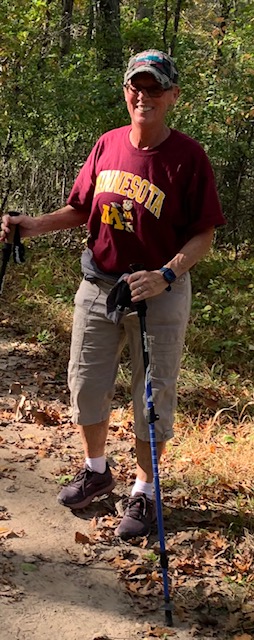
I took a hike today. Hiking is an activity I want to do after I retire on January 7, 2022. It occurred to me this week that I didn’t need to wait until then to research hiking groups. A simple Google search led me to a Twin Cities hiking meetup at Afton State Park on Sunday. 45 people had registered for the hike.

Crystel gave a hearty laugh when she scrolled my Facebook (she was home for the day from college). Twin Cities Bike Club, she chortled. I might do that when I retire, I said a bit defensively. Even though I have an electric bike I can still join, right? Doesn’t Crystel think that I pedal? Just because I put the bike on cruise on for an entire twenty-mile ride on my recent 63rd birthday?

Other activities I’m interested in are pre pre-beginner lessons in pickle ball. The few times I’ve tried the game I awoke my inner Frankenstein as I lurched for the ball. Most often I missed the ball entirely. I’ll also be pursuing writing, classes, reading, travel, and cross-country skiing.

I expected to be fully retired in January, but a recent job offer with minimal hours has altered my thinking. I’m excited about this new job opportunity.

I’ve also recognized an internal shift about the idea of being a grandparent. When the kids were in their teens, I preached, lectured, and cajoled safe sex. Topping it off with a trip to Planned Parenthood on a Christmas Eve. Though I feel the shift, I continue to want grandparenting to be years away. Jody and I were older parents to Juan and Crystel. We can be much older grandparents.

I’ve explored other meetup groups and added them to my profile: Twin Cities Indoor/Outdoor Sports, Minnesota Hardy Hikers, Outdoor Introverts, Outdoor & Snow Lovers, Cross Country Skiing, MN Sierra Club Outings and Intrepid, Fit & Social.

One group put my membership on hold. They required a photo to join. I had Jody snap one of me on our Sunday hike and uploaded it to their site. The administrator requested a new photo that showed my entire face with no sunglasses. She also mentioned that she couldn’t tell by my picture but wanted to give me a heads up that the members’ average age is just over 50. She didn’t want me to be surprised if I was a lot younger than that. I was still welcome to join but it was up to me.

I uploaded a new photo. I hope they can keep up with me.

Beyond Peshtigo

The Great Chicago Fire began October 8, 1871. More than 100,000 residents were left homeless and 300 lost their lives. Help flowed in nationally and internationally to rebuild the city.

North of Chicago, the largest and deadliest forest fire in United States history took place the same day in Peshtigo, Wisconsin. Over 1,200,000 acres (1,875 square miles) burned. The number of people killed can only be estimated because church and government records burned in the fire. Some of the 1,500 to 2,500 men, women and children would never be identified. The fires were so intense that some victims were totally incinerated. 

Many of the Peshtigo fire victims were immigrant farmers and small-town dwellers. Belgian and German settlers bought acres of cheap land to farm only to discover thick forests covered the area. Along with the railroads and timber industry, farmers slashed through the trees and left much wood on the ground. It was not unusual to see several small fires burning. Even ships in Green Bay and Lake Michigan experienced visibility problems from smoke. In 1871 drought dried fields and wood waste. October 8 a cold front moved in and whipped flames from many small fires into a giant firestorm with temperatures of about 2,000 degrees Fahrenheit.

People who hid in their wells or storm cellars died. People who tried to outrun the flames in their wagons or buggies died. Some burned, some suffocated. Others drowned while seeking refuge in rivers or ponds. The flames formed a tornado of fire that tossed buildings into the air. Peshtigo was burned to the ground with only two buildings remaining. Fires burned on both side of Green Bay touching Marinette and stopping short of Sturgeon Bay.

The Belgian Heritage Center remembers the fire each October and the dramatic impact it had on its community. Thick wooded lands were transformed into barren acres. Wooden farmhouses were replaced by red brick buildings. Roadside chapels stood near many homes. 

My Belgian ancestors lived in the Peshtigo fire area. This year I find a strange comfort in the reality that awful fires are not a modern experience but have devastated parts of our country before. Instead of seeing our current wildfires as one more sign that we are heading toward doom, history is reminding me that there can be more living on the other side of disaster. Learning from the disaster to make the rebuilding smarter is the challenge.