My grandparents’ families came from places like Walhain-St. Paul, Incourt, Nievelles, Tourinne-St. Lambert, and Huldenberg in Walloon Brabant, Belgium. Impacted by the same potato famine that brought many Irish to the United States, the Belgians made their way to Wisconsin communities with names like Brussels, Tonet, Namur, Luxemburg, and Walhain. The homes they left had been clustered in an area about forty miles wide. The farm towns they carved out of tree-covered land, almost four thousand miles across an ocean and half a continent, were about the same distance apart.
When I was a child I spoke some Walloon, a nearly forgotten language, with my Belgian-American great-grandmother and her friends as they quilted in our living room. We ate Belgian farm food like jut, a boiled cabbage side dish, stoemp, a mashed potato and cabbage dish, trippe, a bratwurst-type sausage, booyah, a chicken-based soup with many ingredients, and Belgian pie, a sweet dough tart filled with prunes and a cream cheese style top. Our Catholic church held a Kermis celebration in autumn. Beyond jokes about how much Belgians sweat or drank or were short, maybe stout, that’s about what I knew of our heritage. All the amazing accomplishments of the Belgians or their art or chocolates were from a different socio-economic part of the country.
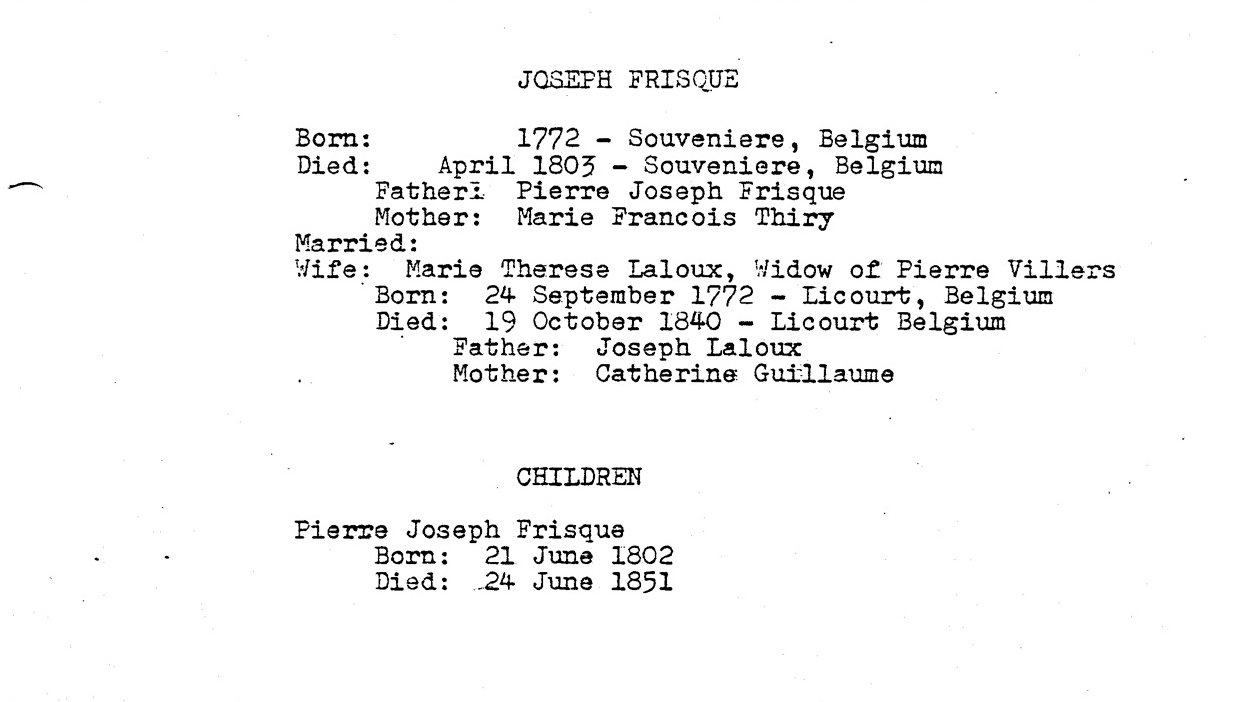
My mother’s cousin and my father’s cousin researched family trees. Through the Frisque genealogy I discovered that my family was related to many, many people in Luxemburg, Wisconsin, the small town where my father grew up and we lived through part of my childhood. The Nockaert family information uncovered that my mother was mostly Belgian although she believed she was German. Names, dates, locations, relations fill pages. That’s it. The Belgian Heritage Center in Namur, Wisconsin may provide information to further the cousins’ research.
The histories of these people, who permanently left all they knew for 40 acres of land and a better future, are probably lost forever. But this summer we are going to visit Belgium, specifically Walloon Brabant, and trace what is left of our Cravillion, Frisque, Nockaert, and VanderKelen ancestors. They were all small farmers who left Belgium in the mid 1850s so there is probably little left of their lives beyond cemetery headstones.
We have nothing physical from their lives in Belgium and little expectation of connecting with other great-great-great grandchildren of the original immigrants. But one can always hope.