Companion for the Journey

Several close friends and I are immersed in the heartbreaking work of caring for elderly parents who are fading.

One friend’s father is growing more and more forgetful. When she asks what he had for dinner, he can’t recall whether or not he ate. But they conclude he must have eaten, because his caregiver would have made sure he did. He’s in his 80’s and his heart condition is responsible for the memory loss. It’s so hard to realize that this man, who had been an incisive school administrator with a sharp wit, can’t recall if he took his pills or not.

Another close friend’s 86-year-old father is very frail and losing the battle with congestive heart failure. He’s thin, weak and his heart and kidneys can’t keep up with the demands of moving blood and removing excess fluid. The sports teams he used to love to watch barely stir his interest now—he’s too tired and worried to care about a touchdown.

My 91-year-old mother has grown more forgetful in the last six months, and she knows it. For years, she could be counted on to manage all of the household and financial details while she cared for my Dad, whose health was deteriorating. Her sister Corinne was also in poor health recently, and Mom helped manage her affairs, too.  Now, however, Mom

Mom, me, Aunt Corinne

relies on extensive notes so she can recall phone conversations, her plans for the day, or what to tell the doctor—not just a list of topics to cover with him, but the logic behind her requests. Today, she’s still able to manage living in her own home with the help of my siblings and me. But who knows how much longer that will work?

My friends and I are all take-charge women. We know how to solve problems and get things done. What’s hard is the realization that there’s little we can do to change the course of events. We can’t “fix” our parent’s health issues—whether memory loss or congestive heart failure. For them, there’s no going back to great health. Instead, we try to slow the decline, help them stay as long as possible on each new plateau.

I’m working on accepting the inevitable. I’m trying to be Mom’s companion for the journey.

I’m doing my best to enjoy Mom while she’s here. So we talk, I give her homemade cookies, I help with household chores when I visit, and when she says, “You know, I’m not going to be around forever,” I look her in the eye and say, “Yes, I know.” I believe it’s important to let her say what’s in her heart and not dismiss her feelings with fake cheeriness. But the moment passes and we refocus on having fun—a good meal, a good laugh, a good memory. A lot of days, that’s enough.

Tooth Fairy

Jody and I are the parents that you hate. Your children might come home from school

Crystel, six-years-old. First four teeth pulled.

one day and ask you why the tooth fairy doesn’t give them a treasure hunt like she or he does for Antonio and Crystel (our tooth fairy is a boy or girl, depending on the tooth).

Oh yes, the kids also get the dollar under the pillow. That comes with a letter. And depending on the circumstances, the tooth fairy might use the opportunity to gently remind them to be nice to their sibling or to thank them for a job well done. The fairy often goes on to explain what the tooth is going to be used for. It could be a doorbell (teeth clanging together make just the right sound), a decoration in a flower garden, or it may join other teeth and line the walkway up to the tiny fairy house. The tooth fairy doesn’t stop there with the toothless child. Before flying to the next house the fairy drops a box of candy – like Sour Patch or Mike and Ike’s – under the sibling’s pillow. I know … candy … right?

Crystel often has her teeth pulled out in groups of four by the dentist. The first time it happened, the tooth fairy felt so bad that at the end of Crystel’s treasure hunt, there was an American Girl Doll that looked like her. Well, not quite. The fairy brought home an Indian American Girl doll that the tooth fairy thought matched Crystel’s complexion but the tooth fairy helper said No way, and the fairy trudged back to the Mall of America and got Josephina, the Latin American girl.

Fortunately, getting teeth pulled is like scheduling a Cesarean. You know when it has to come out.

When the kids started asking me if there actually was a tooth fairy, I asked them whether they really wanted to know. By then, they had a relationship with the fairy. They might leave a letter for her or him under the pillow, asking questions and stating that they wanted to come to the fairy’s castle.

Antonio and Crystel hesitated. The stories that accompanied a lost tooth were so magical. Would the magic disappear?

After the age of awakening (at seven-years-old) when Crystel was in the dentist chair getting her next four teeth out, the dentist asked her what she thought the tooth fairy was going to bring her. “A hamster,” Crystel said. The dentist looked at me. I nodded. A hamster.

Yesterday, eating pasta, nine-year-old Antonio said he lost a tooth. There it was in his hand. I looked up at his frothy bloody mouth. My kids are not known for toying with their teeth. Teeth have fallen out while drinking water.

By now the tooth fairy has gotten old and tired and a bit lazy. I asked Antonio if he minded if the fairy just left him money. “I don’t care,” he said, “As long as it’s a twenty.”

Antonio, 7-years-old.

Parents warned us that whatever the first tooth cost the tooth fairy, the ante would always have to be matched. Jody and I never worried about that. I sometimes feel as if I am experimenting with what love will do for a child. I know that giving presents doesn’t equate to love and you risk having spoiled children. So far, I feel as if we have escaped that. Antonio and Crystel are polite, kind, and giving.

Love Your Public Library

Growing up, my Dad, my sister, and I visited the Sanger library in west Toledo every week. In all my memories, the library is sunny and bright, and I was eager to discover what wonderful stories might be waiting for me. When the pickings were slim, I was actively disappointed, but checked out whatever books I could find. Being without books to read was worse than reading so-so books. To this day, I have stacks of books by my bed and downloaded onto my iPad. If I’m traveling, I need at least three books available to feed my reading addiction and keep my no-book anxieties at bay.

The three of us loved to read and each of us checked out four books (the maximum allowed). In second and third grade, I read through a shelf of orange-bound biographies and met Mary McLeod Bethune, George Washington Carver, Florence Nightingale, Lucretia Mott, and others. I also LOVED Nancy Drew mysteries and tore through them. Later, I learned that Toledoan  Mildred Benson (whose pen name was Carolyn Keene), wrote many of the stories in that series.

By the time I was in fourth grade, I had read all of the children’s chapter books, so Dad arranged with the librarian to let me read whatever I wanted in the adult section. Today, when book banning is rampant in schools, this seems like a surprising decision, but Dad wasn’t worried about what I might find. He once told me that he attempted to read all of the library’s books (he got from the A’s through the G’s), so he understood my need to read. In fourth grade, Daphne DuMaurier’s Rebecca was one of my favorites, and I went on to read all of the DuMaurier books at the library.

At home, our bookshelves may have seemed oddly empty. Although Dad loved reading, he didn’t need to own the books, and so my sister and I learned we didn’t either. As a practical matter, we couldn’t possibly find space for all the books we read. Dad’s philosophy is still ingrained in me. Over the years, I’ve borrowed most of what I wanted to read from the public library, and I’ve bought books as a special treat or if the library didn’t carry what I wanted. I still feel that way, but now I buy books I love in order to support living authors. However, typically I buy them after I’ve read the library’s copy. Weird, I know, but I can’t own everything I’ve read or plan to read.

Today, my relationship with the library is different. I don’t visit in person as often as I used to. Instead, I download ebooks from the library, because I love reading on my iPad (so many books in one lightweight place!). But I am as firmly committed to public libraries as ever. For me, they represent a world of stories and knowledge: garden books about shade plants, novels about China during the Mao’s Cultural Revolution, financial reports of companies I want to invest in, travel guides about small Irish towns. For other people, they’re a source for free computer and Internet access for research papers, Facebook, and job searches.

Today, the Dakota County Library in Minnesota is my home library. While their funding is secure for this year, the Toledo-Lucas County Public Library is facing a 50 percent budget cut if the local levy doesn’t pass this fall. I hope my Toledo friends and family will vote for the levy renewal, so this wonderful resource doesn’t become a memory!

Surprises in San Marcos la Laguna

Every morning I took a photo from our patio of what the novelist, Aldous Huxley, described as, “…really too much of a good thing.” Lake Atitlan takes its name from the Mayan word, “atitlan,” which translates to, “the place where the rainbow gets it’s colors.”

Volcano and lake, height and depth, pointed and vast, cradled me for five nights and six days. I felt taken care of regardless of what was or what would be. 2,895.3 miles from Minnesota, my family and I were home. Jody, Antonio, and Crystel were perceptibly at peace as well.

Antonio and Elizabeth waiting for launch

Across the lake from our suite at Los Elementos, Volcano Toliman rose up with Volcano Atitlan behind it.  Owners, Lee Beal and his wife, Elaine, reinvented their lives in Guatemala. They have been full-time residents of Santa Cruz la Laguna on Lake Atitlan for the past five years. They came to Guatemala looking for a simpler and more fulfilling life and found it on Lake Atitlan. They originally started working with a local nonprofit Amigo de Santa Cruz. Lee now serves on the board of directors. As he and others learned more about the people of Santa Cruz, they realized there was a need for jobs. The CECAP vocational training center run by Amigos helps fulfill that need.
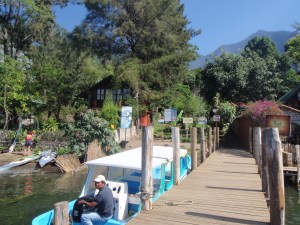
Dock at San Marcos–homemade signs telling us where to go

Lee’s background as an entrepreneur in the horticultural field gave him the experience and basis to introduce a new cash crop to the area. He has developed a Vetiver Grass program, which is a good fit with the agricultural culture of the local people. This is a multi-year program that will not yield profits for 3-5 years, but will make an impact in the long-term. Lee and Elaine wanted to expand on the idea of creating new jobs, and from this idea grew Los Elementos Day Spa and Los Elementos Adventure Center.
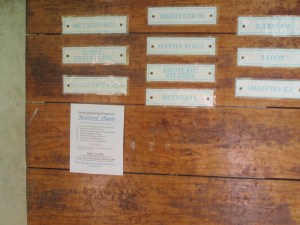
Classes available on San Marcos

Elaine has trained over a dozen local women to do manicures and pedicures and has trained three women as massage therapists. Each of these training programs offers the women employment opportunities that would not have been available to them otherwise.

Lee developed a series of tours, hikes, kayak excursions, rock climbing, and cultural sharing opportunities through Los Elementos Adventure Center. He has been employing two local guides trained through INGUAT on some of the tours and have been training a dozen local youth to develop the skill sets needed to be a guide.

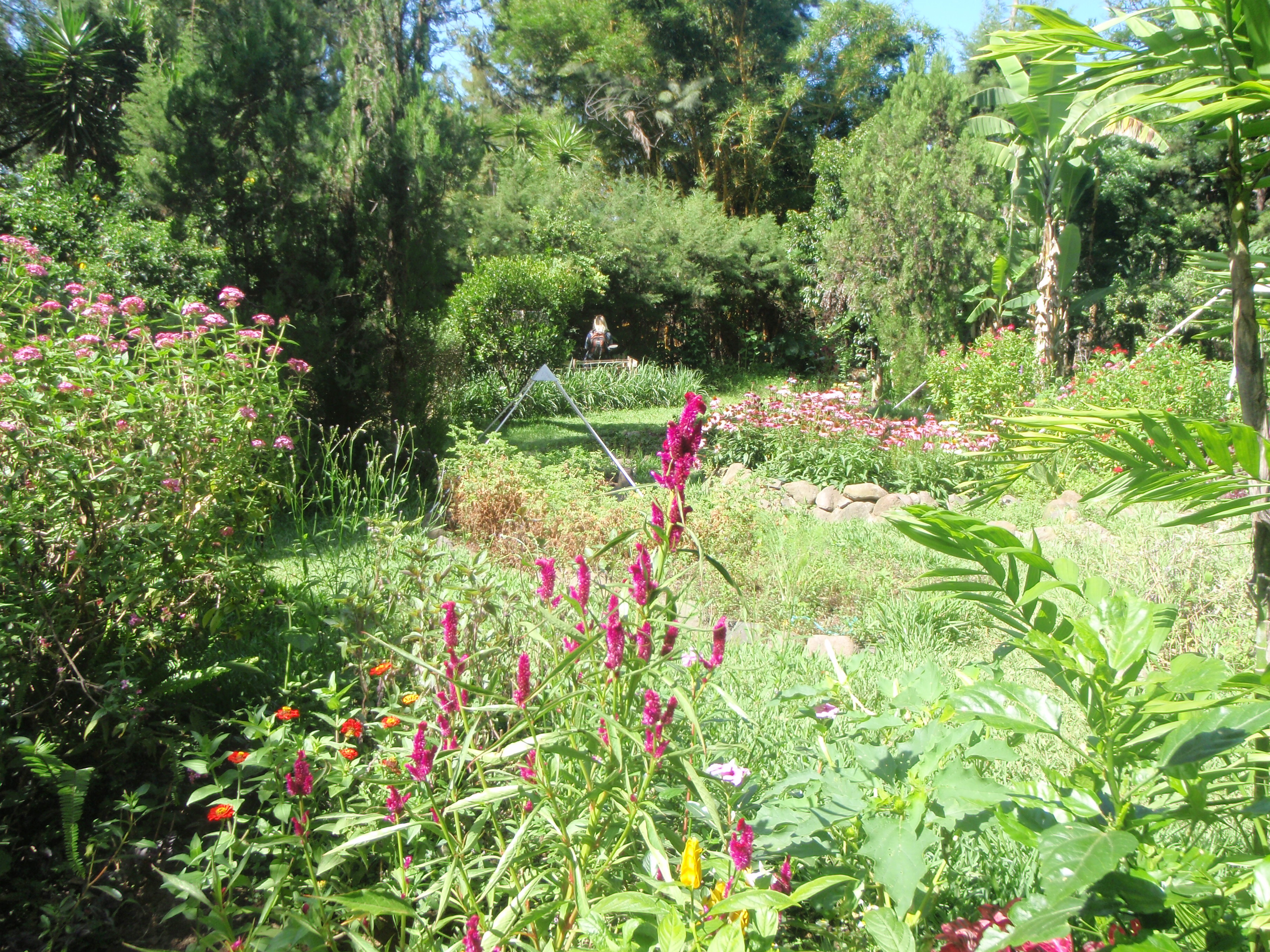
Medicinal and curative garden

Accompanying us to San Marcos la Laguna was Zach, a 14-year-old adventure “guide in training” who was staying with Lee and Elaine. Zach’s personal story is similar to Antonio and Crystel’s. He was born in and adopted from Guatemala, he met his birth family for the first time last year, and he returned to Lake Atitlan and Los Elementos as an intern. It was our good fortune that Zach would be our guide for much of our stay. Antonio and Crystel had someone ‘just like them’ to hang with.

Lee had arranged our day for us. We were picked up at his dock and ferried twenty minutes to San Marcos. The waters were calm on Lake Atitlan as they usually are in the morning. They don’t kick up until noon. This surprising turn-around is known as the Xocomil winds.

Medicinal and curative garden

Stepping onto the shores of San Marcos is walking into New Age. Signs greeted us touting Astral Traveling, Metaphysics, Kabbalah, Tarot reading, Reiki and more. The village has several meditation, yoga, and massage centers. Walking up the foot path to the main center, Lee pointed out medicinal and curative plants and elaborated on their use and origin. Banana, coffee, and avocado trees blended with the landscape.

Mayan calendar

Next to the walkway was a wall with beautiful colorful paintings including a Mayan calendar.

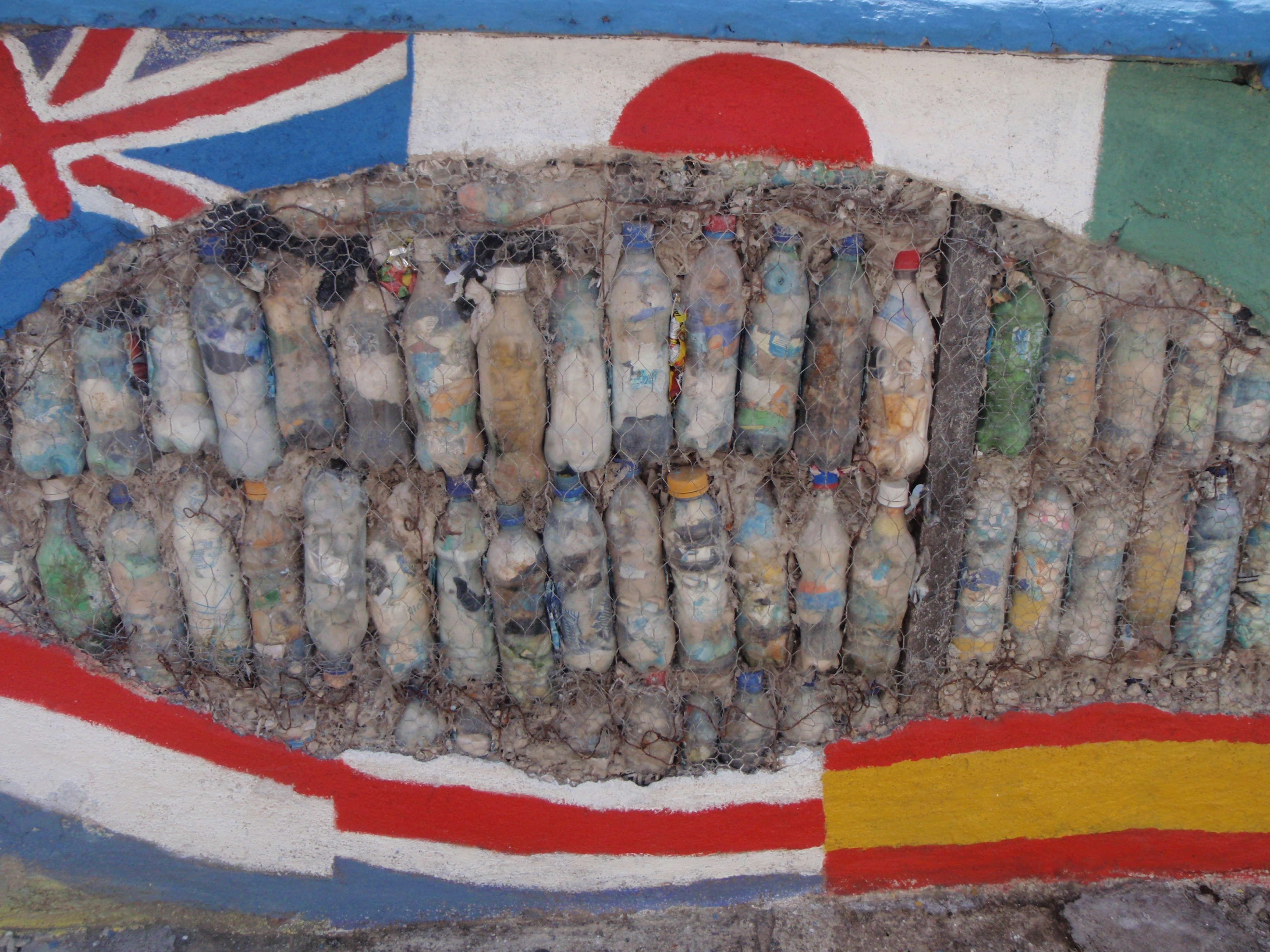
We came to a wall on our right made of plastic bottles. Project Pura Vida or what I call the bottle project finally made sense to me. The evening before in their home, Elaine had shown me how she was putting plastic trash in a bottle. She had a stick she used to compress the waste. But it was the moment that I saw the wall in San Marcos that I understood what she was doing.

The bottle project – Pura Vida

The bottle of trash would be joined with other bottles and become a wall for a home. In more technical terms, the construction technique consists of stacking thousands of bottles between a shelter’s wooden supports, holding them in place with chicken wire, then applying concrete to create what looks like a typical concrete wall.

Close-up of construction

The walls are cheaper than those built with cement blocks, which is the material typically used in low-cost construction in Guatemala. The plastic core also makes the walls more flexible—and thus less dangerous—than block walls in the event of an earthquake.

Pura Vida began in January 2004 as a pilot project in San Marcos to solve the local problems of garbage.

Walking towards path that will lead us to cliff jumping

One of Lake Atitlan’s greatest attractions is the cliffs of San Marcos. Our group headed towards a dirt path that led up the side of the mountain when a very large sack fell out of the sky and hit me on my head. After I straightened up and shook off the shock, Lee explained that the locals unloading a truck were looking at me and not where they were throwing. I have often told people I need to be hit on the head to get the message, so it was kind of funny in a spiritual sort of way. Still, I missed the esoteric message that was divined for me.

Zach, preparing to jump

The sack incident was not on anyone’s mind a short while later when we were standing on a diving platform three stories above the cool waters of Lake Atitlan. We quickly determined that Zach should be first to jump. 

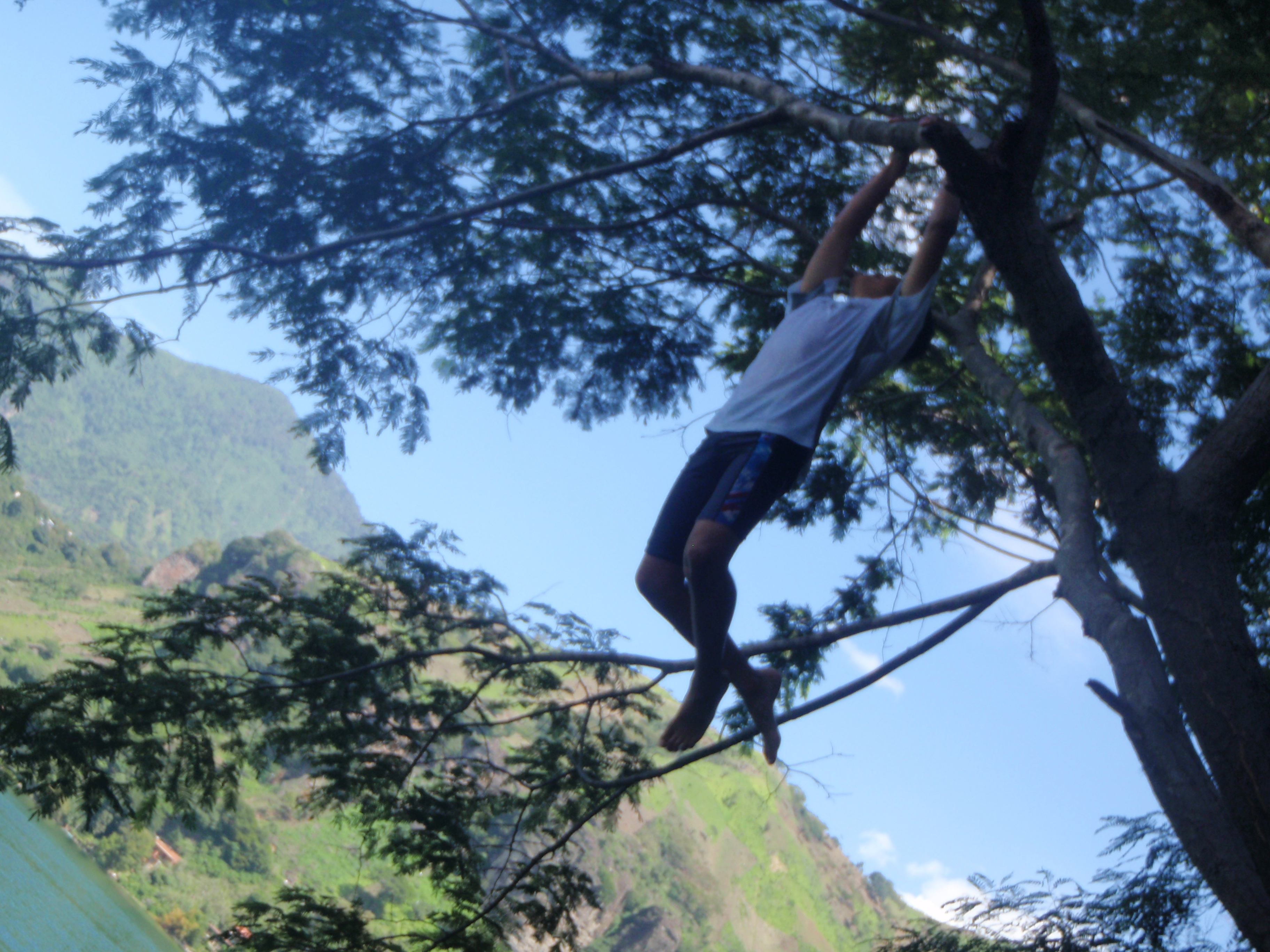
Sometimes all it takes is one. If that first person can make it safely through an adventure, then we figure it will be okay for the rest of us. I wasn’t any stranger to cliff jumping, having jumped and dived off the cliff at Spring Valley dam in Wisconsin when I was a teenager. Still, it was frightening. My heart went up, my body went down and that feeling didn’t dissipate on any of my next jumps. The kids kept telling me to do a pencil dive. I screamed and waved my arms crazily instead. Lee pointed out a tree that hung out over the water to Antonio. Without hesitation, just like at home, Antonio scampered up the trunk, inched out on a limb, and swung off into the water. He did this over and over and over.
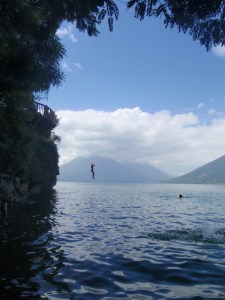
Elizabeth not doing a pencil dive

Later, I asked Antonio and Crystel which was scarier, meeting their birth moms, or jumping three stories off of a cliff. In unison, they said, meeting their birth moms. The bar was set. Their world had opened up. From the moment they met their greatest fear, they leaped beyond their nine years.