Category: Legacy

  • Mom’s Inspiration

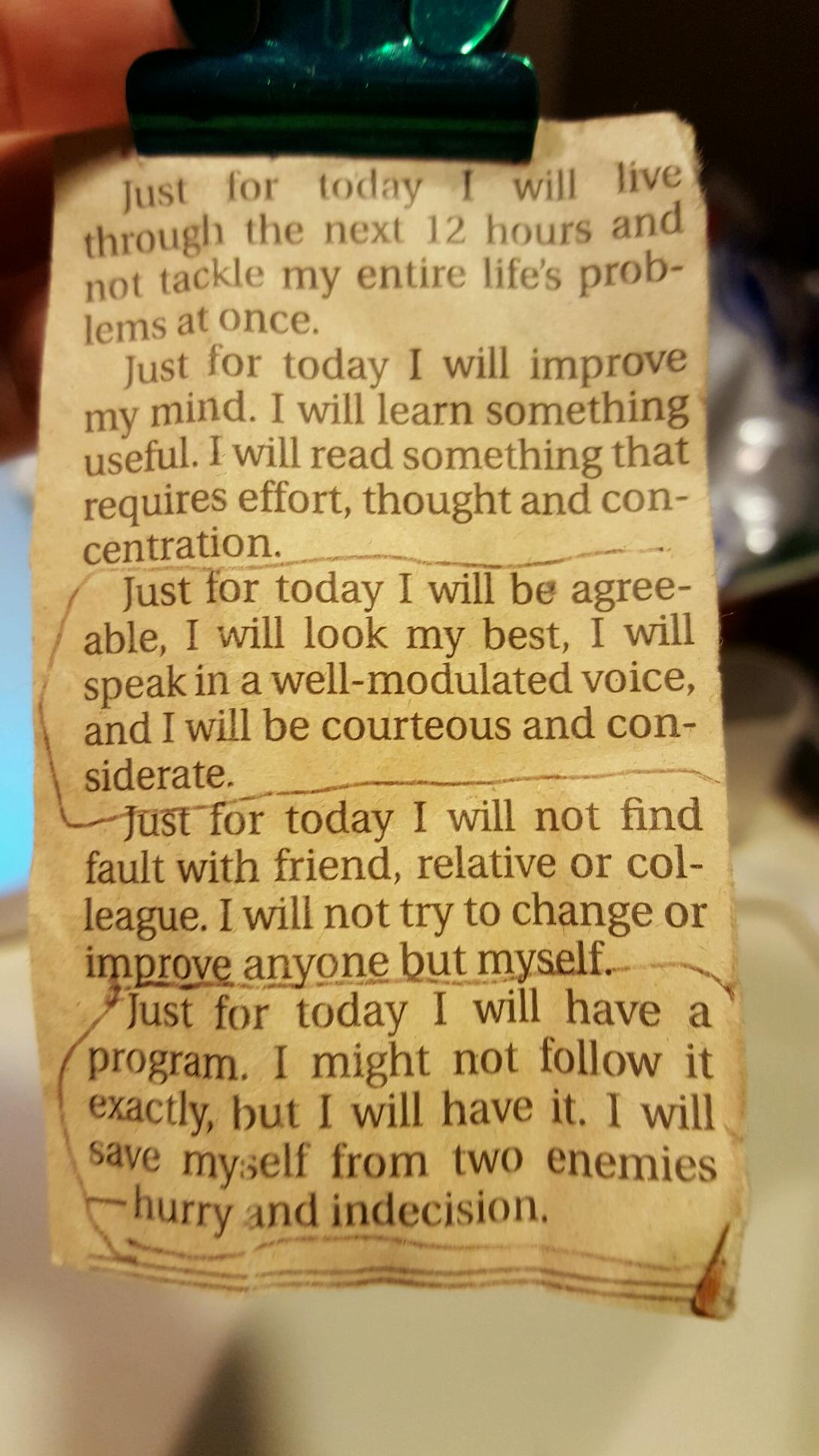
    For years, my mom had a clipping stuck on her refrigerator with a magnet.
    moms-resolution

    Although it was in a semi-public place, the clipping was a private message for her, not a directive for the family and friends who might see it.

    Mom knew she’d be in and out of the refrigerator numerous times a day. She probably hoped that by putting the clipping right there she’d be forced to notice it. At least once a day, she’d really see the words and be reminded of her intentions. Every day, she could rededicate herself to the effort of becoming her best self.

    As a visitor, I saw it often but never thought too hard about it. They were her goals, not mine, and Mom wasn’t in the habit of preaching about her values or goals.

    But when the clipping turned up in a box of Mom’s things that my sister had saved, I realized how much her example has influenced me. I, too, regularly rededicate myself to the effort of being my better self.

    I make New Year’s resolutions (often the same ones about health and writing – they’re still good, because I frequently stray from my goals). Throughout the year, I also take stock and evaluate whether or not I’m living the life I want to live. For example, I might ask myself: Am I too bizzy with household tasks that don’t matter? Am I letting other people’s agendas overtake my own? Can I be more tolerant and easygoing and let go of irritation faster? Am I pushing myself creatively? And more.

    My refrigerator is bare. Unlike Mom, I keep my resolutions and inspirations in journals or in the Notes app on my phone where I see them often. When I reread my intentions, I’m pleased to see that I’ve followed through on some. Others, not so much. But I’m easy with myself – effort counts. I’m a work in progress and I just need to keep trying.

    Mom’s clipping lists five goals. I love that she circled the two that were most meaningful to her. As her daughter, I can tell you that most days, she nailed them.
  • The Nature of Being an Aunt

    As a child, I didn’t think deeply about my aunts and uncles. They were a kindly presence at family gatherings, people who smiled at me, asked me about school, sent birthday cards, and gave me first communion and graduation gifts.

    I recently saw my 10-year-old grand nephew. If pressed, he might recall that we had fun exploring a nearby creek and that I gave him Halloween candy, but I wouldn’t expect him to know more about me than that. I didn’t know much about my aunts and uncles when I was 10 years old either.

    When I was a child, all I knew about Aunt Corinne was that she didn’t have children of her own, but she was fond of her nieces and nephews. She and Uncle Bob always gave us treats when we visited—cookies or candy from the stock Uncle Bob used in his vending machine business.

    When I became a mother, I suddenly got it—I saw how much my brothers and sister cared about my children and in turn how much I cared about theirs. The connections between us are strong.

    Aunts and uncles are part of a whole circle of people standing behind a child. We’re interested our nieces and nephews’ activities. We know this one is a sprinter, that one is good at hockey, another one loves theater. We’re concerned about their problems—this one got laid off or that one is going through a breakup. We’re pleased about their accomplishments—this one won a prize at school and that one is getting promoted at work.

    When things are going well, we’re more in the background, but if something happened to one of our siblings, we’d come forward to help out.

    Aunt CorinneI gained new appreciation for my aunts and uncles, especially Aunt Corinne, who would have been 90 on her birthday a few weeks ago. As an adult, I understood more about her life. She had systems for running her household and was meticulous about details. For example, her address book was always up to date and she kept her coupons in an organizer. She worked full-time as an office manager. I can imagine her as an organized and competent worker. She was also a sympathetic listener and seems like the sort of person who would have brought baked treats for her coworkers.

    I’m glad I got to know her well enough to discover what we had in common—she liked NPR and cared about politics. She was funloving and always willing to go out to lunch, to a show, or to travel. She was as particular about coffee as I am. If it’s warmed over, we would rather skip it. Only when I was middle-aged, was I able to talk to her woman to woman. Then I could ask about her health or we could share insights and concerns about family members.

    Because I live hours away from my nieces and nephews and don’t see them often, they don’t know me very well. They would probably be surprised at how much I know about them. But I’m observant. And your parents talk about you! My nieces and nephews may never know how much love and support their aunts and uncles have invested in them, but being a secret supporter is a pleasure. If our relationships deepen as we get older, that will be a gift, too.

    Who knows? Maybe twenty years from now at some family gathering, my grand nephew and I will discuss politics or the books we’re reading!

  • Treasure

    Before we went to Italy I photographed all the jewelry I’d really miss if it were stolen. Some of the pieces have street value, but most of them are keepsakes and their associations are what make them valuable. My childhood charm bracelet with the teeny orange crate. Mom’s matching sweater pins with the blue, rose and yellow rhinestones. A cameo necklace from my grandmother. Rings from my sister and my sons.

    IMG_0447I felt paranoid and silly, but took the photos anyhow. Two friends have had jewelry stolen while they were away from home. Because they didn’t have photos, their insurance companies couldn’t value the items and the police couldn’t identify the jewelry if they found the stolen property.

    If my jewelry were stolen would I be comforted to get it back? Probably not. The simple joy in wearing the earrings, rings, and bracelets is that they’re pretty and I like thinking of the people who gave them to me. If they were returned to me after a theft, that event would distort my feelings about the pieces.

    My impulse to treasure keepsakes is misplaced. Regardless of whether or not I possess the jewelry, I will have the memories of the occasions and the people who gave them to me.

    What I really want is to protect what is irreplaceable. If only the police could show up at my door and return all of the people I lost last year: Mom, Aunt Corinne, Uncle Jim, and Uncle Rocky.

    I am rich in memories but still making payments on how to accept impermanence and loss.