Category: Family

  • Why Get Married?

    Why Get Married?

    P8100024-1-2reducedJody and I are asked that question. Maybe we were asked that because we were married 12 years ago in our backyard. And that person thought that celebration was perfectly fine so why do it again?

    The question made me stop and think. Why was getting married on August 10, 2014 important to me?

    A myriad of reasons.

    The most significant is that getting married made me feel legitimate.

    Regardless of your political leanings my not being able to be married as a same sex couple and having the same lawful standing as my heterosexual neighbors is as close as I can get to how illegal immigrants in our country must feel.

    You always stay a little hidden. A little under the radar. Don’t make waves. Someone might not like your relationship, your family and you will be discriminated against.

    Discrimination is undeniable.

    P8100031-1reducedToday I feel seen. I feel valid. I feel rightful. I have a partner. And her name is Jody.

    This blog isn’t a political rant. Jody and I aren’t activists. We’ve quietly lived our lives as a couple on our cul-de-sac, with the same ups and downs, the same challenges as all couples. We have two children. We worry about them as you do yours.

    Often we’ve had our children’s friends and parents over to our house to show how normal we are. Antonio was in Scouts and I was a den leader; Crystel in Scouts and Jody a troop leader. Antonio in soccer. Crystel in dance. All of us active in Tae Kwon Do.

    Being a Police Reserve Officer I always hoped that ‘badge’ carried a little bit of weight when we were being sized up as a different kind of family.

    P8100034-1reducedI hoped people saw us as safe even though we were a same sex family.

    Jody and I never thought that same sex marriage would be legal in our lifetime. And, I’m not sure that either of us cared. We were going to do what was right for us and protect ourselves by having a will, power of attorney, assigned beneficiaries, second parent adoption, and the same last name.

    12 years ago, August 10, 2002 flowers had opened to their utmost bloom and spread their green leaves their widest. Bees darted for nectar, dragonflies with iridescent wings dropped to the swimming pool for a quick drink. Butterflies watched from the fringes of the yard.

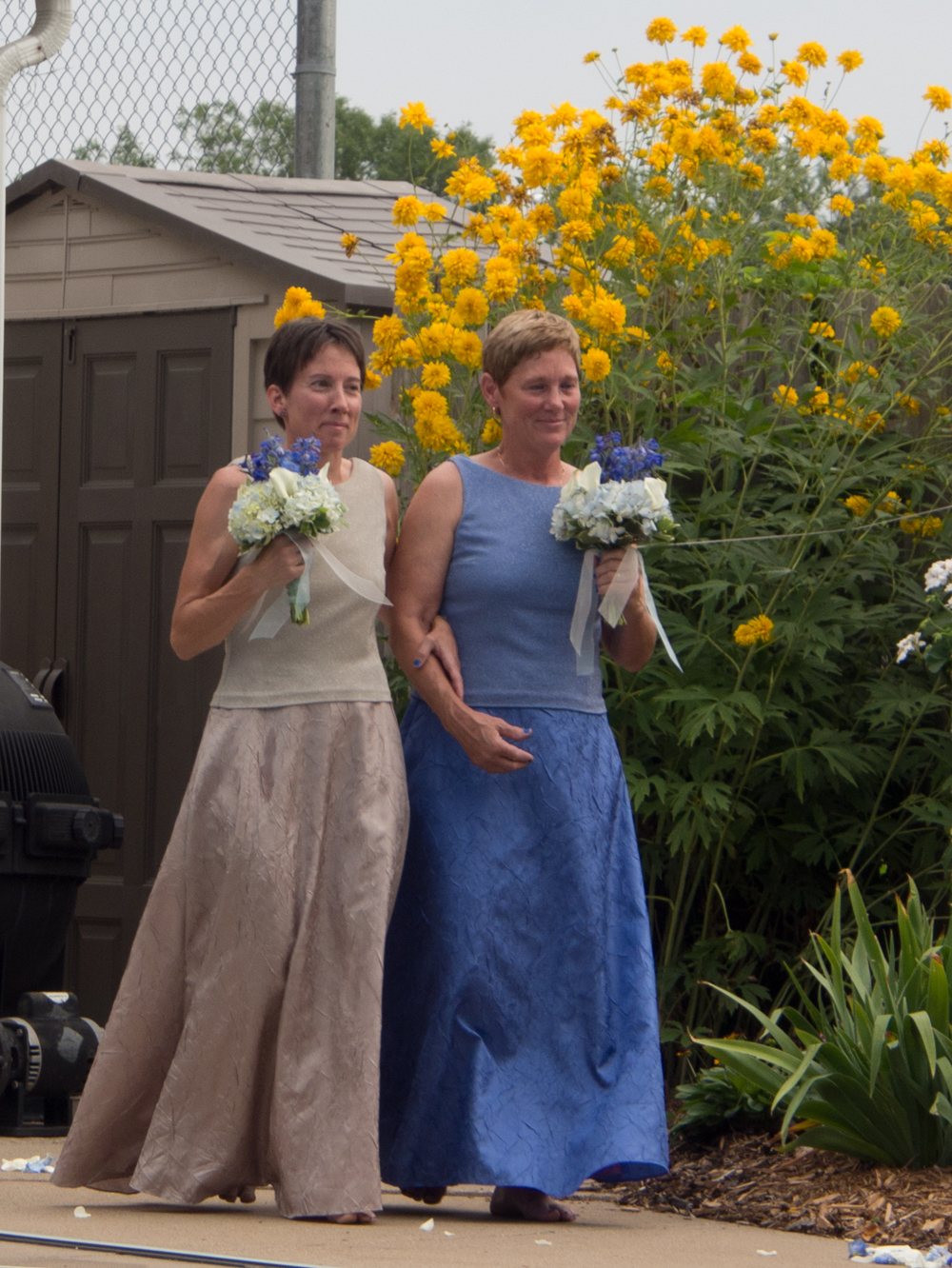
    P8100020-1reducedMy wedding dress was sky blue, sleeveless, floor length, with a swoop back. It brought out the blue in my eyes and matched my toenails. Jody’s dress had the same design, and was champagne.

    P8100021-1reducedMy niece, Jenny, was our flower girl, laying rose petals along the pool where we walked to the gazebo for the ceremony. Barefoot, we felt the softness of the roses.

    Aunt Jo, my mother’s sister, an ordained minister, performed the Holy Union ceremony.

    75 friends and relatives surrounded us while I told Jody, “I take you as my life companion. I pledge to share my life openly with you – to speak the truth to you in love. I promise to honor and tenderly care for you – to cherish and encourage you – through all the changes of our lives.”

    And she, in turn, said the same to me.

    155999_10204865713428150_1746575820117958063_n[1]12 years later, August 10, 2014 we did it again.

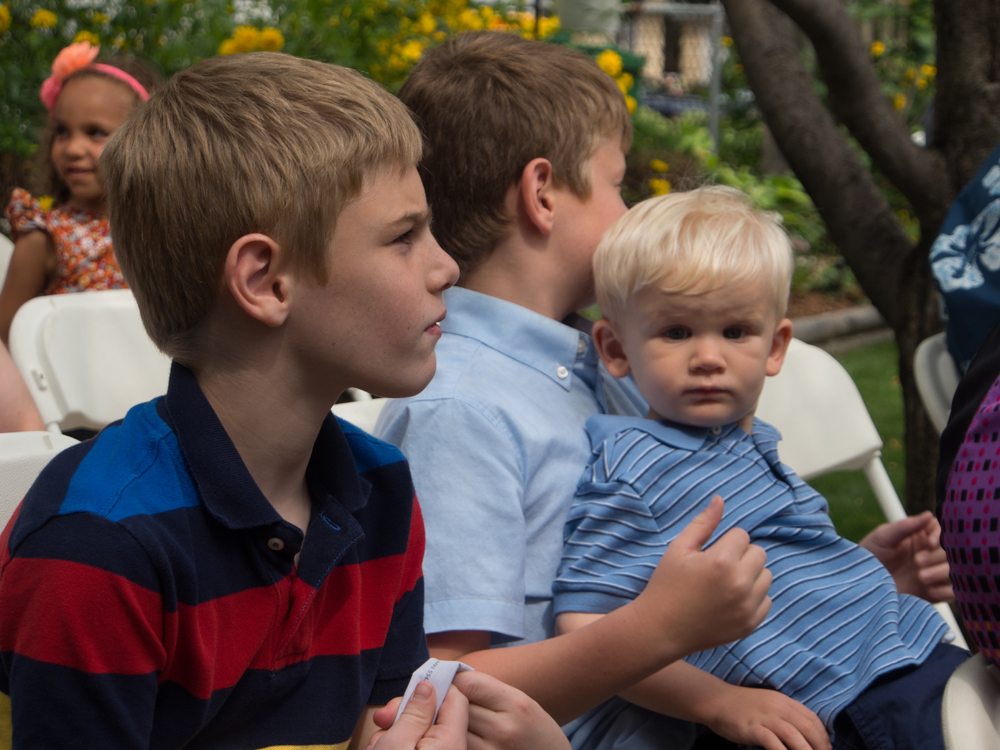
    But this time 150 friends and relatives surrounded us, our lives having grown twice as large because of our children and because we ourselves had grown.

    Crystel was our flower girl and best lady. Antonio our best man.

    Our Officiant was Minister, Judie Mattison. Butterflies and dragonflies once again danced among the attendees.

    And when “All of Me” by John Legend played and the words, Love your curves and all your edges All your perfect imperfections Give your all to me I’ll give my all to you, Jody and I held hands, rotated in the gazebo and slowly turned to face all of you- – –

    P8100136-1reducedMy mother-in-law, sisters and brother in laws, aunts and uncles, nieces and nephews, fellow writers, Tae Kwon Do peeps, school and work friends, friends from long ago, and next door neighbors.

    Then right before the ceremony ended we rotated once more and breathed in your good wishes and blessings to the music of Gloria Estefan. If I could reach, higher Just for one moment touch the sky  From that one moment In my life I’m gonna be stronger Know that I’ve tried my Very best I’d put my spirit to the test …

    and we came out of hiding.


  • Writing Memoir Is Risky Business

    Last fall I finished revising my memoir manuscript, BRAVADO AND A SKETCHY VISION LED ME HERE, and I shared it with several friends and family members before I started seeking a publisher. All of them were familiar with the basic premise of the book: it’s a coming-of-age-in-the-workplace story that takes place in 1979-1980. As a young woman, I was unsure about how to apply my feminist principles to my own life—What did I believe? How far was I prepared to go in pursuit of a career? How much did having a relationship and a family matter to me? If I wanted all three, how would that really work day-to-day?

    Sharing the manuscript is scary. I’m exposing my personal life. To judgment – (Your life is boring. Your experiences don’t matter.) To criticism – (The writing is amateurish. The book is poorly written.)

    Writing about my own life means I’m also writing about friends and family in my life. Real risky business. They didn’t ask to be in my book or become part of my creative project. They may resent the intrusion. Hate how I’ve characterized them. Even if I don’t intend to, my words can hurt people.

    There’s a risk that my family won’t like what I’ve written. A risk that goes beyond embarrassment or irritation about the portrayals. More like – “I don’t care for memoirs—all that emotional stuff. I’d rather read a spy novel.” OK, I can handle that. Tastes vary. Vampire novels may be great stories, but they don’t appeal to me.

    But if someone dear to me said, “I’m worried that although I love you, I might not like your writing,” that would be hard. I’d have difficulty separating my relationship from my craft, which is my passion and my life’s work.

    I’m exposing my innermost thoughts. Often they’re innermost for a reason—sometimes because they’re painful. Embarrassing. Unworthy. Or stupid. As a writer, I’ve learned that the painful and embarrassing moments are most worth exploring—they’re most likely to yield the material that others really connect with.

    The story I’m telling is only as good as my craft. As a memoirist, I use my writerly skills to shape the stories I tell. I decide which incidents, feelings and insights will create a story arc and which are extraneous details and better omitted. I use my powers of description, write dialog, and mine my memory for details. I’ve learned to check facts instead of trusting my memory (The lecture happened in February, not November as I recalled) so I can present a scene as accurately as possible. My skills or shortcomings as a writer determine the value placed on my memoir.

    Why take that risk? Some memoirists write in hopes that they can teach others. That’s not what motivates me. Instead, I hope others will recognize something about themselves – “That frustrates me, too.” They’ll enjoy a moment of reminiscence – “OMG, that happened to me!” Or they’ll realize that they’re not the only one – “Wow, I’ve thought that, too.”

    Despite the inherent risks, I examine certain periods of my life to find and share meaning. My experiences are worth writing about, not because they’re mine, but because they’re human and other people will see themselves in some of the central truths of my life, even if the particulars differ. For example, other working women have worried about pay and workplace politics. Today, some young women still wonder about how to balance a relationship with a career, just as I did. Other middle-aged women are looking back and considering their legacy.

    If you write memoir—what makes it worth the risk?

    If you read memoirs—why do they appeal to you?

  • Lessons from a Life

    This week, guest blogger and WordSister Brenda van Dyck continues our meditation on fatherhood.

    Finally it happened. Father’s Day came and went, and instead of feeling sad, I was grateful. Every June in the eight years since my father died, I have met Father’s Day with dread; the day was an annual reminder of what I no longer had. But this year, I found myself thinking more of my five-year-old daughter and what my dad can still teach her.

    My daughter, Shelby, was born three years after my dad died. He was 41 when I was born; I was 41 when I gave birth to my daughter. I think that’s as far as the similarities go. For him, I was the fourth child to come in the four-and-a-half years since my oldest sister was born (yes, that’s right, four kids in four-and-a-half years). For me, the birth of my only child was a much sought-after and anticipated event.

    Brenda and Shelby
    Brenda and Shelby

    In the months after Shelby was born, I mourned the fact that she wouldn’t grow up with my dad around. He was grandfather to nine others before her, and in many ways, he was a better grandfather than father; without the responsibility of having to provide for his grandchildren, he was more relaxed, more playful, and more able to enjoy them without worry. She wouldn’t experience his sense of humor, gentle teasing, or steady presence.

    Despite his absence, he can still teach her things.

    My father was stubbornly stoic—a man of few words and even fewer expressions of emotion. He wasn’t one to give advice. But he taught me a lifetime’s worth of values, not from what he said, but from how he lived.

    Here is what I think he would say to her.

    Work hard and you will overcome your struggles. There is always value in working hard. My father only had a primary school education; he grew up in a village in Yugoslavia where more schooling than the basic Catholic primary school was a luxury that few families could afford. When he was 14, my father moved to Munich during World War II to become a baker’s apprentice. In the long trajectory of his life, he would live through the war, immigrate to another country, learn how to fix mainframe computers, and retire from a steady career working for Control Data. He made the American Dream his own.

    You are not a victim of your circumstances. Despite what you witness, despite what you live through, know that you will live through it. My father didn’t like to talk about growing up poor or living through the war. He didn’t say much about his father, who died when my dad was 16. There was certainly a lot of pain in his life. And while he was not given to emotion or affection, the hard times of his life shaped him into a man who was strong and quietly compassionate.

    Four kids in four-and-a-half years
    Four kids in four-and-a-half years

    Family is the glue that will keep you together. Family will help you keep perspective on what’s really important. My father’s immediate family, consisting of my dad’s parents, three brothers and two sisters, was broken up by poverty and war. After my father was about 12, the family never lived together again because of various circumstances. But when my father came to the United States, joining an aunt and uncle and their children in a small house in the east side of St. Paul, he finally experienced the family life he had longed for. It gave him the semblance of a normal life at last. He would go on to meet my mother and raise four children in a very conventional and blessedly uneventful way. And they created a solid footing for the next generation to come.

    Don’t be a phony. If you are overly concerned with what people think of you rather than being a good person, you’ve got it wrong. My dad could always spot a phony, and he wasn’t shy about showing his disdain for those who spent more time trying to appear to be hot stuff rather than being authentic. He wasn’t impressed by wealth, and was even turned off by it, but he was more impressed with authenticity, kindness, and respect.

    Parents love you the best way they know how and they aren’t perfect. They will disappoint you, hurt your feelings, and even fail you. Learn to forgive them for their shortcomings, because it will make you who you are. There are many things I wish my father had done differently. I wish he’d been more communicative and more nurturing for starters, but I know that he did the best he could. And what he did do in providing a stable home, was pretty darn good.

    Be responsible and dependable. Do what you say you’re going to do and be the kind of person that people can count on. My father was reliably on time. If he said he would do something, he always followed through. I hope that I have inherited that quality from him.

    Lastly and maybe most importantly, leave those around you better than when you found them. Through your love, your gifts, and your efforts, make this world better. Do right by your family and friends and the rewards will come back to you. This, in essence, was my dad’s life. It’s what he did for me, and it’s what he has enabled me to do for my daughter.

    Brenda van Dyck is a writer and editor who lives in Minneapolis with her family. She writes memoir and essays, bolstered by her WordSisters since first joining the writing group ten years ago.