Category: Family

  • To parents of college-bound kids


    Whether you’re taking your first or your last child to college this fall, my advice is, “Hang in there, you’ll all be OK in a while.” I’ve done both and lived to tell the tale.

    But admittedly, undoing all the underpinnings of daily parenthood is a very odd process. You’ve spent nearly 20 years building the structure of parenthood—teaching them to dress themselves, holding them close when they’re sick or sad, cheering the speech they give and the goal they score, nagging them about homework and chores, worrying about their friends and who’s driving—but now you’re supposed to quickly dismantle all that daily caretaking. You’re supposed to gracefully move into the next phase—occasional bursts of intense parenting—which is what being the parent of an adult consists of. I almost wrote “parent of an adult child.” That paradox explains how weird it is to send a young adult out into the world. Your son or daughter is and isn’t an adult, is and isn’t a child, but you’re always a parent. Sigh. It’s confusing.

    Becoming a parent was a major adjustment for me, even though I’d longed to be a mother and was delighted when I became pregnant. Learning to share my body and change my eating and drinking habits—more protein, less junk, no caffeine, no alcohol—was hard but worth it. Assuming the role of responsible parent was even harder. I always had to think about someone else and bring the equipment he’d need—food, diapers, pacifier. I had to learn to plan ahead, make sure there was gas in the car and money in my purse—no more flying by the seat of my pants when I had a baby with me. Staying out partying didn’t make sense anymore when we had to drive a babysitter home late, and I’d just have to get up with a baby at 6:00 a.m.

    Soon I became accustomed to being responsible and it no longer felt like a sacrifice. Soon it was second nature to put the kids first—making sure they got fed something relatively nutritious before they got too cranky, scheduling my plans around naps and bedtime at first, and later, around homework and extracurricular activities. Juggling work, daycare, and the kids’ schedules. My life was crazy-bizzy, but good.

    When my kids were young, the biggest challenge of parenting was having the stamina to do it all. Later, the challenge became thinking through the best way to handle a kid’s emotional and moral development—teaching them how to handle mean kids, how not to be a mean kid, deciding how long they needed to keep practicing something they weren’t good at, teaching them how to be their own person, how take care of themselves, how to take care of others, and so on.

    By the time my kids were teenagers, I could hear the warning bells—ACT tests, talk of colleges, college visits. I knew their departure was coming, and I knew it was how their life was supposed to go. But it was hard to wrap my head around the reality of them leaving. These people I love so much, who have been the center of my life, are really going? I could hardly bear to think about how big a hole they’d leave in my life, and yet and I had to help them go, because that’s what was right for them. Occasionally they were annoying, so was easier to think of letting them go. It helped to remind myself that the goal of parenthood is to raise a person who’s capable of being independent, that I should measure my effectiveness as a parent by their ability to be OK without me—but after nearly 20 years of worrying about them daily—well, old habits die hard.

    But each of our sons left and I lived through it.

    Soon I learned that they still needed me but in a different way—not daily, but occasionally, in intense spurts. Their problems were harder—how to deal with all the drinking in the dorms, how to handle roommates who wreck your stuff and are late with the rent, how to find the right career path.

    My husband and I lived through a number of jangling adjustments: from being alone to having them back, from being delighted to see them and their friends to wishing they’d pick up the pop cans and pizza boxes, from acknowledging their independence to setting ground rules for the courtesies a house full of adults needs.

    They have turned into adults I genuinely like and enjoy as people. I have turned into a mom who rarely says, “It’s supposed to be hot/cold/snowing, don’t you think you should wear shorts/pants/a jacket?”

    In fact, I’ve gotten so used to my youngest being gone, that the night before he returned to college this year, to my profound embarrassment, I forgot to cook dinner. I don’t mean I neglected to cook a special goodbye dinner, but I didn’t remember to cook any dinner whatsoever (bad Mommy). So we ate nachos, leftovers, and frozen pizza. And it was fine. Because now we’re all adults, and I don’t have to be in charge of meals. 

    But my youngest still welcomed the box of cookies I stayed up late baking the night before.
     

  • A Ring, Not Such A Simple Thing

    It occurred to me on my drive to work that this was going to be Jody’s 50th birthday. I hadn’t come up with an idea for a present but I was happy that I realized it was her 50th.  The significance of her birthday suddenly hit me. Her 50th birthday!

    I was grateful that the significance of this milestone occurred to me, because often significance could hit me on the head and I still might not get it. I have a very good friend that knows this about me and she checks up on me around Jody’s birthday and our wedding anniversary.

    I was pleased with myself. I had thought of the significance all by myself and I still had a few weeks to come up with a SIGNIFICANT present.

    Jody’s birthday is around Mother’s day. Maybe that is where I got the idea that a bracelet or necklace with all of our birthstones would be nice.

    Crystel, our nine-year-old daughter, was with me at Jared’s. Antonio, our other nine-year-old was across the parking lot at SchmItt’s for his drum lesson. Crystel and I only had a short amount of time to make a decision before Antonio’s lesson would be over. While I was looking at bracelets with the personal attendant, Crystel was examining rings. She called me over and pointed out a ring that she liked. I thought about it. The ring could have the number of stones we needed and Jody was more apt to wear the ring all of the time.

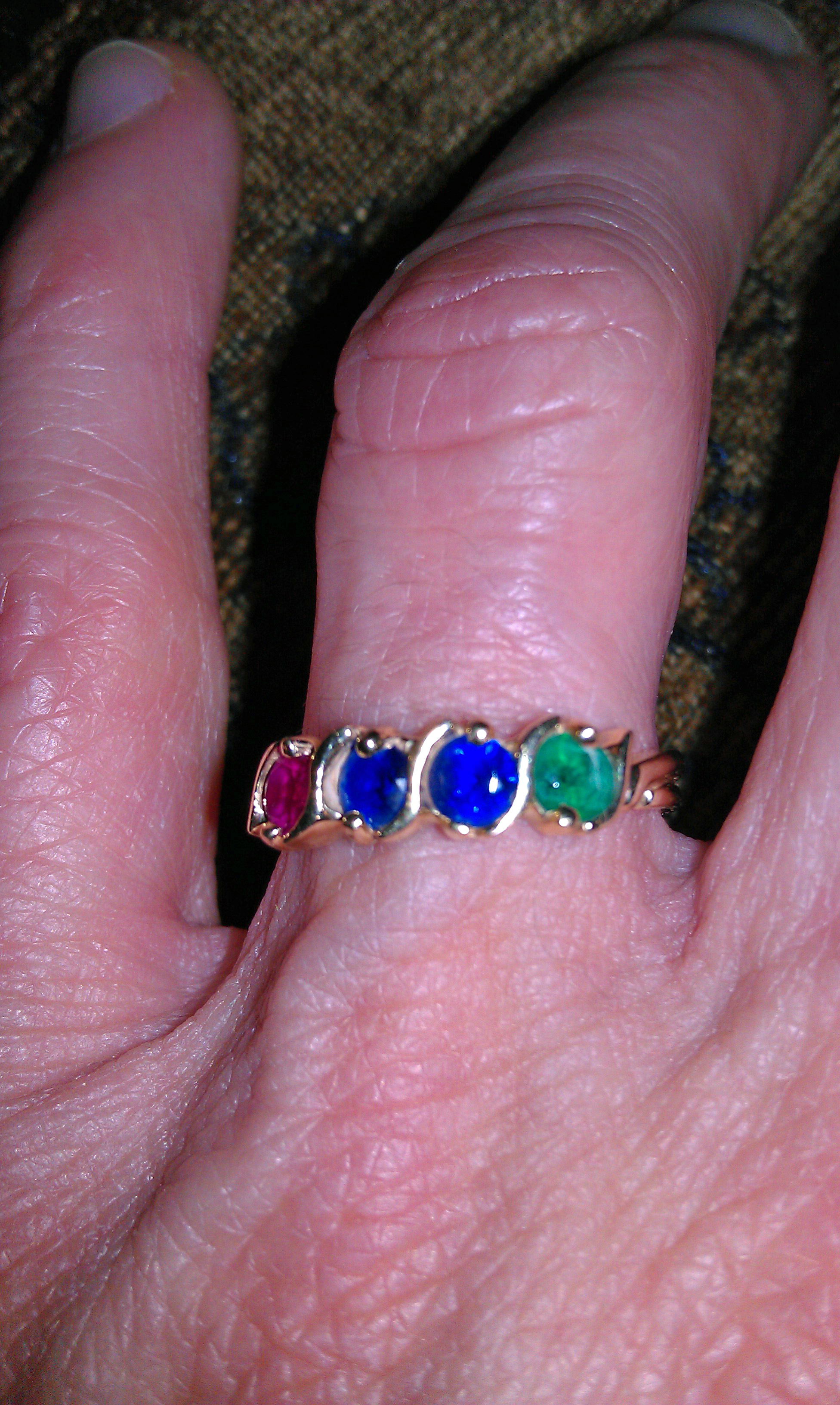
    I changed course and had the gal price a ring for me with an emerald, ruby, and two sapphires. When it came time to decide the order of the stones I asked Crystel. She said the emerald, two sapphires, and then the ruby. I thought her order would be good. Jody being a sapphire would be next to each child depending on what sapphire the kids decided Jody was.

    But … the next few days I puzzled over the order of the stones. I had an unsettling feeling. Jody was Emerald, not Sapphire. Antonio was Ruby. Crystel and I were Sapphire. Crystel’s order put Sapphire next to Emerald. Now on the face of things this is no big deal. But, symbolism is very important to nine-year-olds. The stones would be Jody, Crystel, Beth, Antonio. Antonio would be next to me if the first Sapphire was Crystel and not next to the birthday mama.

    I checked online and the ring hadn’t yet shipped. I stopped into the jewelry store to check on the possibility of changing the order of the rings to sapphire, emerald, ruby, sapphire. This would put Jody next to each child.

    This time Antonio was with me at Jared’s. He said that he thought the stones should match the order of the birthdays, emerald, ruby, sapphire, sapphire. I raised my eyebrows. The stones would be Antonio, Jody, Crystel, Beth. His order would place Ruby next to Emerald.

    I was told that the ring had already shipped but that they could change the order of the stones for a price. I thought about it, and economically, this didn’t make sense. I told the gal that the order of the stones was perfect and explained to Antonio on the way out of the store how the ring was round, never-ending, inclusive, just like our family. I put my arm around him and said, “Each stone is important, a representation of us all.”

    Jody’s birthday has since passed. Antonio thinks the ruby stone representing him is pretty, Crystel proudly announced that she chose the order of the stones, and I talked about the SIGNIFICANCE of the ring.

  • What A Day We Had with the Indigenous Mayans of Lake Atitlan

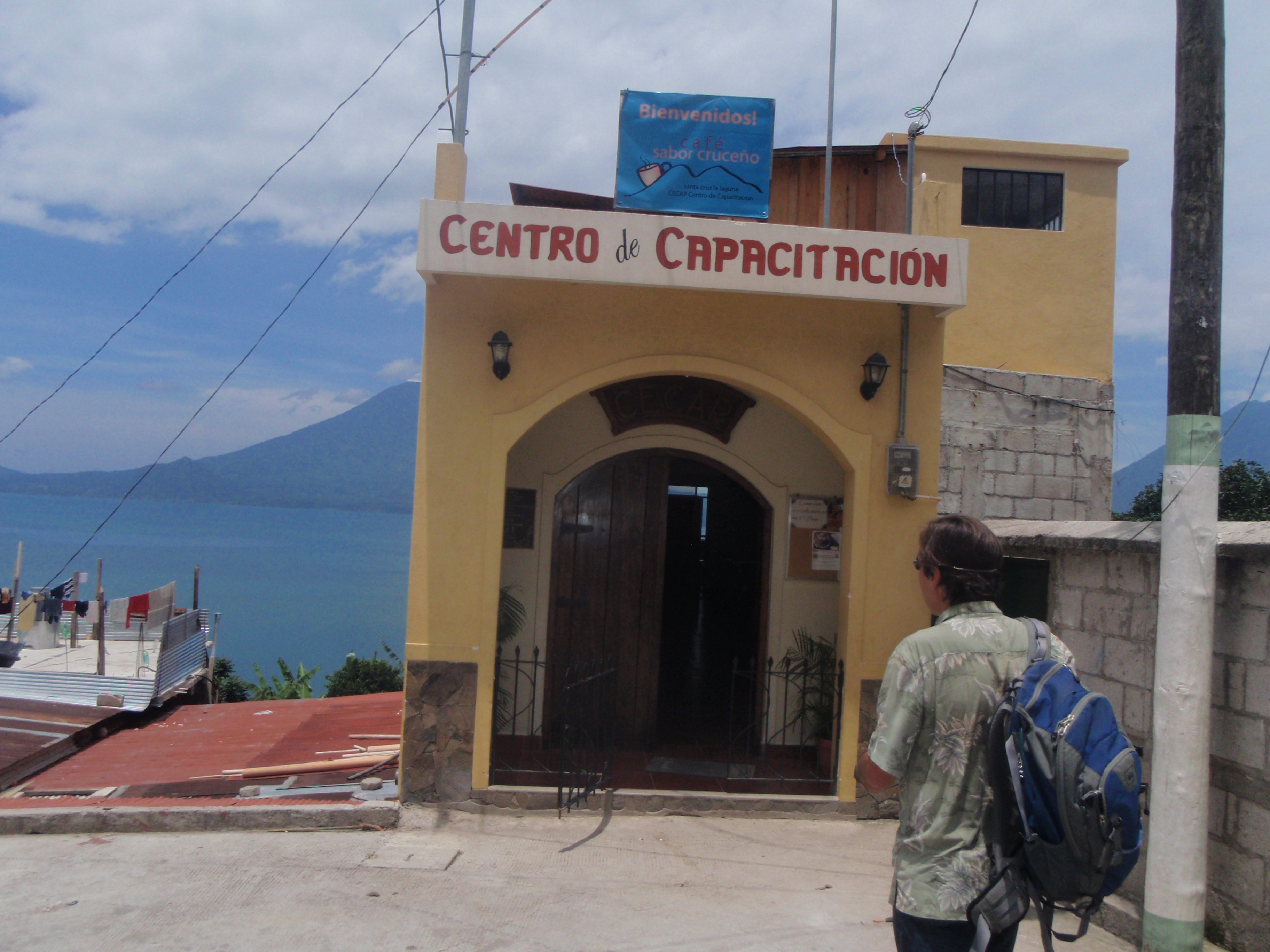
    CECAP Training Center and Cafe Sabor Cruzeno

    I walked into Cafe Sabor Cruzeno in Santa Cruz la Laguna, Lake Atitlan with trepidation. Not because it was recently opened. Not because it wasn’t yet rated on Trip Advisor or that it was a student-run café. And not because it was part of an NGO, Non-Government Organization.

    Café Sabor Cruzeno was the result of the CECAP (Centro de Capacitacion) Culinary Arts program of Amigos de Santa Cruz foundation. The goal of the program is to train young people for successful employment in the restaurant and tourist business.

    No, it was because I had my doubts that the culinary arts program would be successful with Antonio. I had a suitcase of dried pasta betting on it. Some people might pack extra clothes and shoes to match each outfit. I was more concerned that we have a food supply tucked away. When we traveled to Guatemala in 2010 I had forgotten to pack Crystel’s swimsuit. She ended up swimming in her Hello Kitty pajamas. But, I didn’t forget emergency rations for my son.

    View from Café Sabor Cruzeno

    Antonio is a healthy ten-year-old. He will eat a salad. Just don’t make a pyramid out of the raw vegetables. Instead, imagine a horizontal sundial and align the fixings uniformly around his plate. No dressing wanted or required. When Antonio and Crystel were in highchairs Jody and I would put food on each tray and what one toddler didn’t eat the other would. Being low maintenance, Crystel’s sundial can be any shape: cylindrical, conical, or vertical with a dab of ranch dressing. She’s satisfied with a ham sandwich. Antonio came to us waving a chicken leg in the air. He has never eaten a sandwich in his life. But give him a Sweet Hawaiian bun in one hand and a slice of salami in the other and he will happily eat them separately.

    Our table waiting for us

    We cater to Antonio and Crystel because we can, though sometimes I remind him that he was born in Guatemala.  Tamales made of corn and filled with beans are eaten with nearly every meal.

    Lee Beal, our guide, originally from Texas, has lived around the world over the years, with Colorado being his home base. His wife, Elaine, and he have been full-time residents of Santa Cruz for the past 5 years. The couple came to Guatemala looking for a simpler and more fulfilling life and found it on Lake Atitlan. Lee originally started working with Amigos de Santa Cruz foundation and now serves on the board of directors. As he learned more about the people of Santa Cruz he realized there was a need for jobs creation. A part of this is now being fulfilled through the CECAP vocational training center.

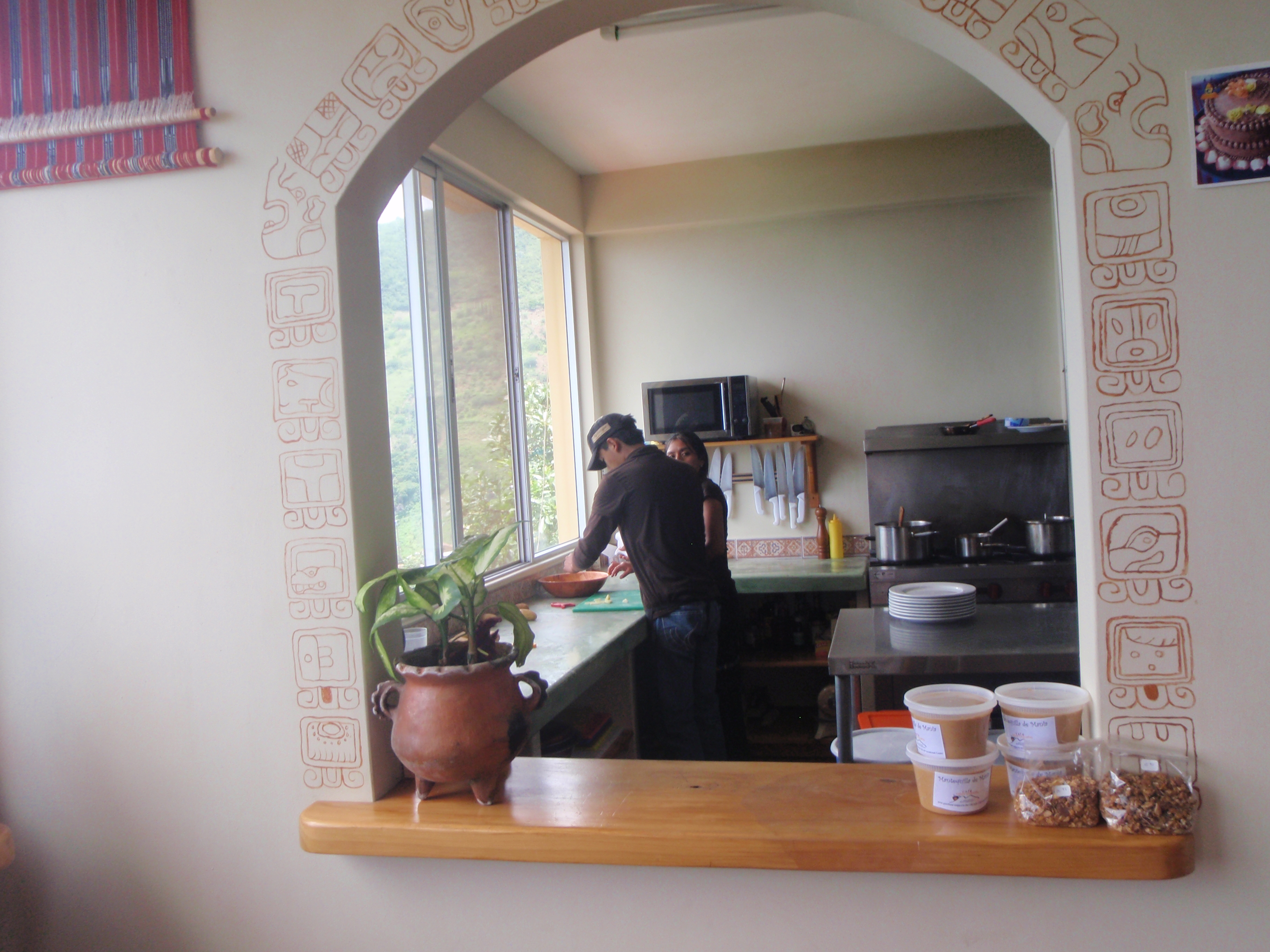
    The kitchen

    Walking into the restaurant, I was surprised how open, clean and fresh it was. I felt as if we were on top of a mountain and we were. Two graduates of the culinary arts program were busy in the kitchen completing our authentic Guatemalan meal. They would also be serving us.

    I don’t out Antonio unless I have too. Usually I just take him aside and remind him that we have food at home and simply be polite and say, “No thank you” if he doesn’t like what’s served. No funny noises or grotesque looks necessary.

    After snapping a picture of our seating area, I took a deep breath and sat down. We had our choice of freshly made cold tea, several sauces, mashed potatoes, and a mixture of glazed vegetables and chicken with pulique sauce. At first glance, there wasn’t anything that I thought Antonio would try. Pulique is a common dish of the Guatemalan highlands. It is often served at holidays, anniversaries, and yearly fairs. Alex, our Guatemalan guide, explained how special it was that our chef had made the pulique for us. (Lee has been employing local guides trained through INGUAT. His goal is to create well-paying jobs that fit with the Mayan culture.)

    Antonio with Alex paying our bill

    The pulique sauce was mild, gentle, and creamy. I watched Antonio as he scraped a bit of it off his chicken.He tried a bite, finished his chicken, and asked for more.

    Antonio had proven that CECAP’s culinary arts program was headed for success.

    The café is located in the vocational center which houses carpentry, welding, computer education, sewing and weaving. The training center was buzzing with students sewing on Singer sewing machines and students welding on the rooftop.

    What makes CECAP unique is that it has always been a community-driven vision and not a government project. Amigos is helping CECAP become self-sufficient.

    Singer sewing machines. Girls and boys sewing.

    Touring the vocational education center, watching students sew and weld, and dining at the café were some of the many highlights of our trip. We were getting a glimpse into the future of Santa Cruz la Laguna. Santa Cruz is one of the 45 poorest townships in all of Guatemala with illiteracy and malnutrition among the highest in the country. Amigos believes that education is the key to breaking the cycle of poverty for the indigenous people of Guatemala. Their primary focus has been on education both at the primary and secondary level. We were fortunate to see it at work.

    Before we left Minnesota, Crystel had told us that she wanted to learn how to weave while in Guatemala. Lee contacted a local Guatemalan and set up a time for us to meet with her in her home. Both Antonio and Crystel quickly became engaged in learning to weave. They returned to her home several afternoons to complete their projects.

    While Antonio and Crystel were weaving, Lee took Jody and me on a tour of the town church and also to Casa Milagro. Casa Milagro (since 1992) is an NGO that supports widows and children. Thilda Zorn, founder and manager of the project, focuses on providing an environment for creativity, joy, and freedom. Jody and I purchased handicrafts that the children had made.

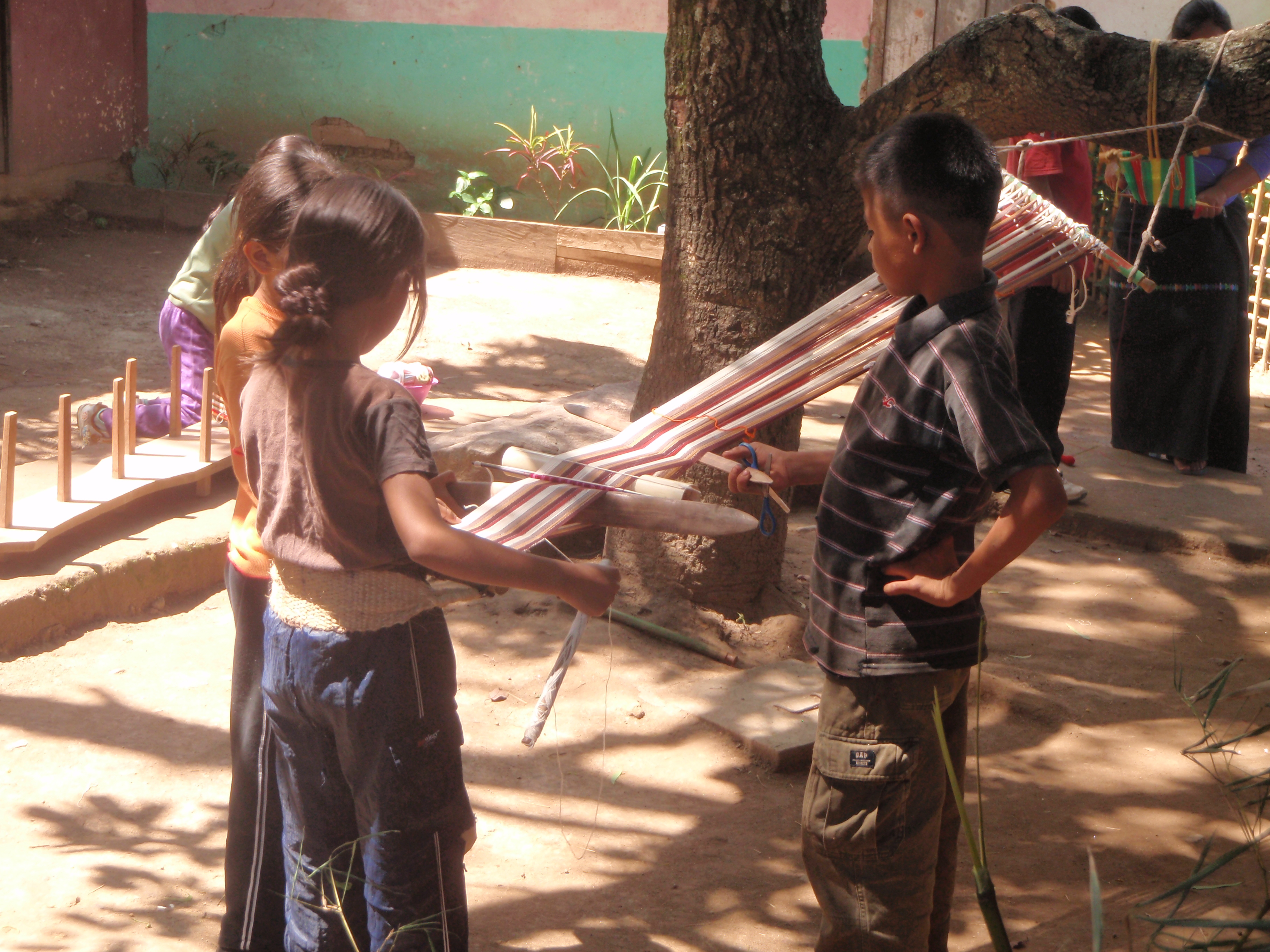
    Casa Milagro – children learning to weave

    By the time Jody and I returned to our children, Antonio had left with Alex and Zach to play soccer in the village square, and Crystel was making fast friends with the girl of the house.

    Antonio rushed in breathless and excited. He was poking fun at Alex and Zach, “Those kids were smaller than me,” he laughed. “We lost 10-7. It cost us 3 quetzales (50 cents).” Apparently, there was a side bet and the local children came away the winners. “Alex, they blew right by you,” Antonio added. “And, Zach he couldn’t stop anything.”

    Antonio and Crystel learning to weave

    Antonio and Crystel were being changed. And, it had nothing to do with their parents and everything to do with their parents. We had brought them here – to their birth country to have an opportunity to connect with other Guatemalans.

    The boy who wouldn’t look at the kids in the square the first night was now facing off with them in a soccer match and for a short time he had two older Guatemalans, Alex and Zach, that could brother him.


    Antonio’s bud’s – Zach and Alex
    Crystel’s new friend

    This very fine day would finish in a hot tub and swimming pool in the next village, El Jaibalito. A ten-minute launch from Los Elementos.