Category: Family

  • The Family Tree

    The Bayside Tavern in Fish Creek, Wisconsin has two buck burgers on Mondays during the off season. There’s a choice in seating– high tops, low tables, tiny booths for two, or stools at the bar. Narrow windows keep the inside dim. It is the place to go before the community Christmas tree is lit across the street, before the high school musical, to watch the Packers or Badgers or Brewers play. Maybe the Bears or Cubs for those brave enough to wear such jerseys. If you are a local, or a seasonal local, they probably know your name.

    My Dad preferred a booth and ordered fried onions on his burger. He had haunts in Door County including the best places for good food. He knew the parents of people important in the community—the Catholic priest, the sheriff, a few bar owners.

    So it was at the Bayside that my cousin Jeff Frisque and I met for lunch, the first time we had ever talked to one another except at family funerals. We connected through Facebook where many of the cousins have friended each other. Taking a risk, Jeff and I moved from responding to postings to trying a direct message.  Jeff’s father and one aunt are the last living siblings.

    In my book, The High Cost of Flowers, the eldest sibling comes to the realization that to have the kind of extended family you want can require effort. And as the elders age, the responsibility passes to the children to do something, or to walk away. My husband and I are the elders of our families. That sounds easier to me than embracing the concept of adult orphans. We value the small circles of those connected to us by birth or marriage. Along with those we love, we have developed new traditions to stay close.

    The Bayside Tavern might become a comfortable setting for weaving together the grandchildren of Michael Frisque. In his prime he spent many hours in bars, but I don’t know if he ever sat at this one. I didn’t know my grandfather well enough to say how he felt about his children and grandchildren. None of that was important in sharing lunch with my cousin Jeff.

    Jeff is known locally for building and restoring exquisite log homes. We share love for Door County. We both showed up with spouses, a sign of how we value our families and would go to great extremes to protect them. We are not members of the same political parties although we may share a few beliefs. I think we are both tender-hearted about the right stuff. We both love or admire each other’s fathers. We walked away with each other’s email addresses and telephone numbers.

    We also both like burgers at the Bayside. Mark that on the family tree.
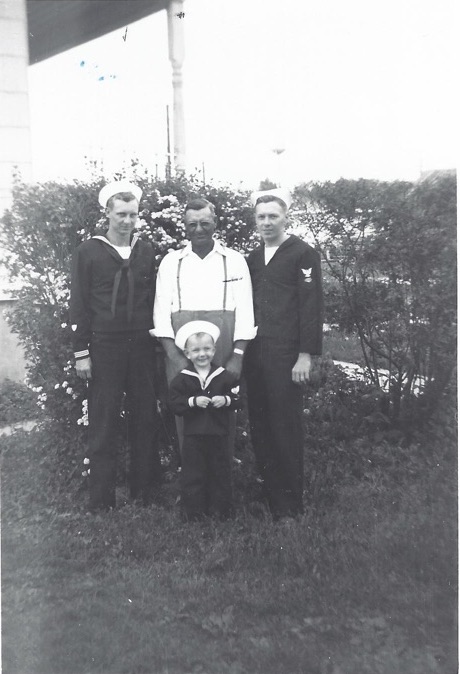
    dad


  • Let the Hope Shine

    About a year ago, on the way to visit my 90-year old uncle in the hospital, I stopped at a coffee shop. While waiting for my mocha, I glanced at the shop’s bulletin board and saw a flyer from The Spread Sunshine Gang with the invitation to take what I needed: COURAGE, KINDNESS, HOPE, GRATITUDE, HUMOR, JOY or PEACE.

    I chose HOPE.

    When I got to the hospital, I passed it on to my aunt even though I knew she didn’t really need it because she—a lifelong Catholic—has her faith.

    But me? I’m always seeking reasons to hope.

    So, when I got home I signed up for the Spread Sunshine Gang’s newsletter. It now arrives in my inbox every few weeks, a welcome reminder that our Land of 10,000 Lakes is filled with people eager to share their goodness in creative ways and inspire others to do the same.  

    In addition to their coffee shop flyers, the group’s recent acts of kindness include hosting a holiday party for seniors, participating in a Polar Plunge to raise money for Special Olympics and decorating Loring Park with warm, colorful (and free-for-the-taking!) hats, scarves and mittens.

    Their “sunshine” has inspired me to spread my own. Here are three lessons I’ve learned along the way:

    Lesson No. 1: Small gestures can have a big impact. Take a smile, for instance. It costs me nothing to give yet can brighten a complete stranger’s day.

    Lesson No. 2: Kindness comes in all shapes and sizes. One day it may arrive as a bouquet of bright orange tulips. On another as a warm hug from a friend, an out-of-the-blue postcard from a relative or an unexpected compliment from a colleague.

    Lesson No. 3: Communicating love doesn’t require words. This afternoon, I’ll be visiting my uncle and aunt once again. He has recovered enough to be living back at home but spends most afternoons sitting beside my aunt at the assisted-living facility where she now lives after having suffered a stroke.

    She won’t be able to say more than a few words, but the way her eyes light up when she sees me fills the room with sunshine and my heart with hope.

  • Je M’appelle Frisque

    My grandparents’ families came from places like Walhain-St. Paul, Incourt, Nievelles, Tourinne-St. Lambert, and Huldenberg in Walloon Brabant, Belgium. Impacted by the same potato famine that brought many Irish to the United States, the Belgians made their way to Wisconsin communities with names like Brussels, Tonet, Namur, Luxemburg, and Walhain. The homes they left had been clustered in an area about forty miles wide. The farm towns they carved out of tree-covered land, almost four thousand miles across an ocean and half a continent, were about the same distance apart.

    When I was a child I spoke some Walloon, a nearly forgotten language, with my Belgian-American great-grandmother and her friends as they quilted in our living room. We ate Belgian farm food like jut, a boiled cabbage side dish, stoemp, a mashed potato and cabbage dish, trippe, a bratwurst-type sausage, booyah, a chicken-based soup with many ingredients, and Belgian pie, a sweet dough tart filled with prunes and a cream cheese style top. Our Catholic church held a Kermis celebration in autumn. Beyond jokes about how much Belgians sweat or drank or were short, maybe stout, that’s about what I knew of our heritage. All the amazing accomplishments of the Belgians or their art or chocolates were from a different socio-economic part of the country.

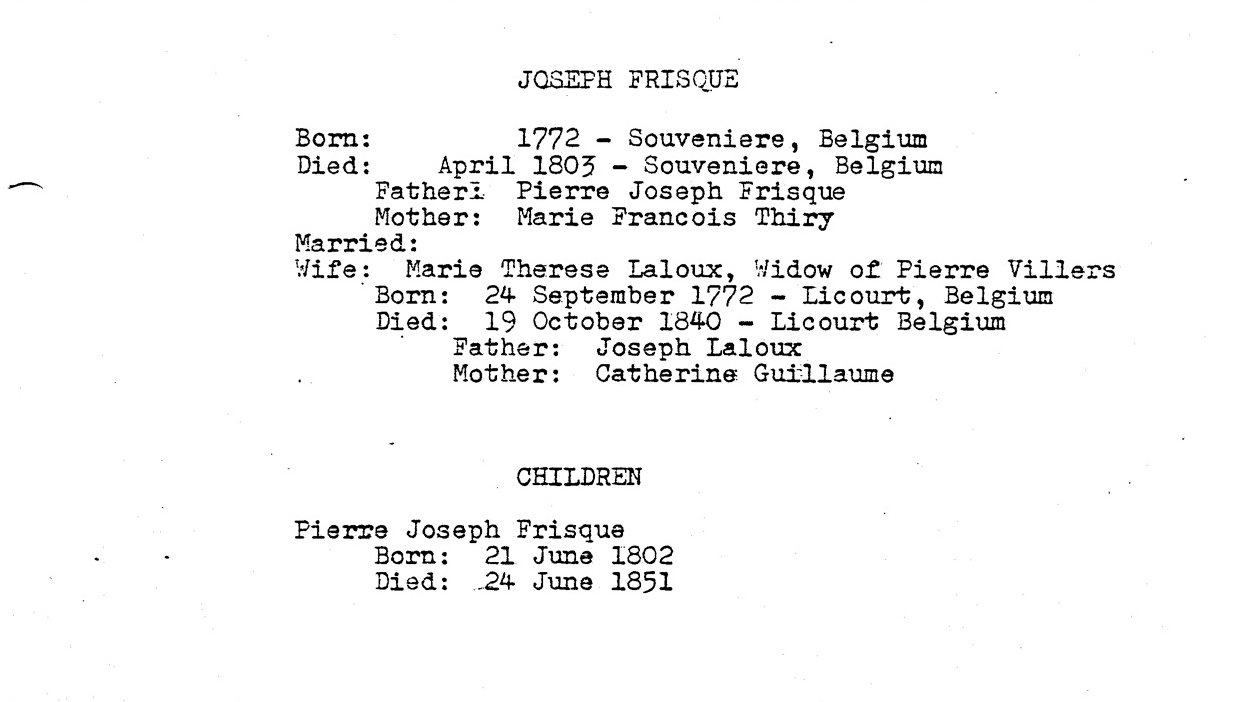
    My mother’s cousin and my father’s cousin researched family trees. Through the Frisque genealogy I discovered that my family was related to many, many people in Luxemburg, Wisconsin, the small town where my father grew up and we lived through part of my childhood. The Nockaert family information uncovered that my mother was mostly Belgian although she believed she was German. Names, dates, locations, relations fill pages. That’s it. The Belgian Heritage Center in Namur, Wisconsin may provide information to further the cousins’ research.

    The histories of these people, who permanently left all they knew for 40 acres of land and a better future, are probably lost forever. But this summer we are going to visit Belgium, specifically Walloon Brabant, and trace what is left of our Cravillion, Frisque, Nockaert, and VanderKelen ancestors. They were all small farmers who left Belgium in the mid 1850s so there is probably little left of their lives beyond cemetery headstones.

    We have nothing physical from their lives in Belgium and little expectation of connecting with other great-great-great grandchildren of the original immigrants. But one can always hope.

    Genealogy