Category: cultural shift

  • Healing Thoughts

    What do you say when acquaintances mention on social media that they or someone in their family has a major health issue? Often, I see some version of this phrase, “Sending you healing thoughts.” I’m curious about this trend.

    In recent years prayer seems to have morphed. People used to say, “I’ll pray for you,” meaning I’ll ask God/Yahweh/Allah to intervene on your behalf. Now when trouble strikes, the default phrases often are, “Thinking of you. Sending you healing energy.” 

    I wonder if the change comes from a wish to be respectful of another’s spiritual beliefs, however informal or nontraditional those might be?

    Or maybe people say those things when they aren’t sure of the recipient’s religious beliefs or if old-fashioned prayer will be appreciated.

    Perhaps our language of concern has changed because fewer people practice the faith they were raised in. Judging from statistics, that’s a lot of Americans. Church membership is declining.

    For formerly religious people, “Sending healing thoughts” may be more accurate than saying, “You’re in my prayers.”

    Or perhaps social media just doesn’t feel like the place to mention something as personal as religious beliefs.

    As a no-longer-practicing Catholic, I’m likely to say, “Sending you strength.” As if I can (I have no idea how or why this would work, but I want it to). At very least, I hope my friend will hear my sympathy and concern. 

    Have you noticed this shift? How do you respond when you learn an acquaintance is dealing with a health issue?

  • A Larger Force

    Healthy exercise respecting social distance in the neighborhood appeared difficult with a cluster of kids playing soccer, family groups stretching across walks and streets, dog walking people following the direction of their pets. We drove to the quiet side of a nature preserve where trails are seldom used on weekends. One car stood empty in the parking lot. Parents with a preschool child exited a different car.

    We waited for them, but as shoe tying and other preparations continued we made our way to the trail map. The youngster, possibly unaware of social distancing, ran to join us and told her parents that she wanted to be lifted to read the map. Offering her their hands, they assured her they knew the way. We backed away as the child threw a hissy complete with screaming, stomping, and slapping. The right trail choice was any that would create space from the unhappy kid.

    As grandparents we’ve learned about giving young children time to make wise choices instead of forcing action on them. Children of privilege are supported in making choices many times daily from choosing to wear clothes to daycare through patient questioning of resistance at bedtime twelve hours later. Family, friends, complete strangers, might be expected to wait while a child tests the limits or can’t choose. It takes a village after all.

    Then comes COVID-19—no negotiations, no children making choices, no endangering strangers by ignoring social distance guidelines. The village has been forced into change.

    From closed schools, to prohibited playgrounds that look the same as open playgrounds, to stores asking only one family member do household chores; parenting has pivoted in answer to the dual wham of pandemic and economic storms. Parental instincts to keep things normal for the kids are strained as jobs are lost, employers demand long work hours in the family’s home, distance learning replaces classrooms, and being homebound stretches. Hugs of grandparents, cousins and close friends disappeared with no known date of return. Parents have had little time to concentrate on adapting to new burdens, to problem solve, to explore their personal fears or worries.

    Experts say our kids experience anxiety of this crisis just like adults. Some will lose a loved one or friend. The soundtrack of childhood has been interrupted to never play in quite the same way. COVID-19 is drawing new lines on the future maps of kids’ adulthood. Our six-year-old family member misses her classmates, her neighborhood friends, going places with her parents. She understands that the sickness means she can’t ride her bike with other kids, climb or swing at the park, be physically present with her friends. The sickness is beyond her parents’ control. She can make good decisions about a snack or activity, but bigger forces now set the limits beyond the front door.

    Technology gives us time to talk, play games, be with family. A plate or two on the table and tiny faces on a screen may be how we celebrate this spring’s holiday and holy day traditions with those we love. Better than no connection, a card or a phone call. COVID-19 denies us the powerful comfort of each other’s warmth, smell, physical presence whether around the dining table, at a special event, at a hospital bedside. Some of us will stay healthy. Some of us will die in the company of strangers. No screaming, stomping or slapping can change what we have to keep doing. We will gather to celebrate or grieve in the future. God willing.

    Stay home. Stay safe. Keep others safe. May your holy day traditions provide comfort.

    GIFIjEQkRfGDZbThEEbPgw

  • Mental Whiplash

    On February 19th, the snow was deep in our yard, and our alley was so rutted with thick ice that my car was forced to follow the deep track. Before my husband and I left for our three-week snowbird experiment in the Southwest, life seemed relatively predictable.

    We are keenly interested in politics, so the Democratic primary in South Carolina on February 25 and Super Tuesday on March 3 (which included Minnesota) were on our minds. We voted before we left town.

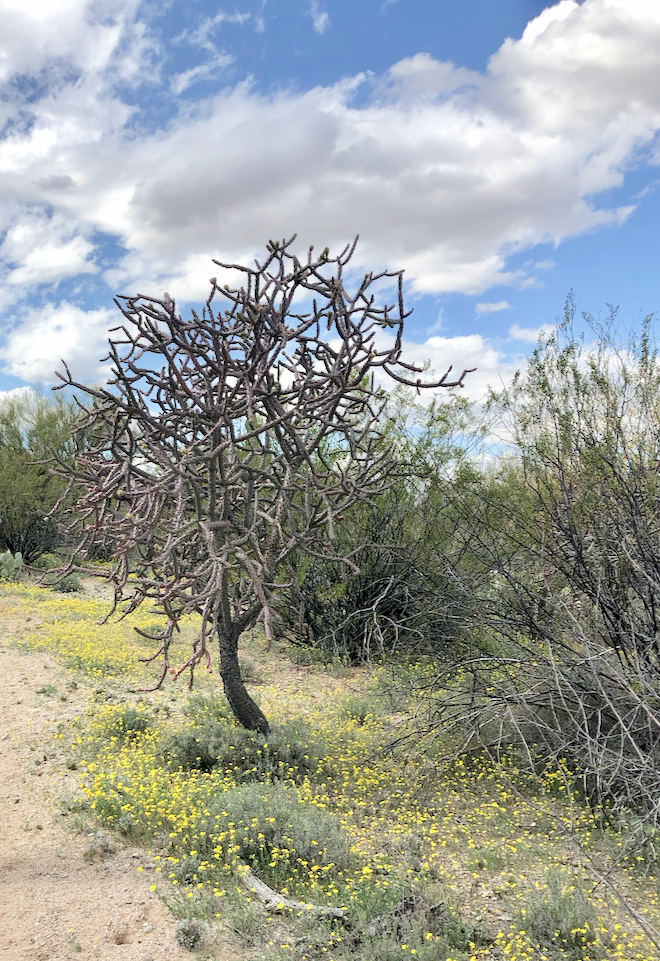
    We speculated about the outcomes as we hiked in the California desert among shaggy palms, Joshua trees, and giant boulders that are tumbled like toys in the foothills.

    Less than 48 hours before Super Tuesday, the trailing presidential candidates ended their runs abruptly. Although the departures were inevitable, the timing was startling. The consolidation of candidates meant that my early vote was irrelevant. Like many, we were astonished by Joe Biden’s surge. When Elizabeth Warren exited a few days later, I was sad that there were no women candidates. The political landscape had changed dramatically, and the rapid change was jangling. However, COVID-19 felt remote.

    In Tucson, our next destination, the desert was blooming. Clumps of yellow desert marigold dotted the hills that bristled with saguaro cactus. The sunny warmth of Sabino Canyon’s trails soothed me.

    During the first week of March, concerns about COVID-19 came to the forefront for us. This was new terrain. Until then, sensible precautions seemed enough; our life hadn’t been disrupted. With each subsequent day, our understanding of the COVID-19 crisis increased as updates poured in faster than we could absorb them.

    The Grand Princess cruise ship, which carried passengers ill with COVID-19, docked in Oakland. We worried about our son and his significant other, a physician in Oakland, who would be on the front lines.

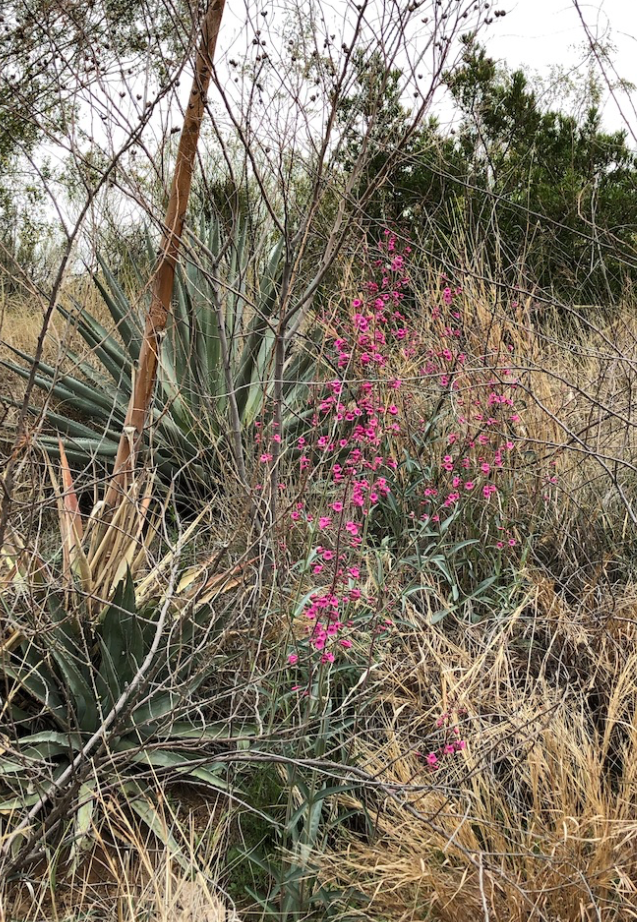
    The sky was overcast but the temps were still warm as we walked trails alongside the broad dry Rillito riverbed. I noticed spikes of pink penstemon, but our conversations centered around the looming pandemic and the conflicting national response. We worried about restrictions on flights from Europe where our niece was studying abroad and the pandemic’s impact on the economy.

    By the time we flew home, the landscape was changing hourly with updates about cases and the CDC and NIH’s latest guidance. On our first day back, the president declared the overdue National Emergency. Comprehending the impact of the cascade of closings and event cancellations was hard. Is hard.

    The pandemic is uncharted territory. Only a week ago, I wondered if I’d be able to fly to Chicago later this month for a wedding shower. Several days ago, meetings with my writer’s group and book group seemed possible. We’ve ruled out travel, in-person visits, and ordinary errands to help “flatten the curve.” The daily, even hourly, changes are like mental whiplash. No school. OK. Restaurants and stores with limited service. OK. Stay home. Got it.

    March 18thIn the space of a month, so much has changed. The world looks very different. Socializing in person has been postponed. I no longer assume my travel plans for May and July will happen. We’ll see. We’re figuring it out, day by day, case by case, just like everyone else.

    Screen Shot 2020-03-18 at 10.56.42 AM            Screen Shot 2020-03-18 at 11.01.46 AM


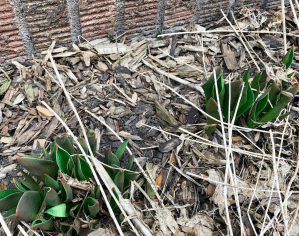
    At the moment, we’re healthy. The snow in our yard is nearly gone, and the alley is ice-free and dry. As I circle the yard, I note the early tulips and weeds pushing up in my gardens as they always have. Though much is unknown and I’m seeing the world with a new perspective, spring is coming, and for that, I’m grateful.