Category: American Culture

  • Resisting Assumptions

    The last time I gave blood, a tech named Dakota took care of me. When she introduced herself, I didn’t expect we’d have much in common. She was in her 20’s and had full sleeves of tattoos and several facial piercings, while I look like the middle-aged, mom-ish person I am. However, she surprised me.

    She made a real effort to talk to me, which I appreciated because giving a pint of blood takes about half an hour and you’re tethered to a gurney the whole time. You can stare into space, listen to music and daydream or play with your phone, which is what I was doing when she tried for a second time to start a conversation. I apologized and set my phone aside. She sympathized and said she’d recently read an article about how involvement with cell phones can put a damper on actual conversations. Her comments sounded like something I would say, not something I expected of someone her age. It was a minor moment, but it reminded me how difficult it is to resist making assumptions.

    Making assumptions is natural and necessary.

    Every day we receive such an onslaught of information—online, at work, and during casual personal encounters at a coffee shop, gas station, or wherever—that our brains simplify and categorize it. We have to. Otherwise, we’d be paralyzed by making sense of the input. The downside of this tendency is stereotyping.

    It’s a wonder people ever make genuine connections! And yet, I’m committed to trying.

    Resisting stereotypes about age, race, gender, politics and so forth, takes a lot of energy. The situation is made doubly difficult because whomever I’m encountering has his or her own set of biases to overcome. But in a culture that’s rife with hateful stereotypes, I’m trying harder to see each person I meet as the individual she or he is.

    At its most basic level, my efforts consist of looking strangers in the eyes and smiling. Just seeing them and looking friendly. Some people don’t return my smile, but a lot of them do. It occurs to me that I may look like a smiling idiot—a dotty lady on the loose—but I’m willing to take the risk.

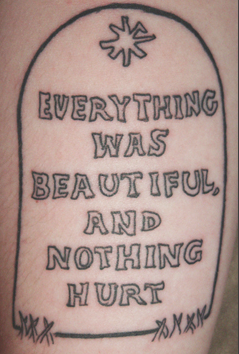
    In Dakota, I found an interesting woman who wants to be a nurse, while I’ve worked for hospitals off and on throughout my career. We’d both lived in Morris, Minnesota, although decades apart. As she described what her tattoos meant to her, it was clear her body is her canvas. I mentioned an ironic tattoo I like that’s in the shape of a tombstone and reads, “Everything was beautiful, and nothing hurt,” a quote from Kurt Vonnegut’s Slaughterhouse Five. Turns out we both like Vonnegut.

    Next time I have a chance to make a casual acquaintance, I’ll try to be the one who initiates conversation.

  • Finding Common Ground in the Essence of the Holidays

    Thanksgiving in Ohio a few years ago - Table set for 16 - before the  carnage
    Thanksgiving in Ohio a few years ago – Table set for 16 – before the dinner carnage

    In the class where I assist, explaining the customs surrounding Halloween and Thanksgiving to adult immigrants who are learning English is challenging. Understanding American customs helps immigrants fit in, even if they aren’t likely to celebrate the holidays the exact same way long-time Americans do. However, Halloween and Thanksgiving have evolved so much from their original meanings that often it’s hard to make sense of our current practices.

    When I try to explain Halloween, it sounds absurd.

    In class, I hear myself say, “Halloween” comes from “All Hallowed’s Eve.” “Hallowed” refers to people who have died—their souls are “hallowed” or “holy,” and Christians believe good souls go to heaven after they die . . . .”

    I write the words on the board and think, How can I possibly explain the history? I try this, “Hundreds of years ago the Celts—people who lived in Great Britain and northern Europe—believed that October 31st was the end of one year and November 1st was the start of a new year. At that time of year, dead souls could visit earth. People dressed in costumes to trick the returning spirits, so the spirits or ghosts couldn’t harm them.” Wow. That sounds completely bizarre. Why is this still a holiday?

    ghosts
    Image from http://www.hdwallpapers.in/halloween_ghosts-wallpapers.html

    I say, “Most people don’t really worry about ghosts, but people still enjoy dressing in costumes.” I pause after that semi-lame comment. Moving along, I start to describe how trick or treating works, but falter when explaining the reasons why that custom is acceptable. Give me a treat or else I’ll play a trick on you? On the face of it, that custom sounds like blackmail. Umm, in America, that how we do things??

    Given the language barrier, I’m not sure how much the students understand.

    cemetary
    Photo from traditionscustoms.com

    The students from Mexico and Central America see the connection between American Halloween and Dia de Muertos (Day of the Dead) in which families visit cemeteries with food and mementoes, and they picnic at the gravesites. At best, the students from Africa and Asia look baffled by Halloween and Dia de Muertos, and at worst, they look repelled.

    Photo by Subharnab Majumdar - originally posted to Flickr as The Rangoli of Lights
    Photo by Subharnab Majumdar – originally posted to Flickr as The Rangoli of Lights (Diwali)

    I extend our discussion to describe Diwali (also called Deepavali). It’s a Hindu festival of lights that’s celebrated in late autumn in parts of India, Sri Lanka, Nepal, Malaysia, and other countries in the region. People light candles and lamps, create intricate decorations called “rangoli” using colored powder, and families exchange small gifts to celebrate the triumph of light over darkness and knowledge over ignorance.

    The Muslim Africans and Buddhists from Asia and begin to nod. They see that in countries across the world, celebrations take place in late autumn when the days grow shorter and darker. They understand that people need light, to gather together, and to celebrate with special food.

    When we discuss Thanksgiving, I feel a different sort of disconnect.

    The official story of Thanksgiving is that Native Americans selflessly rescued starving Pilgrims by teaching them about North American foods—how to grow corn and squash and how to hunt local game and fish. To show gratitude after the first harvest, the Pilgrims prepared a feast and shared it with the local tribe. That’s the version I learned years ago in school, and it’s still favored today in many public schools.

    Fairy tale version of the first Thanksgiving
    Fairy tale version of the first Thanksgiving Historical postcard c. 1910 from Plimoth Plantation collection

    But, I think, it’s only half of the story. European settlers also introduced smallpox and other diseases to Native Americans, who had no resistance to them. Thousands died. Often the Pilgrims’ interactions with local Indian tribes were disrespectful. Native Americans were seen as “savages” who had no religion of their own. For a long while after the Pilgrims claimed New England for their own, the invading European settlers and Native Americans engaged in raids and massacres. Millions were killed.

    How far do I delve into the historical details? After the trouble explaining Halloween customs, I decide to mention, but only summarize, the difficulties between the Native Americans and the Pilgrims. Perhaps it’s wrong to round off history’s sharp edges, but I decide to focus on what connects people of different cultures. I describe the current meaning of Thanksgiving—to be grateful for what you have and to share a good meal (of whatever cuisine) with family and friends. When put in the simplest terms, the students understand the point of Thanksgiving.

    By focusing on the essence of these customs—remembering the dead, pushing back darkness, being grateful for a plentiful harvest, and sharing a good meal with family and friends—students who come from Mexico, Venezuela, Colombia, Cambodia, Sri Lanka, Russia, Somalia, Ethiopia, Eritrea, and Vietnam find common ground with each other and with Americans.

  • I’ve Never Been a Daredevil, But . . .

    As I settled into my seat at the movie theater and muted my phone, an unwelcome thought sneaked in, “Is going out to the movies risky behavior?” I stifled it quickly, “A crazed gunman in the old-fashioned Edina Theater? That’s silly.” Worrying about my safety at movie theaters never used to cross my mind. I resent having to consider it now.

    It’s disturbing to realize so many of the ordinary things I do put me in the kinds of places where mentally ill people or terrorists choose to murder and wreak havoc. However, I have no intention of curtailing my activities.

    Shopping at malls – I don’t spend much time in malls, but while there, I have never worried about my safety. However, the shoppers in the mall in St. Cloud, Minn. or near Seattle, Wash. probably didn’t give it a second thought either.

    Tutoring at the high school – I love the work I do tutoring adult immigrants and have never felt remotely threatened by any of them. The students I know are hardworking and determined to learn, get better jobs, and live the American Dream. But schools and colleges have been the scene of mass shootings in recent years. Perhaps I should be worried, but I refuse to be.

     Visiting international cities – I enjoy traveling overseas, but because of the history of terrorism in London, Brussels, and Paris, I will have to consider my safety in airports as well as in the cities themselves when I go. Losing my luggage or getting pickpocketed seem like more realistic threats than terrorism, but I can’t help being aware of the potential for an attack.

    Often, public places happen to be the settings where a personal grudge is played out—I might not be the target—but I still could be injured or killed by a stray bullet. The issue is not that one middle class white person has to think harder about her safety. It’s that no matter who you are or where you live in America, you are at risk of mass shootings, because of our gun laws and cultural tolerance of violence.

    Equally troubling is that zealots with knives, trucks, and bombs threaten people across the world, not just Americans.

    I remain defiant. There are no easy solutions to gun violence and terrorism. But part of the solution has to be resistance—resisting the impulse to hide and resisting the impulse to shrug and say, “Oh well, what can you do?” We have to keep fighting for change.

    Although terrorism and acts of mass violence are now part of our reality, I refuse to give in to fear. I’ve never been a daredevil, but I have no intention of giving up activities I love like movies, shopping malls, tutoring, or traveling.