Category: Raising children

  • Kids and Keyboards–A Dilemma

    I recently read that Silicon Valley parents are concerned about how using cell phones, tablets, and computers in the classroom affects children’s development. Wait, what?!? The creators of the screens and software don’t want their children using them? The  New York Times article described how families across the country are reconsidering the role of technology in the classroom.

    Whoa. I recall fundraising with the PTO so students at my sons’ school would have computers in the classroom. We wanted our kids to be ready for the world they’d be joining. When my nieces attended a Catholic high school in Ohio, they were given laptops to use with their school work.

    Truth be told, even then I had misgivings about the amount of screen time my kids had. A recent conversation with neighbors, whose children grew up with mine, confirmed that I wasn’t alone. The other mothers—an artist, a human resources manager, and a psychologist—have all seen the downsides of too much screen time.

    The artist was the first to mention the impact on creativity, but all of us  expressed similar concern. When consumed by screen use, children don’t have the opportunity to daydream aimlessly or use their imagination to invent games. The other mothers and I remembered that as kids, we made up goofy games that required imagination but little equipment—building a fort out of sofa cushions or raking leaves into piles that framed “rooms” in the yard.

    Another effect we’ve all seen is underdeveloped social skills. While plenty of young adults are socially adept, some of the young adults we know are awkward in face-to-face conversations. They struggle when talking with people—in job interviews and when dealing with older coworkers. For some, in-person discussions are mistaken for disagreement and conflict, instead of the normal give and take of conversation. Texting and IM’ing are more comfortable. It’s easier for them to express their opinions with the distancing filter of a screen.

    None of us were suggesting that children shouldn’t use computers or cell phones. Personally, I love my phone, tablet, and laptop and recognize that using technology is a vital part of modern life. However, being selective about when, where, and how much children use technology is important. Although our kids hated it, the other mothers and I limited the amount of time our kids spent using screens.

    Limiting screens is an even greater challenge for today’s parents and teachers. Teachers struggle with the disruption of cell phones in the classroom. Parents now have to contend with the potential dangers of social media and the content of their children’s Internet searches. I feel fortunate my kids were older by the time social media was widespread. That was one problem I didn’t have to face.

    A younger mother I know locks up her teenagers’ phones and computers at bedtime so they aren’t online or texting into the wee hours—they need their sleep, and she needs some peace of mind. If her kids’ grades slip, they lose phone privileges.

    It’s disconcerting to realize that the very screens that we sought for our kids years ago could both expand their horizons and limit their potential. But just as we did, I am confident today’s parents will figure out a way to handle the challenges of technology.
  • Are You My Mother?

    Are You My Mother?

    In the classic children’s picture book Are You My Mother? a newly hatched bird falls from its nest and wanders about asking that question of a kitten, a hen, a dog, and a few inanimate objects. He is clueless about his own identity and terribly lost.

    You may have been nurtured by a mother possessing all the perfection of Caroline Ingalls or struggled through childhood with a parent who took lessons from Hamlet’s Queen Gertrude. For most people growing up in Mom’s kitchen fell in a more safe and boring middle ground with measured opportunities to learn about yourself and the world. A place where Mom, trusted adults, books, television and other kids helped answer questions whether insignificant or intense.

    The maker of peanut butter sandwiches, enforcer of daily tooth brushing, comforter of physical or emotional injuries, was just a woman who happened to be older than you. She wasn’t gifted by the gods with amazing knowledge, a graduate of a secret parenting program, or anywhere near perfect. She didn’t know why 9/11 happened, how to stop social injustice, who to call about global warming. Her job was to make sure you felt loved and protected, often difficult work in an imperfect world.

    Discovering that your mother has a masters in labor economics, hides a bag of bodice busters in the closet, holds strong feelings about mutual funds versus annuities, was married before she met your father suggests a richness in this woman’s life that has nothing to do with your existence. This is the school where she learned the mirepoix that flavored every scold, joke or counsel.

    Even when the person who mothered you becomes too old or fragile to cook a really good dinner or read a favorite author without help, there will still be unknowns to explore in the woman who taught you to fake burp, to connect cables on a sound system, to ask your boss for more responsibility, to speak in many voices so your child giggles as you read Are You My Mother?.


    Reprinted from cynthiakraack.com May 9, 2015

  • “Go On, Git”

    “Go On, Git”

    I’m excited about Juan Jose’ and Crystel growing up. Each milestone they have, I celebrate.

    Sometimes, I’m ready before they are.

    I couldn’t wait for Juan Jose’ to learn how to ride his bike without training wheels. Crystel had been riding for months. Finally, I convinced him to give it a try. We went to a grassy knoll at our nearby park. Along with his bike helmet, he insisted on wearing knee, elbow and wrist pads. If he could have figured out how to bungee a pillow around his waist, I’m sure that he would have.

    With a push, I launched him. At high speed, he sailed down the rise, pedaled when he hit the flat field, and after he biked as far as he could, he fell.

    From that moment, he had enough confidence to bike on his own.

    Some parents lament time passing too quickly for their children. I’m loving it. It can’t come quick enough for me. Is this because I’m an older parent? I’m 58-years old with two 14-year olds. I want to be present for all of their firsts.

    Or, is it because I was numb as a teenager? I thought I’d be dead by the time I was 25.

    Through Juan Jose’ and Crystel, I experience their thrills, their excitement, and their fear. I get to see what being alive looks like.

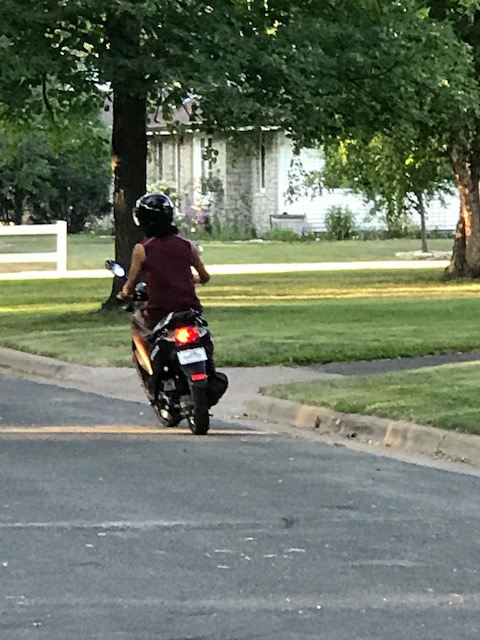
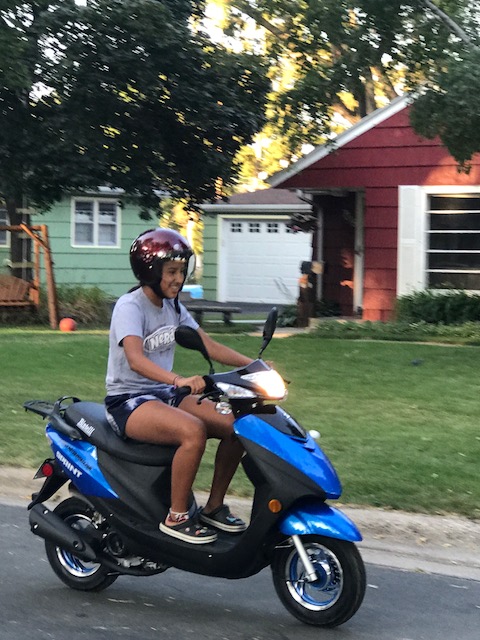
    Recently, Juan Jose’, Crystel, and a friend attended a moped driving class. I expected there to be other 14-year-olds in the classroom. When I opened the door, I was surprised. There were adults with tattoos, mustaches, beards, muscle shirts, and bulking biceps sitting at desks.

    I pushed the children into the classroom without any protective gear. All of a sudden, they were surrounded by a classroom of grownups. They were launched.

    I told the teacher, “I found these folks looking for the moped class.” Now, they are learning to drive.