Category: Memories

  • Peach Seed Mystery

    I have very few memories of the man I knew as my grandfather (Mimmie, my great aunt and Pa, my great uncle raised my father). Pa was a white-haired smiling presence during our weekly visits to Mimmie and Pa’s duplex. He was a quiet man, but many 77-year-olds would struggle to find something to say to a 5-year-old. During one conversation, I recall him teasing me about having “strawberry blonde hair.” I was sure he was mistaken. I had “yellow” hair. 

    He also fed squirrels on their wide front porch. Pa would make a clicking sound similar to a tsk to call them, and the squirrels would take shelled walnuts from his open palm. Apparently, he was unaware or unconcerned about squirrel bites or rabies. He taught me to make the clicking sound but told me never to feed the squirrels without him. He’d gotten in trouble with Mimmie when a squirrel slipped into the house and climbed the drapes. After that he was more careful.

    I’m not sure how I came to have his peach seed monkey—whether he gave it to me because I liked it or if it came to me after he died when I was 8. It’s a peach pit carved in the shape of a monkey and it has tiny red eyes. As a girl I was sure they were rubies, my birthstone. That peach seed monkey was forgotten in a drawer of keepsakes until recently, when I read The Peach Seed by Anita Gail Jones (a novel I recommend). 

    Before the novel, I didn’t know carving peach pits was a thing. I used to assume Pa carved it, but now I speculate about its origin. Born in 1882, he’d lived through WWI, the Great Depression, and WWII by the time I knew him. Was the peach seed monkey a bit of tramp art he bought during the Great Depression to help somebody who needed a handout? Did he pick it up as a novelty at a county fair? Did a friend show him a peach seed monkey and Pa decided to carve one? He might have.

    Pa liked making things. He was a firefighter stationed in a neighborhood that had few fires. To pass the time during slow shifts, he made a small burgundy afghan using a technique that was a cross between weaving and braiding. Mimmie, and later, my mother used the afghan when they took naps.

    I’m left with this odd artifact, scattered memories, and a lot of questions. I keep it in my office along with other mementoes that bring to mind my parents and grandparents. 

    I still prefer to believe the monkey’s eyes are rubies.

  • Seeing Forward and Back

    I’ve cared for enough older women in my family to see the frailties I may have in the coming years. I’ve learned to be patient with their slower pace. I accept the extra steps they take to stay in charge of their lives—switching glasses and putting them away carefully and doublechecking locks. I already do that. I’m accustomed to the effort invested in maintaining dignity—looking where I’m walking, dressing comfortably, but well. So far, I’ve managed to avoid the flat bedhead spot so many older women seem unaware of!

    Some days I feel exactly how old I am. My hip twinges a little. Or I can’t think of a word and it comes back five minutes later. I have a wealth of experiences and insights but the wisdom to know I should refrain from giving too much unasked-for advice. At this stage of life, my outlook is measured. Realistic.

    Other days I feel like I’m fifty. Nothing aches. I’m energetic, ready to tackle big projects, and confident they’ll turn out well. The future is off in the distance and looks bright. I’m optimistic.

    My thirties are also vivid—relived through the lives of my daughters-in-law. Revived by their pregnancies and new motherhood. I remember how fascinating my changing body was and how much it mattered to have a few maternity clothes I really liked. 

    1989

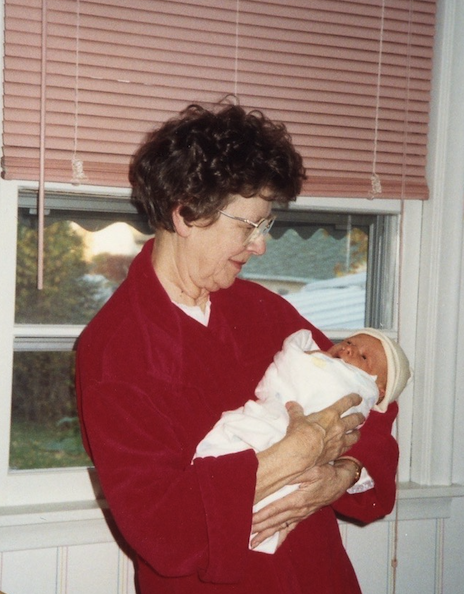
    I haven’t forgotten the fog and overwhelm of life with a newborn. How every little thing worries you. I also know you can grow bored by the long repetitive days, no matter how much you love your child. How ready you can be to use your brain for something besides calculating the hours since the last feeding. But the sweetness of cuddling a sleeping baby tempers that restlessness.

    When my son hands me his baby, our past, present, and future converge.

  • “Why, in my day . . .”

    Growing up, I recall elders recounting tales about life before some innovation. Today, the advent of artificial intelligence (AI) is a hinge moment like so many technological advances I’ve experienced in the last 40 years. I look back on past breakthroughs with wonder and nostalgia. I’m trying to come to terms with current developments.

    1984 – Desktop Computers

    I roll my eyes when young volunteer coordinators enquire if I’m comfortable with computers. In 1984, my boss handed me boxes for an Apple IIe desktop computer and an amber monitor (orange type on a black screen) and told me to set them up so I could write marketing and training materials. 

    1989 – Internet

    Today, that old setup is quaint and humorous—a one-color monitor, 5¼ inch diskettes, a computer that didn’t connect to the Internet . . . because the World Wide Web wasn’t mainstream until 1989-90.

    When the Internet became commonplace, we used painfully slow telephone dial-up modems with their crackling static and rubber band sound. Modems meant I no longer had to courier work product files to my customers on diskettes, which had shrunk to 3½ inches. 

    1994 – 2001 – Search Engines and Websites

    In the mid-1990s, search engines like Yahoo, AOL, and Netscape came on the scene and Search Engine Optimization (SEO) helped people, products, and businesses get found. Google started in 1998. It’s hard to imagine a time before Google, when research meant visiting a brick and mortar library to use printed resources that might be checked out to someone else.

    As websites grew common, having one for my business became important. A friend and I designed and rolled out mine in 2001. Several versions followed until I retired it several years ago.

    1996 – Cell Phones 

    For me, the next technological cliff came around 1996 or 1997 when small cell phones arrived. They made calls. That’s it. If you had the patience to tap number buttons repeatedly, you could eke out texts. No camera. No Internet. No email. No music. No maps. Next, I owned a different dumb phone that opened to a qwerty keyboard. Around 2005, I acquired a fancier flip phone with a camera. Woohoo! Before long my 35mm digital camera was obsolete.

    2007 – Smartphones

    The world shifted dramatically again when the iPhone was introduced in 2007—the best of the available smartphones. Cell phones had enabled me to keep up on client calls and emails seamlessly when I was away from my home office—in other words, an early version of remote work. Staying connected with family became immensely simpler too.

    2007 – 2008 – Facebook & Twitter

    The advent of social media—Facebook and Twitter along with their many step-children—has transformed the world. How we discover, understand, and consume news. How we see ourselves and connect with or demonize others. There’s no denying social media’s far-reaching impact. Despite my mixed feelings about Facebook, it’s where a number of readers find our blogs. 

    Now – Artificial Intelligence

    Evidence of artificial intelligence is everywhere—Siri and Alexa, helpful spelling prompts in texts and emails, blank-eyed, AI-drawn models in ads, and who knows how many AI functions we are unaware of. 

    AI makes me uneasy. But I don’t want to be a Luddite, so I’ve told myself I really ought to dig in, try to understand its scope, possibilities, and implications . . . insofar as any non-AI developer can. I’ve begun experimenting with ChatGPT as a research tool (think of all the data it accesses), but it’s never going to be writing my blogs! Count on 100% Ellen, all the time.

    Five years from now, when the next technological wonder launches, who knows what we’ll be saying?