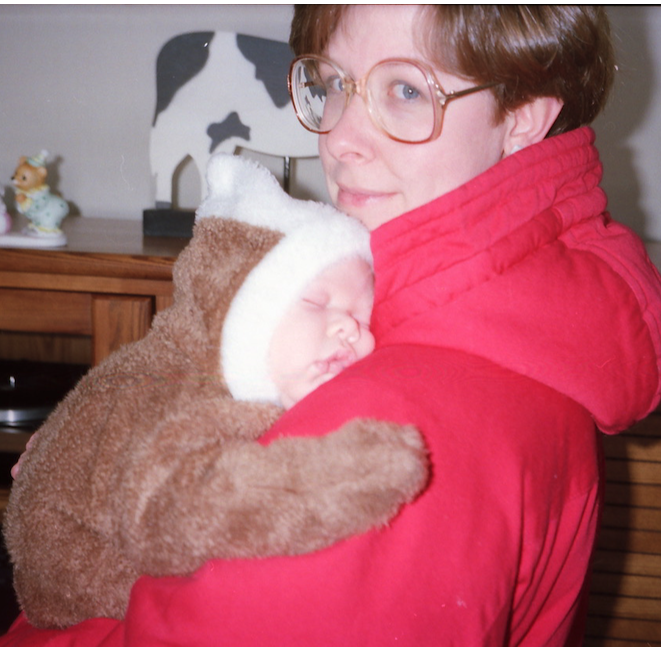
I’ve cared for enough older women in my family to see the frailties I may have in the coming years. I’ve learned to be patient with their slower pace. I accept the extra steps they take to stay in charge of their lives—switching glasses and putting them away carefully and doublechecking locks. I already do that. I’m accustomed to the effort invested in maintaining dignity—looking where I’m walking, dressing comfortably, but well. So far, I’ve managed to avoid the flat bedhead spot so many older women seem unaware of!
Some days I feel exactly how old I am. My hip twinges a little. Or I can’t think of a word and it comes back five minutes later. I have a wealth of experiences and insights but the wisdom to know I should refrain from giving too much unasked-for advice. At this stage of life, my outlook is measured. Realistic.
Other days I feel like I’m fifty. Nothing aches. I’m energetic, ready to tackle big projects, and confident they’ll turn out well. The future is off in the distance and looks bright. I’m optimistic.
My thirties are also vivid—relived through the lives of my daughters-in-law. Revived by their pregnancies and new motherhood. I remember how fascinating my changing body was and how much it mattered to have a few maternity clothes I really liked.
1989
I haven’t forgotten the fog and overwhelm of life with a newborn. How every little thing worries you. I also know you can grow bored by the long repetitive days, no matter how much you love your child. How ready you can be to use your brain for something besides calculating the hours since the last feeding. But the sweetness of cuddling a sleeping baby tempers that restlessness.
When my son hands me his baby, our past, present, and future converge.
Growing up, I recall elders recounting tales about life before some innovation. Today, the advent of artificial intelligence (AI) is a hinge moment like so many technological advances I’ve experienced in the last 40 years. I look back on past breakthroughs with wonder and nostalgia. I’m trying to come to terms with current developments.
1984 – Desktop Computers
I roll my eyes when young volunteer coordinators enquire if I’m comfortable with computers. In 1984, my boss handed me boxes for an Apple IIe desktop computer and an amber monitor (orange type on a black screen) and told me to set them up so I could write marketing and training materials.
1989 – Internet
Today, that old setup is quaint and humorous—a one-color monitor, 5¼ inch diskettes, a computer that didn’t connect to the Internet . . . because the World Wide Web wasn’t mainstream until 1989-90.
When the Internet became commonplace, we used painfully slow telephone dial-up modems with their crackling static and rubber band sound. Modems meant I no longer had to courier work product files to my customers on diskettes, which had shrunk to 3½ inches.
1994 – 2001 – Search Engines and Websites
In the mid-1990s, search engines like Yahoo, AOL, and Netscape came on the scene and Search Engine Optimization (SEO) helped people, products, and businesses get found. Google started in 1998. It’s hard to imagine a time before Google, when research meant visiting a brick and mortar library to use printed resources that might be checked out to someone else.
As websites grew common, having one for my business became important. A friend and I designed and rolled out mine in 2001. Several versions followed until I retired it several years ago.
1996 – Cell Phones
For me, the next technological cliff came around 1996 or 1997 when small cell phones arrived. They made calls. That’s it. If you had the patience to tap number buttons repeatedly, you could eke out texts. No camera. No Internet. No email. No music. No maps. Next, I owned a different dumb phone that opened to a qwerty keyboard. Around 2005, I acquired a fancier flip phone with a camera.Woohoo! Before long my 35mm digital camera was obsolete.
2007 – Smartphones
The world shifted dramatically again when the iPhone was introduced in 2007—the best of the available smartphones. Cell phones had enabled me to keep up on client calls and emails seamlessly when I was away from my home office—in other words, an early version of remote work. Staying connected with family became immensely simpler too.
2007 – 2008 – Facebook & Twitter
The advent of social media—Facebook and Twitter along with their many step-children—has transformed the world. How we discover, understand, and consume news. How we see ourselves and connect with or demonize others. There’s no denying social media’s far-reaching impact. Despite my mixed feelings about Facebook, it’s where a number of readers find our blogs.
Now – Artificial Intelligence
Evidence of artificial intelligence is everywhere—Siri and Alexa, helpful spelling prompts in texts and emails, blank-eyed, AI-drawn models in ads, and who knows how many AI functions we are unaware of.
AI makes me uneasy. But I don’t want to be a Luddite, so I’ve told myself I really ought to dig in, try to understand its scope, possibilities, and implications . . . insofar as any non-AI developer can. I’ve begun experimenting with ChatGPT as a research tool (think of all the data it accesses), but it’s never going to be writing my blogs! Count on 100% Ellen, all the time.
Five years from now, when the next technological wonder launches, who knows what we’ll be saying?
I wrote my first novel when I was 10, in a royal blue spiral notebook I’m sure was meant for my math homework. The story was what you might expect of someone that age. The protagonist was an angst-ridden fifth grader whose family didn’t understand her.
I have other notebooks from those days, mostly filled with bad rhyming poetry and rants about my sisters. But the blue notebook is gone. I think, but I don’t know for certain, that I destroyed it in a fit of frustration. This was long before Anne Lamott wrote Bird by Bird, and I understood the value and necessity of a shitty first draft. I just thought I was a bad writer because I couldn’t resolve the plot in a meaningful way. I was 10.
Since then, I’ve written pages and pages, too many words to count. More bad, unpublished poetry. An op-ed about athletes getting more recognition than scholars that was published in the Midland Daily News when I was in high school. A speech that won an award from Optimist International.
After high school I channeled my writing energy into professional writing: news releases, promotional copy, employee newsletters. I don’t remember much creative prose in the early days of my career, but most of my jobs involved writing.
Years later, driving home from a family reunion in Barnesville, Minnesota, my two kids and my mom strapped in the back of our minivan, I decided to go to graduate school for creative writing. There I became the writer I always dreamed I’d be.
I spent the next seven years learning about the craft I’ve loved since I was 10. I was introduced to Anne Lamott, Joan Didion, Janet Burroway, and a host of others who helped me learn that writing is a process and a passion. Sometimes the words flow easily and land on the page perfectly formed. Most of the time, however, it’s a wrestling match, moving words around until they strike the perfect pose or are pinned to the page in beautiful submission.
Now, two decades later, I turn to Julia Cameron, who encourages me more than any of the others to just write. Every day. In a notebook. Longhand.
***
I go to my local office supply store (some still exist post-pandemic, although my favorite has closed) and shop for two notebooks. I pick a college-ruled notebook for my daily pages. I want a different color for the novel I’m going to write. This will be my third novel if you count the abandoned manuscript from childhood. I rifle through the messy piles in the bins of the store searching for the perfect one. I stack the notebooks neatly back on the shelves, turning them right side out until at the bottom of the bin I find it. I can’t say why it’s “the one,” but it is.
I clutch the two notebooks to my chest and head to the cash register. I lay the two side-by-side on the counter, marveling at the possibilities. The black cover will be for my morning pages. And the other—the one with the vaguely familiar royal blue cover—will hold the novel I’m about to begin.