Category: Legacy

  • Hiding Out

    Porcelain, cardboard, tin, and plastic Jack o’ lanterns grin from a ledge in the laundry room. I moved them to the basement the morning after Halloween along with candy corn lights and a gauzy witch that cackles when someone walks past. Here’s my sad secret, Halloween is nowhere near my favorite holiday. I find it kind of scary for other reasons.

    In Luxemburg, WI there was no trick or treating. We wore our costumes to school and at night a parade happened on Main Street. Candy and substantial treats were thrown from the town’s firetrucks. Many of the town’s 400 or so residents, including many who drove in from their farms, stood on the sidewalk to collect the goodies.  Then everyone joined the parade for about a six block walk to where a bonfire burned at the fairgrounds. Adults and kids partied and danced way after a school night’s normal bedtime.

    When we moved to Milwaukee my mother declared her children were not going to ring strangers’ doorbells to beg for candy. She called the city’s Halloween traditions dangerous. And she wasn’t going to encourage others to ring our doorbell. So instead of a parade or walking the neighborhood with other kids, our parents took us to a shopping mall for the special treat of dinner out. If stores offered a treat bag, we were allowed to accept. 

    My brother managed to weasel out of the family outing after a couple of years. He claimed he was going to help a friend distribute candy so the parents could walk with younger siblings. I snuck out one year with a girlfriend whose mother called to invite me to a sleepover party. It was a ruse because they felt so bad that I had not experienced the joy of running around in the dark with a pillowcase to collect candy. 

    Only I didn’t really find it all that fun. I heard my mother’s disgust with kids begging for candy and caution about the city’s danger. I was kind of afraid of scary costumes and decorations. I worried my parents would drive around the neighborhood and recognize a cheerleader wearing white tennis shoes as their daughter. By high school Halloween parties frequently included booze or pot which weren’t my thing.

    Fortunately, I was great at disguising my fear of Halloween from our children who adored the holiday. A granddaughter’s enthusiastic participation in anything connected to Halloween is awesome. I still decorate and usually keep a treat bowl filled, but I’m more comfortable spending Halloween in the basement reading a book.  

  • Life in Reverse

    Life in Reverse

    I’ve never been super orderly or systematic, but for years, filing papers seemed like the responsible thing to do. Before computers and the Internet, you needed hard copies of financial, health, and school records. Digital wasn’t an option. Sometimes the only convenient way to access a how-to lore was to keep a photocopy of it. As part of an office redo, I’ve been sorting, tossing, and shredding old paper files. Although some of what I saved makes sense, a lot of it is baffling. 

    1972 – High school diploma from the pre-digital age when paper was the only valid proof.

    1976  Where’s my college diploma? Good thing I don’t have to prove that anymore.

    1979  Graduate school grade reports. Why?? And inexplicably, grade slips from three management classes my father took.

    1978 – A photocopy of copyright information (pre-Internet). I suspect I hoped to publish something worthy of a copyright. 

    1984-85 – Wedding catering quotes. I truly don’t know why I kept these. Maybe I thought the information would be helpful when my sister married. Years after our wedding, when I rediscovered the file, I kept it for its entertainment value: Miss Lucille’s Catering: hot buffet with two meats, one kind of potato, one vegetable, a salad, and dinner rolls for $4.75 per person. Plus $1.50 for china, silverware and linen service. Despite the reasonable prices, we went with another caterer, but I didn’t keep that!

    1988 and 1991 – Proposals to work remotely after our sons were born. WAY before corporations were flexible with working mothers. I outlined a plan to return to full-time work after my maternity leave. I would work mornings at home and afternoons in the office for several months. I’m still surprised and grateful I got to do it. Twice.

    1992 – Landscape plans for our old house. We haven’t lived there for 5+ years. Why’d I keep them? Maybe because I put a ton of sweat and love into those gardens, a passion that developed after our second son was born in 1991. Gardening was a creative outlet that didn’t require a babysitter.

    1995  2006 – Vendor contracts and confidentiality agreements. I was in business from 1992 – 2010, but either companies didn’t require agreements or I quit saving them.

    2005 – Records from breast biopsy #2 and #3 – stereotactic then excisional. I don’t know why I kept the details from this painful time. Maybe to remind myself how lucky I’d been?

    2008 – Adjunct teaching contract from St. Thomas University’s Master of Business Communications program. One class, one semester: $4050. Even then, it wasn’t much money.

    2013 – Yellowed copy of a Star Tribune review of an anthology in which I had an essay.

    This ephemera maps some of what I thought was valuable, but I wasn’t saving the right stuff.

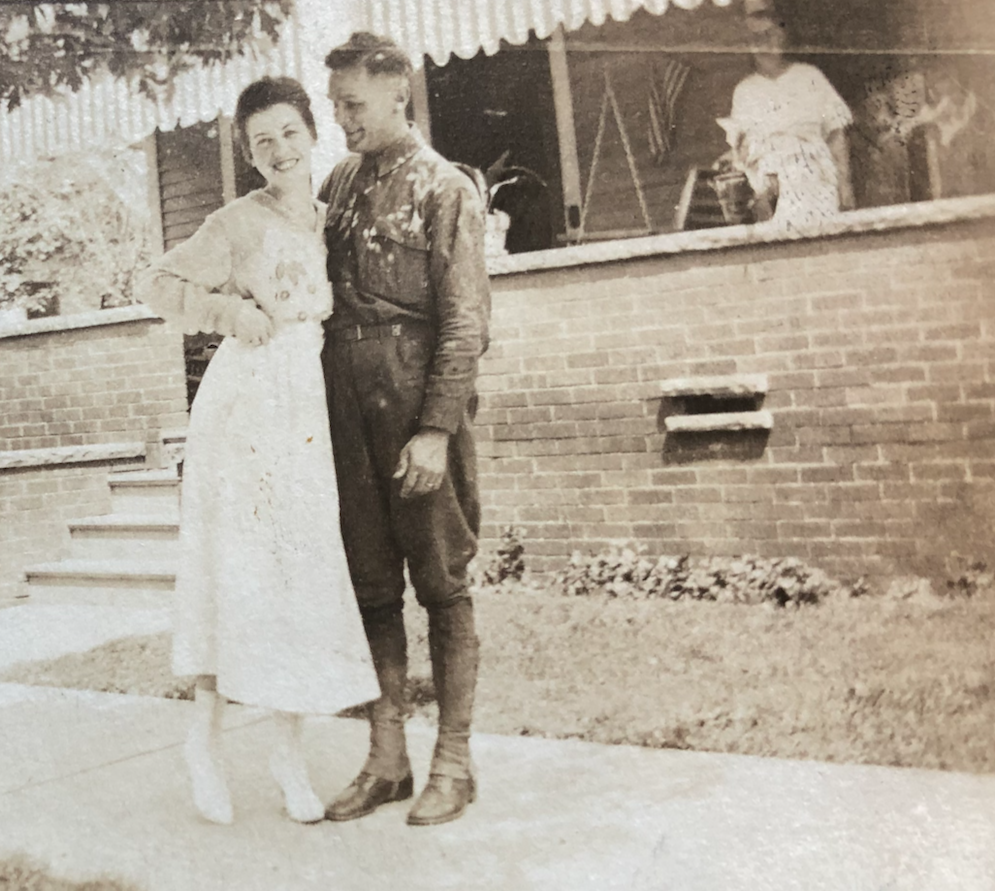
    The real treasures are the snapshots from the 1920s and 1940s tucked in with some of my mother’s Medicare records. I also found four thin files of family history written by my parents, sister, and me. 

    My grandma and grandpa. I’m guessing from their big smiles, he
    was returning from WWI. On the porch is my great grandma, a woman I never met.

    If only my file drawers held more of what’s precious—my parents’ belief in education. The hopeful start of my parents’ and grandparents’ loving marriages. Irreplaceable stories about immigrant ancestors. 

    My parents’ wedding in 1944 during WWII–Aunt Corinne, Mom, Dad, Grandma & Grandpa
    (also shown above).

  • Dear Dr. Rajender . . .

    Dear Dr. Shyamala Rajender,

    The University of Minnesota and the Rajender Consent Decree are probably far from your thoughts. Most of the time they are far from mine, too. However, recently I realized that it’s been 40 years since the decree bearing your name helped me.

    I’m writing to thank you.

    Your courage fighting gender discrimination changed my perceptions of the world and set me on a feminist path that informed the rest of my life—how I see myself and thought about my career, how my marriage works, and how I raised my sons.

    Forty years ago, I was a Freshman Composition instructor at the University of Minnesota-Morris, my first professional job. In the spring of 1980, I got in trouble with the all-male senior faculty in the English department, because I wanted to present a noncredit lecture about women’s literature for a Continuing Education series.

    Several of the senior faculty reacted with a policy that stated, “. . . instructors in English should not participate in off-campus events, either formal instruction or informal presentations, which, in effect, call for a person who has been judged expert in the teaching of English literature.” In other words, I wasn’t supposed to talk about literature even though I had an M.A. in English Literature. The policy was odd and confusing. Several of the literature professors at UMM had been tenured with only a Master’s degree. But my credentials—which were the same as what some of them had—were suspect.

    At first, I was more scared than angry (anger came later). The Continuing Education director and the EEOC officer knew I was afraid I’d damage my career by fighting the policy, so they informed the academic dean about my dilemma. The dean and others were aware of your gender bias case against the Chemistry department on the main campus. Consequently, the dean insisted the English department rescind their policy, and I was allowed to give the lecture.

    Later that year, a number of faculty members, including me, received a $2,000 raise as a result of the Rajender Consent Decree. It’s hard to imagine now, but increasing my salary from $12,000 to $14,000 per year was a meaningful raise then. In general, it’s hard to convey to younger people just how crazy the late 1970s and early 1980s were for professional women.

    Your decision to fight the University of Minnesota had a lasting impact on my life.

    At 25, I learned gender discrimination was as real and insidious as the fatherly men in the English department, who didn’t see me as their equal and wanted to limit my opportunities. That experience didn’t drive me away from academia, but like you, I left the academic world several years later.

    Your career was exemplary (first a Ph.D. in Chemistry, later a law degree). Mine was much more ordinary, but I was always aware of the example I set as a woman in the workplace. Your determination to fight gender bias had a far-reaching effect on me and so many other women. I want to acknowledge your heroic contributions.

    Thank you again for your courage.

    Sincerely,

    Ellen Shriner