Five Simple Ethics Lessons from NYT’s Kwame Anthony Appiah

“Advice on life’s trickiest situations and moral dilemmas.”

That’s the promise made by New York Times’ ethicist Kwame Anthony Appiah. I have found his columns immeasurably interesting and packed with ethical dilemmas ranging from “what do I do now that I’ve hidden my trust fund from my wife for 15 years” to “can people claim spots on the beach with empty chairs” to “does my fiancée love me or does he just want citizenship?”

Thanks to Appiah, I’m becoming wise enough to know that while my advice to others is well-intentioned, it may not always be helpful or even all that ethical. Here are five lessons I’ve learned by reading his columns:

Lesson #1: There are no one-size-fits-all solutions
Ethical dilemmas are rarely black and white. What’s right in one situation may not be in another. The columns remind me that ethics is a nuanced field, one with shades of grey. Solutions must be tailored to individual circumstances. Doing so prevents us from adopting a rigid moral framework and encourages us to consider the context and consequences before making decisions.

Lesson #2: Empathy is key
By putting myself in the shoes of those affected by my choices, I develop a deeper, more nuanced understanding of how my choices impact others. This helps me recognize the interconnectedness of human experiences, encouraging me to consider not just my immediate interests, but also the well-being of others who may be impacted by my decisions.

Lesson #3: Balance principles with real-world constraints
The Ethicist columns show that while our ethical values are important, so is our ability to compromise.

Lesson #4: Seek guidance and diverse perspectives
Reading, discussing options and seeking feedback from can expand our understanding and help us see things we might otherwise miss.

Lesson #5 Continually learn and adapt
Ethical thinking is not static; it evolves over time as societal norms change and our understanding of complex issues deepens. It also changes as we age. That’s one reason the Ethicist columns underscore the importance of continuous learning and adaptation based on current events and ongoing self-reflection.

The NYT’s Ethicist columns serve as a guiding light for me. Perhaps they will for you as well.
Do-Over

Have you ever been unable to forgive yourself for a past action? Your do-over was never enough? Your action, or in my case inaction, continued to pain and haunt you? Prayers and wishes didn’t subside the memory.

I had one such pain.

Aunt Kate asked me to meet her at a funeral home. A dear friend of hers had passed away. I told her I would. I didn’t show. I had plenty of good reasons. I was in my early twenties, had worked all night. I was just plain tired. I needed sleep. I could hear the sadness and disappointment in her voice when she said, “You didn’t come.” I pictured her sitting by herself waiting and waiting for me.

Of course, I told her I was sorry. I could never get over not showing up for her. She never asked for much, if anything, from me or anyone else. I had more fondness for Aunt Kate than I did my mother. Her constant love continues to sustain me although she’s been dead for over 32 years. It’s her that I want to greet me on the ‘other side’ when I die.

I know she forgave me. I never forgave myself no matter how many little pieces of paper I threw into the flames on Solstice or New Year’s Eve.

Until now.

Every day, I do a do-over. And, it finally feels good enough. It didn’t start out as that. It started out as one neighbor helping another.

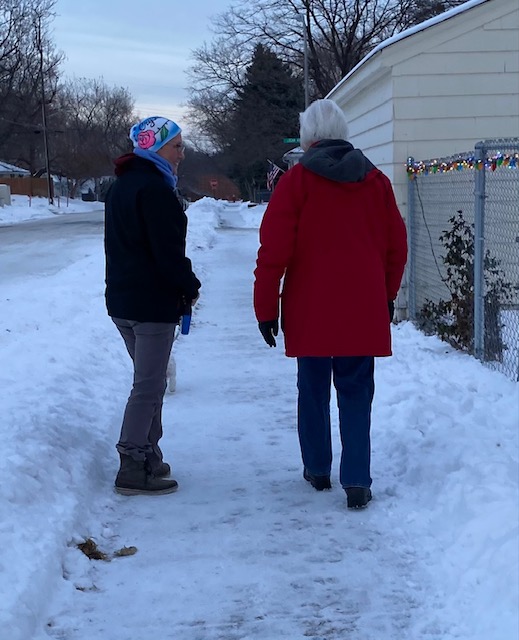
On Halloween, sitting around the fire bowl on our block, I listened as our neighbor said he’d be driving north for a week to his cabin. His wife, who is in her eighties, would be by herself. I imagined her falling in her kitchen and no one knowing. I asked her if she’d like to start taking a daily walk.

She often told me on our strolls that I was the only person she had talked to that day. COVID-19 had pushed her further into isolation. She didn’t like to walk by herself and wouldn’t, but she would walk with me. Sometimes, I’d bring our two dogs and hand her one leash while I grasped the other. The dogs began to greet her like family. At other times, Jody would walk with us while the neighbor and I chatted.  

Our conversations were generally the same: the weather, the home and garage projects in the neighborhood, and what our families were doing. I never tired of it.  

After her husband came home our walks have continued. She has become my companion.

We don’t talk politics. We don’t talk religion. There is so much more to bind us.

I sense Aunt Kate’s spirit when we walk. I know she’s pleased. I know she’s happy. I have a different image in my mind. She’s not sitting alone in the funeral home waiting for me. She’s walking beside me.