Category: Family

  • Tooth Fairy

    Jody and I are the parents that you hate. Your children might come home from school

    Crystel, six-years-old. First four teeth pulled.

    one day and ask you why the tooth fairy doesn’t give them a treasure hunt like she or he does for Antonio and Crystel (our tooth fairy is a boy or girl, depending on the tooth).

    Oh yes, the kids also get the dollar under the pillow. That comes with a letter. And depending on the circumstances, the tooth fairy might use the opportunity to gently remind them to be nice to their sibling or to thank them for a job well done. The fairy often goes on to explain what the tooth is going to be used for. It could be a doorbell (teeth clanging together make just the right sound), a decoration in a flower garden, or it may join other teeth and line the walkway up to the tiny fairy house. The tooth fairy doesn’t stop there with the toothless child. Before flying to the next house the fairy drops a box of candy – like Sour Patch or Mike and Ike’s – under the sibling’s pillow. I know … candy … right?

    Crystel often has her teeth pulled out in groups of four by the dentist. The first time it happened, the tooth fairy felt so bad that at the end of Crystel’s treasure hunt, there was an American Girl Doll that looked like her. Well, not quite. The fairy brought home an Indian American Girl doll that the tooth fairy thought matched Crystel’s complexion but the tooth fairy helper said No way, and the fairy trudged back to the Mall of America and got Josephina, the Latin American girl.

    Fortunately, getting teeth pulled is like scheduling a Cesarean. You know when it has to come out.

    When the kids started asking me if there actually was a tooth fairy, I asked them whether they really wanted to know. By then, they had a relationship with the fairy. They might leave a letter for her or him under the pillow, asking questions and stating that they wanted to come to the fairy’s castle.

    Antonio and Crystel hesitated. The stories that accompanied a lost tooth were so magical. Would the magic disappear?

    After the age of awakening (at seven-years-old) when Crystel was in the dentist chair getting her next four teeth out, the dentist asked her what she thought the tooth fairy was going to bring her. “A hamster,” Crystel said. The dentist looked at me. I nodded. A hamster.

    Yesterday, eating pasta, nine-year-old Antonio said he lost a tooth. There it was in his hand. I looked up at his frothy bloody mouth. My kids are not known for toying with their teeth. Teeth have fallen out while drinking water.

    By now the tooth fairy has gotten old and tired and a bit lazy. I asked Antonio if he minded if the fairy just left him money. “I don’t care,” he said, “As long as it’s a twenty.”

    Antonio, 7-years-old.

    Parents warned us that whatever the first tooth cost the tooth fairy, the ante would always have to be matched. Jody and I never worried about that. I sometimes feel as if I am experimenting with what love will do for a child. I know that giving presents doesn’t equate to love and you risk having spoiled children. So far, I feel as if we have escaped that. Antonio and Crystel are polite, kind, and giving.

  • To parents of college-bound kids


    Whether you’re taking your first or your last child to college this fall, my advice is, “Hang in there, you’ll all be OK in a while.” I’ve done both and lived to tell the tale.

    But admittedly, undoing all the underpinnings of daily parenthood is a very odd process. You’ve spent nearly 20 years building the structure of parenthood—teaching them to dress themselves, holding them close when they’re sick or sad, cheering the speech they give and the goal they score, nagging them about homework and chores, worrying about their friends and who’s driving—but now you’re supposed to quickly dismantle all that daily caretaking. You’re supposed to gracefully move into the next phase—occasional bursts of intense parenting—which is what being the parent of an adult consists of. I almost wrote “parent of an adult child.” That paradox explains how weird it is to send a young adult out into the world. Your son or daughter is and isn’t an adult, is and isn’t a child, but you’re always a parent. Sigh. It’s confusing.

    Becoming a parent was a major adjustment for me, even though I’d longed to be a mother and was delighted when I became pregnant. Learning to share my body and change my eating and drinking habits—more protein, less junk, no caffeine, no alcohol—was hard but worth it. Assuming the role of responsible parent was even harder. I always had to think about someone else and bring the equipment he’d need—food, diapers, pacifier. I had to learn to plan ahead, make sure there was gas in the car and money in my purse—no more flying by the seat of my pants when I had a baby with me. Staying out partying didn’t make sense anymore when we had to drive a babysitter home late, and I’d just have to get up with a baby at 6:00 a.m.

    Soon I became accustomed to being responsible and it no longer felt like a sacrifice. Soon it was second nature to put the kids first—making sure they got fed something relatively nutritious before they got too cranky, scheduling my plans around naps and bedtime at first, and later, around homework and extracurricular activities. Juggling work, daycare, and the kids’ schedules. My life was crazy-bizzy, but good.

    When my kids were young, the biggest challenge of parenting was having the stamina to do it all. Later, the challenge became thinking through the best way to handle a kid’s emotional and moral development—teaching them how to handle mean kids, how not to be a mean kid, deciding how long they needed to keep practicing something they weren’t good at, teaching them how to be their own person, how take care of themselves, how to take care of others, and so on.

    By the time my kids were teenagers, I could hear the warning bells—ACT tests, talk of colleges, college visits. I knew their departure was coming, and I knew it was how their life was supposed to go. But it was hard to wrap my head around the reality of them leaving. These people I love so much, who have been the center of my life, are really going? I could hardly bear to think about how big a hole they’d leave in my life, and yet and I had to help them go, because that’s what was right for them. Occasionally they were annoying, so was easier to think of letting them go. It helped to remind myself that the goal of parenthood is to raise a person who’s capable of being independent, that I should measure my effectiveness as a parent by their ability to be OK without me—but after nearly 20 years of worrying about them daily—well, old habits die hard.

    But each of our sons left and I lived through it.

    Soon I learned that they still needed me but in a different way—not daily, but occasionally, in intense spurts. Their problems were harder—how to deal with all the drinking in the dorms, how to handle roommates who wreck your stuff and are late with the rent, how to find the right career path.

    My husband and I lived through a number of jangling adjustments: from being alone to having them back, from being delighted to see them and their friends to wishing they’d pick up the pop cans and pizza boxes, from acknowledging their independence to setting ground rules for the courtesies a house full of adults needs.

    They have turned into adults I genuinely like and enjoy as people. I have turned into a mom who rarely says, “It’s supposed to be hot/cold/snowing, don’t you think you should wear shorts/pants/a jacket?”

    In fact, I’ve gotten so used to my youngest being gone, that the night before he returned to college this year, to my profound embarrassment, I forgot to cook dinner. I don’t mean I neglected to cook a special goodbye dinner, but I didn’t remember to cook any dinner whatsoever (bad Mommy). So we ate nachos, leftovers, and frozen pizza. And it was fine. Because now we’re all adults, and I don’t have to be in charge of meals. 

    But my youngest still welcomed the box of cookies I stayed up late baking the night before.


  • A Ring, Not Such A Simple Thing

    It occurred to me on my drive to work that this was going to be Jody’s 50th birthday. I hadn’t come up with an idea for a present but I was happy that I realized it was her 50th.  The significance of her birthday suddenly hit me. Her 50th birthday!

    I was grateful that the significance of this milestone occurred to me, because often significance could hit me on the head and I still might not get it. I have a very good friend that knows this about me and she checks up on me around Jody’s birthday and our wedding anniversary.

    I was pleased with myself. I had thought of the significance all by myself and I still had a few weeks to come up with a SIGNIFICANT present.

    Jody’s birthday is around Mother’s day. Maybe that is where I got the idea that a bracelet or necklace with all of our birthstones would be nice.

    Crystel, our nine-year-old daughter, was with me at Jared’s. Antonio, our other nine-year-old was across the parking lot at SchmItt’s for his drum lesson. Crystel and I only had a short amount of time to make a decision before Antonio’s lesson would be over. While I was looking at bracelets with the personal attendant, Crystel was examining rings. She called me over and pointed out a ring that she liked. I thought about it. The ring could have the number of stones we needed and Jody was more apt to wear the ring all of the time.

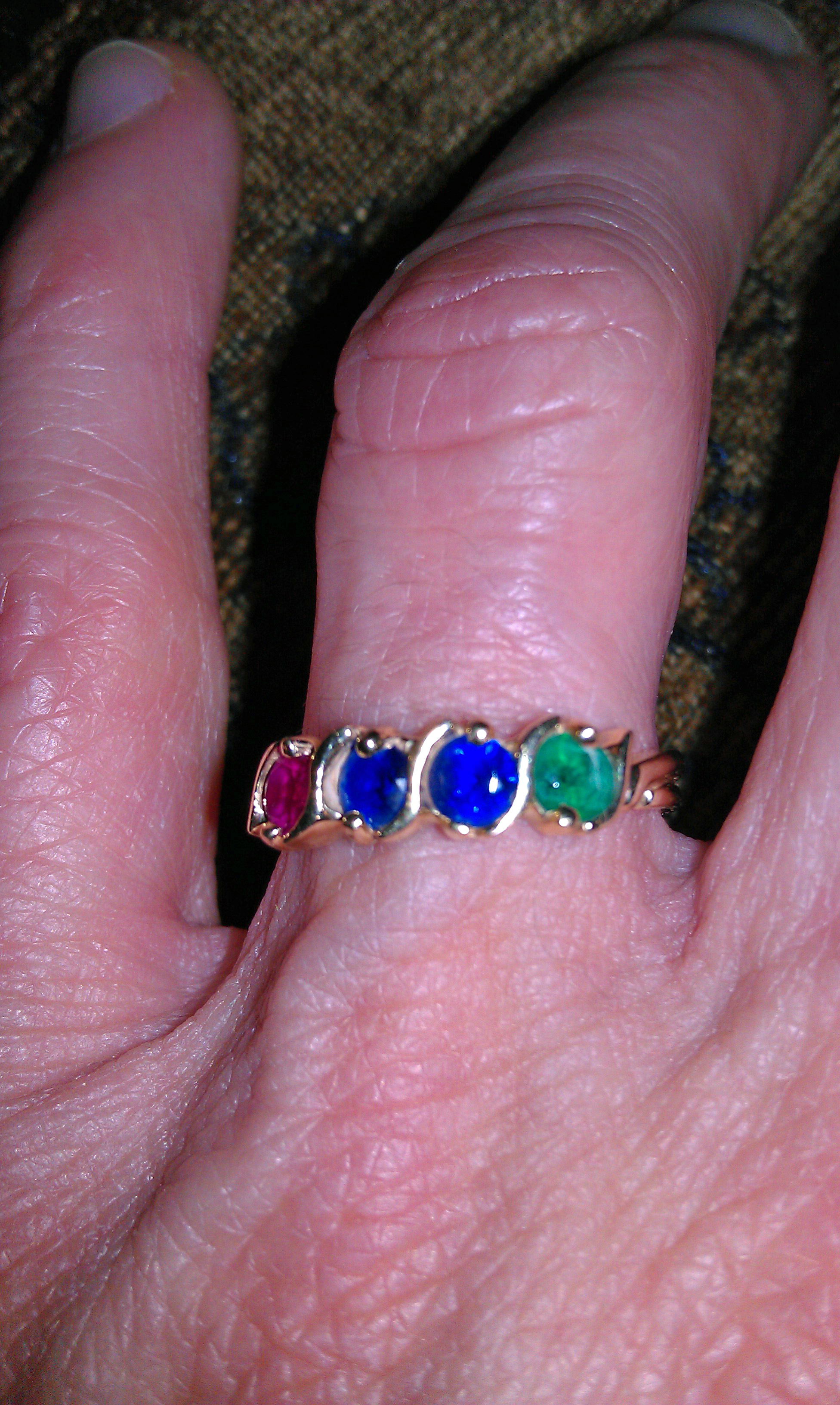
    I changed course and had the gal price a ring for me with an emerald, ruby, and two sapphires. When it came time to decide the order of the stones I asked Crystel. She said the emerald, two sapphires, and then the ruby. I thought her order would be good. Jody being a sapphire would be next to each child depending on what sapphire the kids decided Jody was.

    But … the next few days I puzzled over the order of the stones. I had an unsettling feeling. Jody was Emerald, not Sapphire. Antonio was Ruby. Crystel and I were Sapphire. Crystel’s order put Sapphire next to Emerald. Now on the face of things this is no big deal. But, symbolism is very important to nine-year-olds. The stones would be Jody, Crystel, Beth, Antonio. Antonio would be next to me if the first Sapphire was Crystel and not next to the birthday mama.

    I checked online and the ring hadn’t yet shipped. I stopped into the jewelry store to check on the possibility of changing the order of the rings to sapphire, emerald, ruby, sapphire. This would put Jody next to each child.

    This time Antonio was with me at Jared’s. He said that he thought the stones should match the order of the birthdays, emerald, ruby, sapphire, sapphire. I raised my eyebrows. The stones would be Antonio, Jody, Crystel, Beth. His order would place Ruby next to Emerald.

    I was told that the ring had already shipped but that they could change the order of the stones for a price. I thought about it, and economically, this didn’t make sense. I told the gal that the order of the stones was perfect and explained to Antonio on the way out of the store how the ring was round, never-ending, inclusive, just like our family. I put my arm around him and said, “Each stone is important, a representation of us all.”

    Jody’s birthday has since passed. Antonio thinks the ruby stone representing him is pretty, Crystel proudly announced that she chose the order of the stones, and I talked about the SIGNIFICANCE of the ring.