Every morning, I indulge in a small ritual—choosing what jewelry to wear. What I reach for depends on my mood and what clothes I’m wearing. It’s an expression of my taste. But I’m also choosing talismans. The pieces I wear don’t offer magical protection, exactly, but they do offer a tiny bit of power—to keep people close to me.
Many of the earrings, rings, and necklaces I have were gifts. Slipping them on reminds me that I’m loved. Or if I wear something that belonged to my mother, grandmothers or aunts, I am drawing on memories of them to give me strength.
I’m not alone in assigning secret meanings to my jewelry.
When I visited the Victoria & Albert Museum’s Jewelry exhibit in London last fall, I learned that since ancient times, whether jewelry was made from bones and shells or wrought from gold and precious gems, it has had meanings that go beyond adornment and self-expression.
Seringapatam Jewels at the Victoria and Albert Museum in England.
Often the additional meanings are obvious—to show status and wealth (crown jewels), to express love and affection (wedding bands), as a sign of faith (the cross for Christians and the Star of David for Jews). Jewelry is also worn for protection or in remembrance.
The ancients thought certain stones and gems protected the wearer from illness and evil spirits. For example, rubies are supposed to confer health, strength and fearlessness. I didn’t know that when I chose a wedding band with rubies in it. I just liked rubies—I wasn’t hoping to feel more powerful.
Wearing jewelry as keepsakes is the meaning I most relate to.
After my mother died, I began to wear her wedding band on a chain as a way to keep her close. Not every day, but more intentionally, when I specifically want to think of her.
The opal ring my husband gave me, when I was depressed about turning 60, reminds me of his enduring love and how well he understands me.
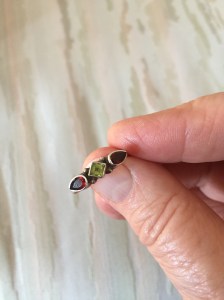
An inexpensive craft fair ring with chips of peridot and garnet in it reminds me of my father and a sunny day when I visited Dad and Mom in Florida. Their health was still good and we were carefree.
The oval garnet ring my sister gave me when I became a mother brings to mind our strong bond.
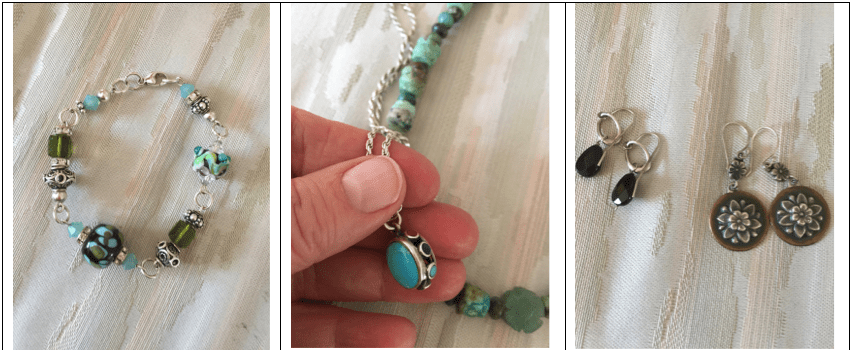
So many of the pieces I love and wear often—the bracelet my sister-in-law made for me, the necklaces a friend has sent me over the years, and the earrings my sons have given me—remind me of some of the special people in my life. Wearing these gifts is a secret source of joy.
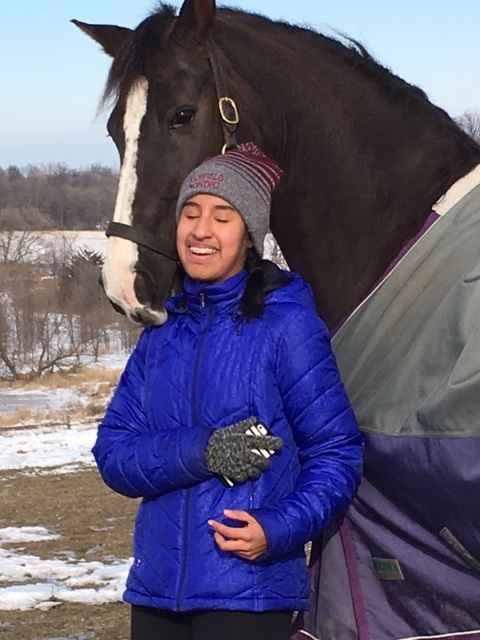
I was half way out the door when I heard, “Be safe. Don’t die.” It was Crystel’s voice. I cringed. She was 12-years-old. I thought of turning around to tell her not to say that. That it would be ‘nicer’ to say, “I love you.”
I paused. She was sincere. I didn’t say anything.
Instead, I asked myself backing out of the driveway, “Why am I uncomfortable? That it’s true? That at any moment I could die, be in a car accident, be shot in an airport, or fall on the Minnesota ice?”
Be safe, don’t die, has all the realness one can ask for in an adieu. It means, “I want to see you again. It means, don’t leave me. It means, I want you to come home.”
Jody remembers that it was after Crystel saw the movie, “If I Stay,” that she started saying, “Be Safe, Don’t Die.”
It was as if she understood that death happens. That people could leave their home and their life could forever be altered.
In the movie, life changes in an instant for Mia after a car accident puts her in a coma. During an out-of-body experience, she must decide whether to wake up and live a life far different than she had imagined. The choice is hers if she can go on.
Crystel is 14 now. She’s still telling me and her other family members to be safe and not to die. I find this comforting. She wants me around. She doesn’t want me to disappear from her earth. “Be safe. Don’t die,” has all the fondness of an “I love you.”
Now, Jody and I also tell her, “Be safe. Don’t die.” Our way of telling her that we love her.
Thanksgiving in Ohio a few years ago – Table set for 16 – before the dinner carnage
In the class where I assist, explaining the customs surrounding Halloween and Thanksgiving to adult immigrants who are learning English is challenging. Understanding American customs helps immigrants fit in, even if they aren’t likely to celebrate the holidays the exact same way long-time Americans do. However, Halloween and Thanksgiving have evolved so much from their original meanings that often it’s hard to make sense of our current practices.
When I try to explain Halloween, it sounds absurd.
In class, I hear myself say, “Halloween” comes from “All Hallowed’s Eve.” “Hallowed” refers to people who have died—their souls are “hallowed” or “holy,” and Christians believe good souls go to heaven after they die . . . .”
I write the words on the board and think, How can I possibly explain the history? I try this, “Hundreds of years ago the Celts—people who lived in Great Britain and northern Europe—believed that October 31st was the end of one year and November 1st was the start of a new year. At that time of year, dead souls could visit earth. People dressed in costumes to trick the returning spirits, so the spirits or ghosts couldn’t harm them.” Wow. That sounds completely bizarre. Why is this still a holiday?
I say, “Most people don’t really worry about ghosts, but people still enjoy dressing in costumes.” I pause after that semi-lame comment. Moving along, I start to describe how trick or treating works, but falter when explaining the reasons why that custom is acceptable. Give me a treat or else I’ll play a trick on you? On the face of it, that custom sounds like blackmail. Umm, in America, that how we do things??
Given the language barrier, I’m not sure how much the students understand.
Photo from traditionscustoms.com
The students from Mexico and Central America see the connection between American Halloween and Dia de Muertos (Day of the Dead) in which families visit cemeteries with food and mementoes, and they picnic at the gravesites. At best, the students from Africa and Asia look baffled by Halloween and Dia de Muertos, and at worst, they look repelled.
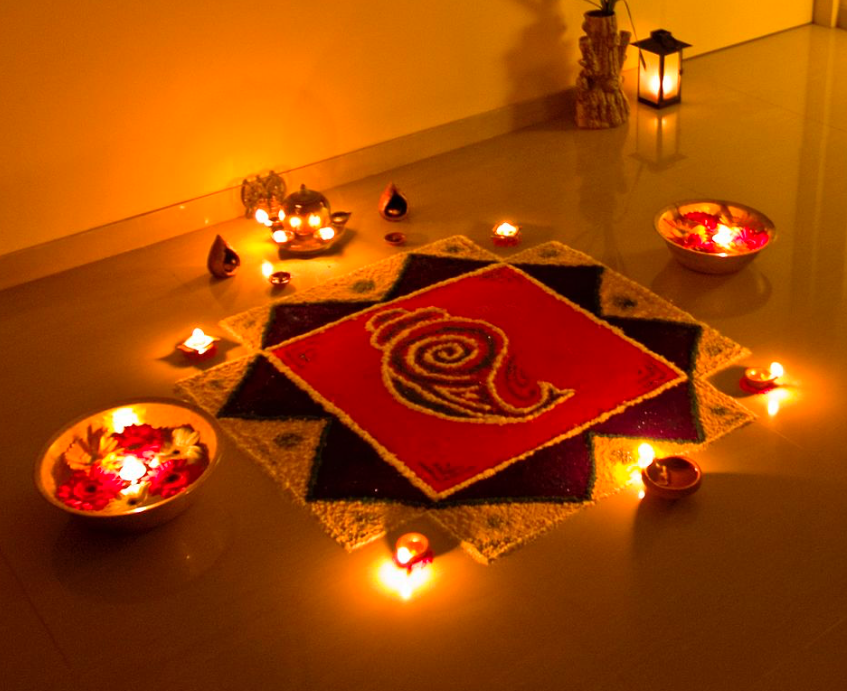
Photo by Subharnab Majumdar – originally posted to Flickr as The Rangoli of Lights (Diwali)
I extend our discussion to describe Diwali (also called Deepavali). It’s a Hindu festival of lights that’s celebrated in late autumn in parts of India, Sri Lanka, Nepal, Malaysia, and other countries in the region. People light candles and lamps, create intricate decorations called “rangoli” using colored powder, and families exchange small gifts to celebrate the triumph of light over darkness and knowledge over ignorance.
The Muslim Africans and Buddhists from Asia and begin to nod. They see that in countries across the world, celebrations take place in late autumn when the days grow shorter and darker. They understand that people need light, to gather together, and to celebrate with special food.
When we discuss Thanksgiving, I feel a different sort of disconnect.
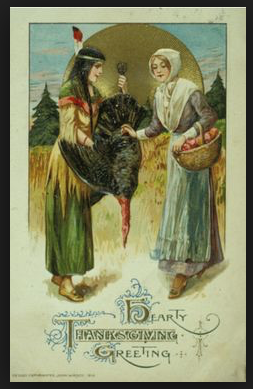
The official story of Thanksgiving is that Native Americans selflessly rescued starving Pilgrims by teaching them about North American foods—how to grow corn and squash and how to hunt local game and fish. To show gratitude after the first harvest, the Pilgrims prepared a feast and shared it with the local tribe. That’s the version I learned years ago in school, and it’s still favored today in many public schools.
Fairy tale version of the first Thanksgiving Historical postcard c. 1910 from Plimoth Plantation collection
But, I think, it’s only half of the story. European settlers also introduced smallpox and other diseases to Native Americans, who had no resistance to them. Thousands died. Often the Pilgrims’ interactions with local Indian tribes were disrespectful. Native Americans were seen as “savages” who had no religion of their own. For a long while after the Pilgrims claimed New England for their own, the invading European settlers and Native Americans engaged in raids and massacres. Millions were killed.
How far do I delve into the historical details? After the trouble explaining Halloween customs, I decide to mention, but only summarize, the difficulties between the Native Americans and the Pilgrims. Perhaps it’s wrong to round off history’s sharp edges, but I decide to focus on what connects people of different cultures. I describe the current meaning of Thanksgiving—to be grateful for what you have and to share a good meal (of whatever cuisine) with family and friends. When put in the simplest terms, the students understand the point of Thanksgiving.
By focusing on the essence of these customs—remembering the dead, pushing back darkness, being grateful for a plentiful harvest, and sharing a good meal with family and friends—students who come from Mexico, Venezuela, Colombia, Cambodia, Sri Lanka, Russia, Somalia, Ethiopia, Eritrea, and Vietnam find common ground with each other and with Americans.