Category: Family

  • Changing Thanksgiving Traditions

    When I was a girl, Thanksgiving dinner might occur on Thanksgiving itself or the day after—whichever day my father had off from the fire department.

    The table was set for eight with an ironed tablecloth, Mom’s sterling silverware, and her good ivory china bordered with a band of light blue and a thinner band of gold. My father presided at one end of the table and my mother faced him at the opposite end in the chair closest to the kitchen—in case she needed to hop up to get something. My two grandmothers, my two older brothers, my younger sister, and I filled out the sides.

    Mom masterminded the meal—getting up early to put the turkey in the oven, making the stuffing, the green bean casserole, mashed potatoes, gravy, and pie. One of my grandmas brought cranberries and the other brought rolls. My sister and I chopped onions and celery for the stuffing, stirred gravy, and set the table. We also helped clean up. But Mom bore the weight of making this holiday a success. Now that I’ve helped prepare many family holiday meals, I understand and appreciate how much work and pressure this labor of love can be. That we shifted days barely registered with me then. What I recall were the smiling faces and good food.

    As is the way of things, our family grew and we expanded the Thanksgiving table.First came my brother’s wife and their kids. Later, my great aunt and my mother’s sister, both widowed and childless, joined us. When my sister and I married and had kids, we enlarged the table again.
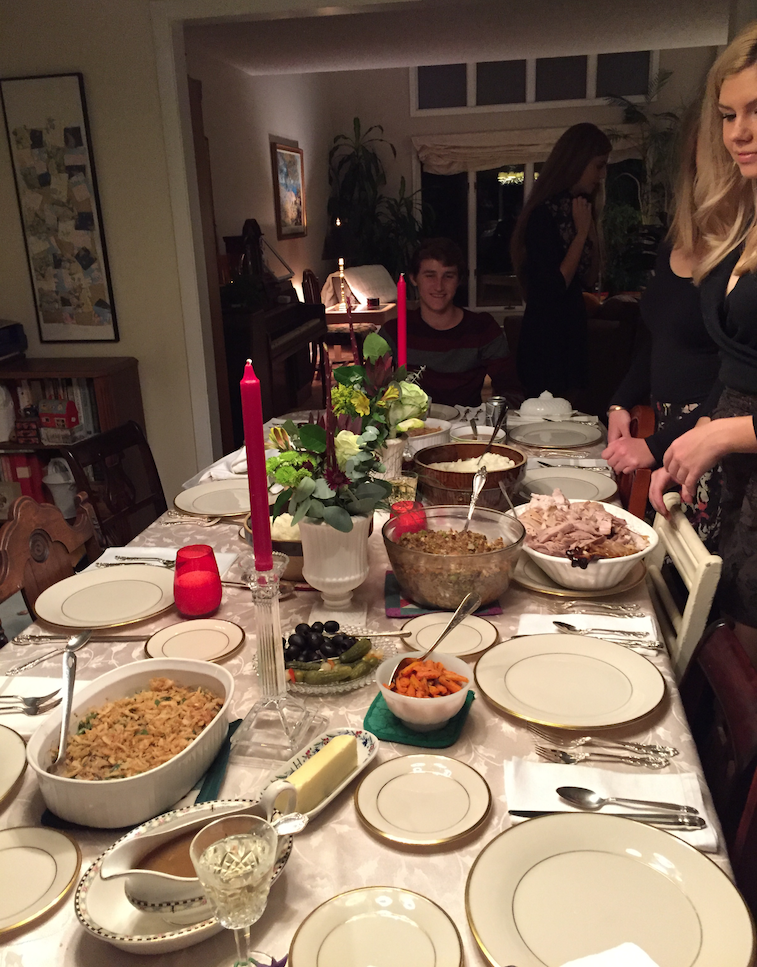
    At that point, there were too many of us for my parent’s small dining room. A dinner for 20-22 was getting to be too much for Mom, who was now in her mid-70’s. Thanksgiving dinner moved to my sister’s bigger house. My parents contributed pre-roasted turkeys from the deli, and Mom brought several pies. My siblings and I prepared the rest of the food. My sister set two adjoining tables with her sterling silverware, ivory china rimmed in gold, crystal goblets, and a flowery centerpiece. Wine flowed freely and we were a festive and rowdy bunch.

    In the last several years, the family circled around the Thanksgiving table has grown smaller. My parents and two aunts are gone now. Our small family of four doesn’t always travel to Ohio for the holiday. Sometimes my sons’ girlfriends join us at our smaller table, but now my sons each need to be a part of their girlfriend’s family gatherings, too. That’s as it should be. Holiday traditions are supposed to flex with a family’s changing circumstances.

    This year, the day of our Thanksgiving celebration shifted once again, because that’s what works best for our sons. Several days ago, I set out my good white china and sterling silverware, arranged flowers, cooked and baked, and gave thanks for the smiling faces at my table.


                    We at the WordSisters wish you a Happy Thanksgiving and hope there are plenty of smiling faces at your table.


  • Time Traveling

    toll road  Last week, I traveled back in time while driving to Ohio to visit my sister, brothers, and their families. The 12-hour road trip called for lots of tunes, and I found myself craving oldies that I could sing along to, even though I don’t usually like the oldies stations when I’m in Minneapolis.

    Reeling in the Years” by Steely Dan sent me back to college, when I hung out with my wild boyfriend, partied with his buddies, and took midnight dips in borrow ponds on hot summer nights.

    The Fifth Dimension brought back high school and sleepovers in a girlfriend’s basement rec room. We danced to the “Wedding Bell Blues” and sang it at the top of our lungs. At 14, we yearned for love and passion, but for most of us, that was still a ways off.

    As I drove through the neighborhood where I grew up, Roy Orbison’s “Pretty Woman” took me back to my best friend’s pool and her mother snapping off the radio when she heard his sexy growl. She thought it was unsuitable for our 10-year-old ears.

    Several times I got lost while bumping along Toledo’s crumbly blacktop roads that are scribbled with tar. I’m no longer as sure of my way around—I’ve been gone 30 years—longer than I lived there.

    But inside my sibling’s homes I found myself. I became the middle sister again, the one who loves Bruce Springsteen like my sister and the Beatles and Creedence Clearwater Revival like my brothers.

  • The Care Giver Relay

    Baby Boomers ran the first relay race known as working and maintaining families without help or comprehensive policies from our government.  Day care, sick child care, after school care, elder care. Home or facility based? Who takes the call when the plan falls apart? Who helps the cared one feel comfortable?

    I’ve run all legs of that relay using strategies that worked in the moment for our kids, ourselves, our parents. We had wonderful experiences, and days I hope no one remembers. The cry of a toddler dealing with separation anxiety, a sick child asking a parent to stay with them, the whine of a school kid not wanting a babysitter, all disappear as a family matures.

    The set of sounds that haunt me is a fragile parent demanding you stay, forgetting anything else exists in your world because they are anxious, the suggestions of hired caregivers that maybe dad would feel better if you walked out of a work meeting to come spend an hour. When you are carrying the heaviest responsibilities of a job that provides for the family you created, those calls tilt the world. Different, but equally difficult if you live miles away or states away.

    Our local newspaper is running a series of stories about family elder care providers, also known as adult children. Just like searching for quality child care decades ago, individuals quickly discover there is no safety net or logical system to access when an elder family member needs help. It isn’t there so don’t do an online search. Network, know the finances of the person depending on you as well as their needs, then do the best you can. And do it right now. The hospital plans to discharge the individual tomorrow afternoon.

    It isn’t an employer’s responsibility to expect less of you because an ill spouse or parent has doctor appointments, physical restrictions, emotional insecurity or a string of emergencies. Increased longevity does not equal decades of quality living. Without a safety net, it will be you standing on one foot balancing too many glass balls.

    Elder care was the most difficult leg of the relay. Unlike an expected due date, elder + care can become part of your life any day or in a few months or years. That relay leg is run on a special course with more rocks than cushion. The vulnerable one can have physical needs but be capable intellectually and aware that they have become a burden. The vulnerable one may be physically capable but wandering in dementia. There is no known end. Your loved one will not enter kindergarten in twenty months. This part of life has no schedule for the refrigerator. You will have days that vaguely resemble television commercials where adult children chat with a professional provider and mother is wearing pearls. There will be more days that you lift a fragile loved one off the toilet in a bathroom that could use a better cleaning. You do the best you can.

    No need to continue. Many of us have run the race and placed somewhere in the standings. Some finish their caregiving with shaky finances, some with high blood pressure and anxiety of their own, some with a scrapbook of treasured memories. As a Baby Boomer, I fear the end of life years for many reasons. Not the least that there is no national forethought about caring for the coming gray tsunami. Maybe like the baby boomlet of the 1980s, we’ll just let the Gen Xers and Millennials stumble through working long hours, raising their own children, dealing with deep debt, and caring for a couple of vulnerable elderly parents.

    It isn’t going to be pretty.


    fullsizeoutput_12d6