Category: Culture

  • Disappearing—The Joy of Reading?

    I was sad to hear a book group friend say her 11-year old-granddaughter didn’t consider it a treat to go to a bookstore to choose a book—she doesn’t read books. I was slow to realize the books I’d been gifting my 10-year-old niece weren’t a hit. Not because I’d chosen boring stories but because she doesn’t enjoy reading. It saddens me they won’t have the pleasure of being immersed in the imaginary worlds I have so enjoyed.

    Although it sounds counterintuitive, fiction presents truths through the lives of made-up people.

    I’ve learned about worlds I wouldn’t have access to any other way. Through novels, I’ve entered the lives of a Black Texas Ranger, an 15th century Chinese physician, an escaped enslaved woman, a modern-day reporter in India, Korean deep-sea divers, and more. I’ve gained insight and empathy by seeing cultures beyond my own and feeling the dilemmas of people unlike me. Memoirs also offer me inspiration and perspective for my own life.

    Recently, the disinterest in reading novels and the related inability to read whole books has been receiving attention. Several theories may explain the change.

    Instead of reading whole novels, many middle school students read excerpts and are tested on their ability to write critical analyses of the excerpts. To be sure, critical analysis is an important skill, but it appears to have the unintended consequence of editing out the joy of completing a good, satisfying story. 

    Reading whole novels requires skills many high school students aren’t taught. They grow bored, can’t follow the plot, and don’t connect to the characters or themes.

    That puzzles me, because TV and movies still engage us. With “Game of Thrones,” “Succession,” or “Slow Horses,” viewers enter into invented worlds and can track the plot and characters, so why not in novels and memoirs, whether paper or Kindle books? Perhaps nonreaders have lost the ability to imagine. With TV and movies, the visuals are supplied.  

    Shorter attention spans are also part of the problem, and students aren’t alone in this. Myriad distractions clamor for our attention and our culture serves up lots of information in short bits—texts, Instagram posts, 35- to 50-word news summaries. In 20 minutes, I might read a dozen short clips instead of one 3,000-word article. Constant interruptions have diminished my powers of concentration. I can still enjoy a 400-page novel, but these days, I get restless and impatient with longer novels.

    I learned to love reading whole stories as a girl when there were far fewer distractions. At 8 years old, I draped myself across an upholstered chair and devoured Nancy Drew mysteries. By 14, it was Daphne du Maurier. Often, I wonder about the characters in novels I’m reading and am eager to find out what happens next. 

    I wish my niece, my friend’s granddaughter, and their peers could experience the gift of being immersed in good books. The joy of being transported to another time or culture. The hours of pleasure, escape, and knowledge.

  • Five Simple Ethics Lessons from NYT’s Kwame Anthony Appiah

    “Advice on life’s trickiest situations and moral dilemmas.”

    That’s the promise made by New York Times’ ethicist Kwame Anthony Appiah. I have found his columns immeasurably interesting and packed with ethical dilemmas ranging from “what do I do now that I’ve hidden my trust fund from my wife for 15 years” to “can people claim spots on the beach with empty chairs” to “does my fiancée love me or does he just want citizenship?”

    Thanks to Appiah, I’m becoming wise enough to know that while my advice to others is well-intentioned, it may not always be helpful or even all that ethical. Here are five lessons I’ve learned by reading his columns:

    Lesson #1: There are no one-size-fits-all solutions
    Ethical dilemmas are rarely black and white. What’s right in one situation may not be in another. The columns remind me that ethics is a nuanced field, one with shades of grey. Solutions must be tailored to individual circumstances. Doing so prevents us from adopting a rigid moral framework and encourages us to consider the context and consequences before making decisions.

    Lesson #2: Empathy is key
    By putting myself in the shoes of those affected by my choices, I develop a deeper, more nuanced understanding of how my choices impact others. This helps me recognize the interconnectedness of human experiences, encouraging me to consider not just my immediate interests, but also the well-being of others who may be impacted by my decisions.

    Lesson #3: Balance principles with real-world constraints
    The Ethicist columns show that while our ethical values are important, so is our ability to compromise.

    Lesson #4: Seek guidance and diverse perspectives
    Reading, discussing options and seeking feedback from can expand our understanding and help us see things we might otherwise miss.

    Lesson #5 Continually learn and adapt
    Ethical thinking is not static; it evolves over time as societal norms change and our understanding of complex issues deepens. It also changes as we age. That’s one reason the Ethicist columns underscore the importance of continuous learning and adaptation based on current events and ongoing self-reflection.

    The NYT’s Ethicist columns serve as a guiding light for me. Perhaps they will for you as well.

  • Finding Common Ground in the Essence of the Holidays

    Thanksgiving in Ohio a few years ago - Table set for 16 - before the  carnage
    Thanksgiving in Ohio a few years ago – Table set for 16 – before the dinner carnage

    In the class where I assist, explaining the customs surrounding Halloween and Thanksgiving to adult immigrants who are learning English is challenging. Understanding American customs helps immigrants fit in, even if they aren’t likely to celebrate the holidays the exact same way long-time Americans do. However, Halloween and Thanksgiving have evolved so much from their original meanings that often it’s hard to make sense of our current practices.

    When I try to explain Halloween, it sounds absurd.

    In class, I hear myself say, “Halloween” comes from “All Hallowed’s Eve.” “Hallowed” refers to people who have died—their souls are “hallowed” or “holy,” and Christians believe good souls go to heaven after they die . . . .”

    I write the words on the board and think, How can I possibly explain the history? I try this, “Hundreds of years ago the Celts—people who lived in Great Britain and northern Europe—believed that October 31st was the end of one year and November 1st was the start of a new year. At that time of year, dead souls could visit earth. People dressed in costumes to trick the returning spirits, so the spirits or ghosts couldn’t harm them.” Wow. That sounds completely bizarre. Why is this still a holiday?

    ghosts
    Image from http://www.hdwallpapers.in/halloween_ghosts-wallpapers.html

    I say, “Most people don’t really worry about ghosts, but people still enjoy dressing in costumes.” I pause after that semi-lame comment. Moving along, I start to describe how trick or treating works, but falter when explaining the reasons why that custom is acceptable. Give me a treat or else I’ll play a trick on you? On the face of it, that custom sounds like blackmail. Umm, in America, that how we do things??

    Given the language barrier, I’m not sure how much the students understand.

    cemetary
    Photo from traditionscustoms.com

    The students from Mexico and Central America see the connection between American Halloween and Dia de Muertos (Day of the Dead) in which families visit cemeteries with food and mementoes, and they picnic at the gravesites. At best, the students from Africa and Asia look baffled by Halloween and Dia de Muertos, and at worst, they look repelled.

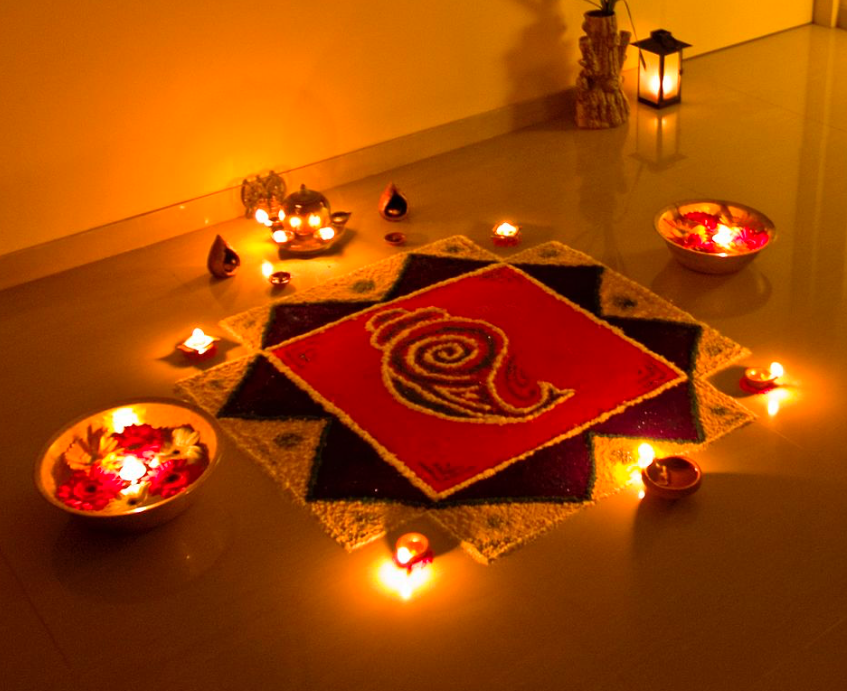
    Photo by Subharnab Majumdar - originally posted to Flickr as The Rangoli of Lights
    Photo by Subharnab Majumdar – originally posted to Flickr as The Rangoli of Lights (Diwali)

    I extend our discussion to describe Diwali (also called Deepavali). It’s a Hindu festival of lights that’s celebrated in late autumn in parts of India, Sri Lanka, Nepal, Malaysia, and other countries in the region. People light candles and lamps, create intricate decorations called “rangoli” using colored powder, and families exchange small gifts to celebrate the triumph of light over darkness and knowledge over ignorance.

    The Muslim Africans and Buddhists from Asia and begin to nod. They see that in countries across the world, celebrations take place in late autumn when the days grow shorter and darker. They understand that people need light, to gather together, and to celebrate with special food.

    When we discuss Thanksgiving, I feel a different sort of disconnect.

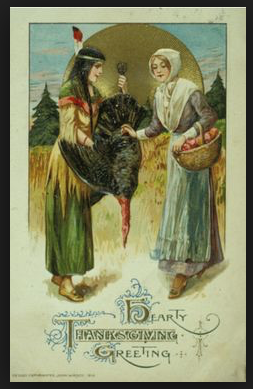
    The official story of Thanksgiving is that Native Americans selflessly rescued starving Pilgrims by teaching them about North American foods—how to grow corn and squash and how to hunt local game and fish. To show gratitude after the first harvest, the Pilgrims prepared a feast and shared it with the local tribe. That’s the version I learned years ago in school, and it’s still favored today in many public schools.

    Fairy tale version of the first Thanksgiving
    Fairy tale version of the first Thanksgiving Historical postcard c. 1910 from Plimoth Plantation collection

    But, I think, it’s only half of the story. European settlers also introduced smallpox and other diseases to Native Americans, who had no resistance to them. Thousands died. Often the Pilgrims’ interactions with local Indian tribes were disrespectful. Native Americans were seen as “savages” who had no religion of their own. For a long while after the Pilgrims claimed New England for their own, the invading European settlers and Native Americans engaged in raids and massacres. Millions were killed.

    How far do I delve into the historical details? After the trouble explaining Halloween customs, I decide to mention, but only summarize, the difficulties between the Native Americans and the Pilgrims. Perhaps it’s wrong to round off history’s sharp edges, but I decide to focus on what connects people of different cultures. I describe the current meaning of Thanksgiving—to be grateful for what you have and to share a good meal (of whatever cuisine) with family and friends. When put in the simplest terms, the students understand the point of Thanksgiving.

    By focusing on the essence of these customs—remembering the dead, pushing back darkness, being grateful for a plentiful harvest, and sharing a good meal with family and friends—students who come from Mexico, Venezuela, Colombia, Cambodia, Sri Lanka, Russia, Somalia, Ethiopia, Eritrea, and Vietnam find common ground with each other and with Americans.