Category: Conversation

  • Reclaiming My Focus

    Focus. It’s an ability I used to take for granted. But not anymore. For whatever reason—age, information overload, pandemic-induced anxiety—I’m just not able to concentrate the way I once did.

    Is the inability to do so a warning sign of cognitive decline?

    After coming across conflicting opinions online, that’s a question I plan to ask at my next physical. In the meantime, I did what I usually do when seeking answers, I found a book to read: Stolen Focus: Why You Can’t Pay Attention and How to Think Deeply Again byJohann Hari.

    What I learned—that our attention is being stolen—was disturbing enough but the fact that Facebook and other social media companies have intentionally designed their sites to keep us online and coming back so they can maximize their revenue has prompted me to shy away from logging on.

    Despite this, Amazon knows what I’m reading, and Alexa often knows what I’m having for dinner. Google Nest knows if I’m home, and Google Maps knows where I’m at when I’m not.

    While there are some positives to this—for instance, I no longer have to look up and then print directions—I don’t like feeling that I’m being surveilled.

    So I unplugged Alexa and put her in the basement, and I closed out 60+ accounts I rarely use. I also unsubscribed from dozens of e-letters.

    And, after a University of Oregon study found that if we are focusing on something and get interrupted, it takes 23 minutes on average for us to get back to the same state of focus, I’ve turned off the ringer on my phone and no longer leave email open all day.

    The goal: to return my focus to what I really want to be paying attention to: my family and friends and the causes I care about.
  • Seen and Heard

    Recently, I was reminded that seemingly small moments can have a lasting impact. My mother-in-law told me about her visit with a local librarian. They got to know each other, and now the librarian chooses books for her as part of a library outreach program for people who don’t drive. Although the librarian came only once, her visit meant a lot to my mother-in-law.

    Every now and again, acquaintances tell me about a time when something I said or did came at exactly the right time. Often, I’m surprised because I don’t remember the moment and wasn’t aware that I’d had any special impact. With that in mind, I try to be gracious when someone I don’t know well wants to talk. Maybe they need to be heard.

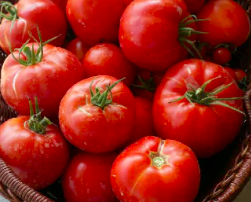
    I love good tomatoes and there’s one vendor I look for at the St. Paul Farmer’s Market, because his tomatoes are consistently good. We have a nodding acquaintance—we know each other’s faces, but not each other’s names.

    The last time I saw him, he asked me if I liked the Tennessee Ernie Ford song that the market’s musical entertainer had just played. I agreed that it was a good oldie and recalled that a neighbor friend’s mother used to play it on the stereo.

    Then the tomato vendor told me he loves to sing, and he sang a little of the song in a surprisingly rich bass. I complimented him, and he explained that when he was young, a voice teacher taught him to breathe properly. Now he shows the guys in his church choir how to breathe so they won’t strain their voices when they try to sing bass.

    As I walked away, I realized that after our longer-than-expected conversation, I had a fuller sense of him as a person. I don’t know if the conversation meant anything to him or not. Maybe he needed to be seen, wanted someone to know that tomato farming was just one dimension of his life. Or maybe he was just bored and feeling chatty.

    Either way, I’m glad I listened. There’s a gift to me in that.

  • Resisting Assumptions

    The last time I gave blood, a tech named Dakota took care of me. When she introduced herself, I didn’t expect we’d have much in common. She was in her 20’s and had full sleeves of tattoos and several facial piercings, while I look like the middle-aged, mom-ish person I am. However, she surprised me.

    She made a real effort to talk to me, which I appreciated because giving a pint of blood takes about half an hour and you’re tethered to a gurney the whole time. You can stare into space, listen to music and daydream or play with your phone, which is what I was doing when she tried for a second time to start a conversation. I apologized and set my phone aside. She sympathized and said she’d recently read an article about how involvement with cell phones can put a damper on actual conversations. Her comments sounded like something I would say, not something I expected of someone her age. It was a minor moment, but it reminded me how difficult it is to resist making assumptions.

    Making assumptions is natural and necessary.

    Every day we receive such an onslaught of information—online, at work, and during casual personal encounters at a coffee shop, gas station, or wherever—that our brains simplify and categorize it. We have to. Otherwise, we’d be paralyzed by making sense of the input. The downside of this tendency is stereotyping.

    It’s a wonder people ever make genuine connections! And yet, I’m committed to trying.

    Resisting stereotypes about age, race, gender, politics and so forth, takes a lot of energy. The situation is made doubly difficult because whomever I’m encountering has his or her own set of biases to overcome. But in a culture that’s rife with hateful stereotypes, I’m trying harder to see each person I meet as the individual she or he is.

    At its most basic level, my efforts consist of looking strangers in the eyes and smiling. Just seeing them and looking friendly. Some people don’t return my smile, but a lot of them do. It occurs to me that I may look like a smiling idiot—a dotty lady on the loose—but I’m willing to take the risk.

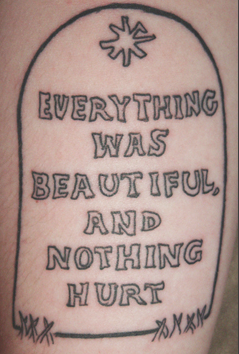
    In Dakota, I found an interesting woman who wants to be a nurse, while I’ve worked for hospitals off and on throughout my career. We’d both lived in Morris, Minnesota, although decades apart. As she described what her tattoos meant to her, it was clear her body is her canvas. I mentioned an ironic tattoo I like that’s in the shape of a tombstone and reads, “Everything was beautiful, and nothing hurt,” a quote from Kurt Vonnegut’s Slaughterhouse Five. Turns out we both like Vonnegut.

    Next time I have a chance to make a casual acquaintance, I’ll try to be the one who initiates conversation.