Category: Cell phones

  • Kids and Keyboards–A Dilemma

    I recently read that Silicon Valley parents are concerned about how using cell phones, tablets, and computers in the classroom affects children’s development. Wait, what?!? The creators of the screens and software don’t want their children using them? The  New York Times article described how families across the country are reconsidering the role of technology in the classroom.
    Whoa. I recall fundraising with the PTO so students at my sons’ school would have computers in the classroom. We wanted our kids to be ready for the world they’d be joining. When my nieces attended a Catholic high school in Ohio, they were given laptops to use with their school work.

    Truth be told, even then I had misgivings about the amount of screen time my kids had. A recent conversation with neighbors, whose children grew up with mine, confirmed that I wasn’t alone. The other mothers—an artist, a human resources manager, and a psychologist—have all seen the downsides of too much screen time.

    The artist was the first to mention the impact on creativity, but all of us  expressed similar concern. When consumed by screen use, children don’t have the opportunity to daydream aimlessly or use their imagination to invent games. The other mothers and I remembered that as kids, we made up goofy games that required imagination but little equipment—building a fort out of sofa cushions or raking leaves into piles that framed “rooms” in the yard.

    Another effect we’ve all seen is underdeveloped social skills. While plenty of young adults are socially adept, some of the young adults we know are awkward in face-to-face conversations. They struggle when talking with people—in job interviews and when dealing with older coworkers. For some, in-person discussions are mistaken for disagreement and conflict, instead of the normal give and take of conversation. Texting and IM’ing are more comfortable. It’s easier for them to express their opinions with the distancing filter of a screen.

    None of us were suggesting that children shouldn’t use computers or cell phones. Personally, I love my phone, tablet, and laptop and recognize that using technology is a vital part of modern life. However, being selective about when, where, and how much children use technology is important. Although our kids hated it, the other mothers and I limited the amount of time our kids spent using screens.

    Limiting screens is an even greater challenge for today’s parents and teachers. Teachers struggle with the disruption of cell phones in the classroom. Parents now have to contend with the potential dangers of social media and the content of their children’s Internet searches. I feel fortunate my kids were older by the time social media was widespread. That was one problem I didn’t have to face.

    A younger mother I know locks up her teenagers’ phones and computers at bedtime so they aren’t online or texting into the wee hours—they need their sleep, and she needs some peace of mind. If her kids’ grades slip, they lose phone privileges.

    It’s disconcerting to realize that the very screens that we sought for our kids years ago could both expand their horizons and limit their potential. But just as we did, I am confident today’s parents will figure out a way to handle the challenges of technology.

  • Opposing Thumbs

    In 1975, as I sat in Miss Bloom’s typing class, I never thought that one day I’d be typing primarily with my thumbs. I’m sure Miss Bloom, ancient even then, couldn’t have imagined a keyboard so tiny that even the end of her thumb would be too large to hit just one key.

    I picture myself in her class, feet planted firmly on the floor, my skirt pulled down over my knees, fingers curled over the keys of the IBM Selectric in front of me. Four rows of eight desks neatly lined the room. The only sounds were the soft squish of Miss Bloom’s orthopedic shoes on the linoleum floor as she paced up and down the rows checking our posture, and the hum of the newly purchased typewriters in front of us. (What a marvel those electric typewriters were. How much easier than the 1928 Smith Corona I used at home.)

    What were my lonely thumbs doing then? They were relegated to the space bar, waiting for the opportunity to create a void between words. Only my right thumb ever got any business, the left thumb dangled uselessly while all of the other digits pounded away at 65 words per minute.

    No wonder that now my thumbs have trouble finding the letters when I answer e-mails or send my daughter a text message from my iPhone. They’re not conditioned for this kind of work. Now they’re front and center, the rulers of the written word while my fingers curl around the back of my handheld device, providing support, but little else.

    Occasionally my right index finger can’t stand the pressure and it says to its friends on my left hand “Take over. I’m going in!” as it darts from behind the screen to hunt and peck for the letters, thinking itself faster than my clumsy thumbs.

    But even this is unsatisfying, because my right index finger doesn’t know the keyboard any better than my thumbs. The only familiar keys are y, u, h, j, n and m. And what can you spell with only those letters? Eventually, my index finger gives up and returns to its friends behind the screen, letting the thumbs take over because they at least can work together, doubling the speed of my messaging.

    Gone are the days of 65-75 words per minute. My thumbs are lucky if they can get in 20. So they’re less creative. A reply that once might have been “I’d love to join you on Saturday evening. A trip to the theatre sounds like fun,” becomes “K” or more likely a thumbs up emoji, but rarely anything longer. It’s just too slow, too cumbersome, too demoralizing to spend so much time pecking for the keys and constantly backspacing to correct mistakes.

    I’d like to say my thumbs are happy, that they’re glad for the opportunity to carry the torch after all these years. But I don’t think they are. I think they miss the days of working in tandem with my fingers, resting lightly on the space bar while the fingers searched for just the right sequence of letters. I think they’re lonely out there in front by themselves. Who knows? I could ask them, but they’d probably just reply, “IDK, may b. U D cide.”


    Guest blogger and WordSister Jill W. Smith is a Twin Cities’ writer. Her work has appeared in the anthologies Here in the Middle: Stories of Love, Loss, and Connection from the Ones Sandwiched in Between; A Cup of Comfort for Parents of Children with Autism; and Siblings: Our First Macrocosms, in the online journal Mothers Always Write, and occasionally on her blog, The Autism Fractal, which she co-authors with her oldest daughter.

  • Resisting Assumptions

    The last time I gave blood, a tech named Dakota took care of me. When she introduced herself, I didn’t expect we’d have much in common. She was in her 20’s and had full sleeves of tattoos and several facial piercings, while I look like the middle-aged, mom-ish person I am. However, she surprised me.

    She made a real effort to talk to me, which I appreciated because giving a pint of blood takes about half an hour and you’re tethered to a gurney the whole time. You can stare into space, listen to music and daydream or play with your phone, which is what I was doing when she tried for a second time to start a conversation. I apologized and set my phone aside. She sympathized and said she’d recently read an article about how involvement with cell phones can put a damper on actual conversations. Her comments sounded like something I would say, not something I expected of someone her age. It was a minor moment, but it reminded me how difficult it is to resist making assumptions.

    Making assumptions is natural and necessary.

    Every day we receive such an onslaught of information—online, at work, and during casual personal encounters at a coffee shop, gas station, or wherever—that our brains simplify and categorize it. We have to. Otherwise, we’d be paralyzed by making sense of the input. The downside of this tendency is stereotyping.

    It’s a wonder people ever make genuine connections! And yet, I’m committed to trying.

    Resisting stereotypes about age, race, gender, politics and so forth, takes a lot of energy. The situation is made doubly difficult because whomever I’m encountering has his or her own set of biases to overcome. But in a culture that’s rife with hateful stereotypes, I’m trying harder to see each person I meet as the individual she or he is.

    At its most basic level, my efforts consist of looking strangers in the eyes and smiling. Just seeing them and looking friendly. Some people don’t return my smile, but a lot of them do. It occurs to me that I may look like a smiling idiot—a dotty lady on the loose—but I’m willing to take the risk.

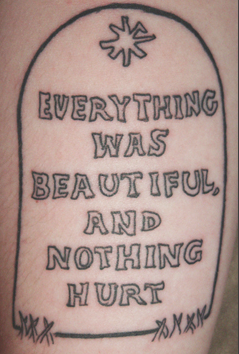
    In Dakota, I found an interesting woman who wants to be a nurse, while I’ve worked for hospitals off and on throughout my career. We’d both lived in Morris, Minnesota, although decades apart. As she described what her tattoos meant to her, it was clear her body is her canvas. I mentioned an ironic tattoo I like that’s in the shape of a tombstone and reads, “Everything was beautiful, and nothing hurt,” a quote from Kurt Vonnegut’s Slaughterhouse Five. Turns out we both like Vonnegut.

    Next time I have a chance to make a casual acquaintance, I’ll try to be the one who initiates conversation.