Category: Baby Boomers

  • Halloween Past—St. Helena by Day, Fairy Godmother by Night

    When I think of Halloween, this memory comes to mind: cutting across neighborhood lawns (it was faster than running down the sidewalk and up each driveway) and clutching a pillowcase that was at least one-third full of candy. It was dark and the streetlights were on, but I wasn’t scared, because decades ago when I was 9, none of us worried about crime. Besides, I ran in a pack with half a dozen other kids who were also trick or treating.

    How I imagined my costume looked . . .

    I recall jogging down Charlestown St., several blocks away from my house, because more is more, and I wanted to cover as much territory as possible before 8:00 p.m. when I had to be home. My parents were home, not trailing along on the sidewalk or in the car. I doubt Mom even remembered to take our picture before we left. Halloween was for kids, not parents.

    That was an era before tampered-with Tylenol or razor blades in apples. I was old enough to take care of myself in the neighborhood. Running block after block was no trouble because I was 9, and kids ran everywhere, especially if it meant more candy.

    My molded plastic fairy godmother/princess mask was pushed up off my face so I could see while I ran. I’d pull it down before I rang each doorbell. I had hiked up my belted white shift so I could run, and my blue cape floated behind me. I had worn this same costume to school—minus the mask and magic wand/scepter—so I could go as St. Helena, as my saint namesake, a Catholic school requirement.

    St. Helena

    The nuns at my grade school kept us rooted in the religious meaning of Halloween—All Hallowed’s (Saints) Eve. November 1st is All Saints Day, which involved going to Mass and praying for the dead, but it didn’t really resemble the Mexican Day of the Dead (Día de Muertos). Supposedly, that’s a day when the boundary between the worlds of the living and the dead thins and spirits of the dead can visit.

    However, the usual boundaries of my life were also looser at Halloween. My parents were indulgent. They didn’t fuss about us being out after dark on a school night. They reserved the right to cherry-pick some of the better loot, like Reese’s cups and Butterfingers, but I got to keep and eat the rest of my Halloween candy.

    What I remember most is how carefree I was.

  • Enlarging My Circle

    cactus-flower-2For years, my husband and sons visited relatives in Green Valley, a retirement community in Arizona. I loved seeing our family and experiencing spring in the desert. But I disliked the way some of the residents had become intolerant of young people and as prickly as the blooming cactus that surrounded us. I vowed that wouldn’t be me. While I was still working for pay, I didn’t have to think about how to make good on that promise. I had friends of all ages among my coworkers. Now that I’m retired, I want to be more intentional about connecting with younger people (younger than a Baby Boomer, that is).

    Though older, I’ll be the seeker, not the sage.

    I’ve learned so much from my sons, so I want to go further and invite more people of other generations into my life. I hope to learn from people who are at different stages of life from mine and understand how they see the world, what their challenges, reactions, and solutions are. To know what they know. To welcome their insights and wisdom.

    Making connections is part of my personal style.

    Networking is one way people connect with strangers and make friends of acquaintances. While I was a freelance writer, I networked for professional reasons. Often the connections I had with clients and colleagues sparked friendships that have lasted 5, 10, or 20 years.

    My plan is more of an outlook than a highly systematic effort.

    My current idea isn’t exactly “networking,” which implies a career emphasis. Instead, I hope to continue to do what I have always done—make and keep friends. The part that requires more focus is putting myself in settings where I will meet new people of all ages. Then, if we like the same things and have common interests, friendships will have the chance to blossom.

    For example, a young woman I know manages communications for a nonprofit. We met when I started volunteering there, and since then, we have become friendly.

    I recently reconnected with a younger writer who’s a friend’s daughter. The daughter is traveling in Europe and writing about her experiences. One of her blogs reminded me how I felt while traveling alone in Europe in my later 20’s, so I sent her a note. Currently, we are acquaintances, but I’m open to getting to know her better.

    One of the women who styles my hair is at least 20 years younger than I am, but we have discovered that we have similar taste in movies and politics. Recently, her family experienced a crisis, and it was comforting to her to see that I really understood her reactions—our temperaments are similar too.

    I value my longstanding friendships with people my age, but I hope to enlarge the circle to include friends of all ages.

  • Anachronisms (Or 3 Reasons Why I Love My Electronic Devices)

    My youngest son and I were talking about eating alone in restaurants, when I flashed back to life before cell phones, tablets, GPS and Internet connectivity. He’s a nice guy, so he didn’t tease me about my “Why in my day, Sonny, we used to . . .” moment. Electronic devices have profoundly changed the outcome of several awkward or frustrating experiences.

    Eating Alone

    While traveling for business in the late 1980’s, I faced a dilemma that no longer exists: how to eat alone in a restaurant without looking weird or attracting unwanted attention.

    Articles for career women advised bringing a book and reading at dinner. That way you wouldn’t feel stupid, and you wouldn’t attract sleazy guys trying to pick you up. Or you could order room service and avoid the whole issue.

    I usually preferred a good meal with a glass of wine to a dry turkey sandwich in my room, so I learned to carry a book. Wait staffs’ reactions and service varied from dismissive to sympathetic. To boost my confidence and convey that I had a right to be there, I was pleasant but a bit aloof. While waiting for my order I sipped my wine and read. Usually that worked, but sometimes I didn’t have the energy for the performance.

    Now I can take my smartphone or tablet and catch up on email, check Facebook, read online, or write and be legitimately busy and content. I don’t have to worry that I look pathetic or vulnerable.

    Missing Connections

    Before cell phones, bad luck could ruin a rendezvous. Imagine this: you’re in Chicago on business. You have a free afternoon before your flight and want to see a college friend. You agree to meet by the lions in front of the Art Institute at 1:00. By 1:15, you’re checking your watch and wondering. At 1:35, you’re frustrated and uncertain. Stay? Go? What’s going on?!?

    Screen Shot 2015-05-27 at 10.47.28 PM

    There was no way for your friend to call or text to say, “Missed my train. Can I meet you inside by the Chagall window at 2:00 instead?” You could go inside alone but she’d have no idea where to find you. Or you could leave, angry and disappointed. Either way, you would have missed each other. The afternoon of laughs and reminiscing couldn’t be salvaged.

    Getting Lost

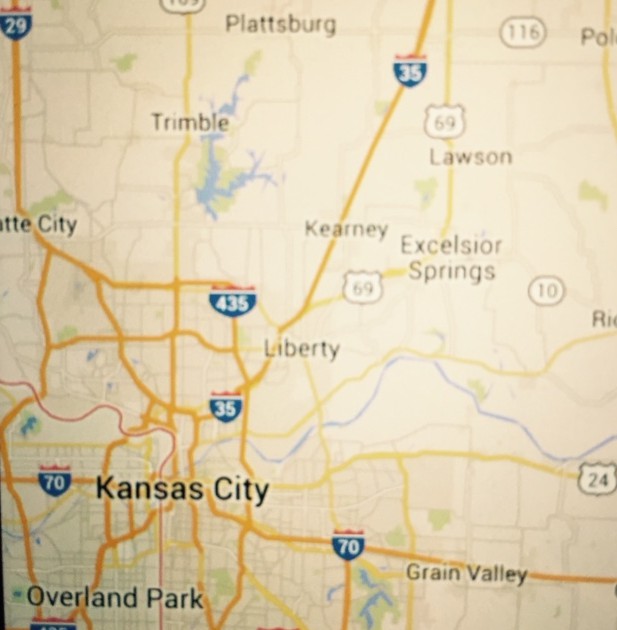
    MissouriFor years, I’ve driven cross-country for family visits to Ohio or vacations in Virginia, Texas, and Montana. I also think nothing of driving to a distant suburb to meet friends for dinner. Usually I navigate these trips successfully . . . as long as I have a map or Garmin for GPS.

    Occasionally, though, I’ve gotten spectacularly lost. Driving 30 miles out my way near Green Bay, Wisconsin. Circling Eden Prairie, Minnesota for 40 minutes (and Eden Prairie isn’t that big). Hubris accounted for these mishaps. I thought I knew where I was going, so I didn’t bring a map.

    Back in the day, the only solution was to stop and ask for directions. I had to hope the person was reliable and not a knucklehead who’d send me the wrong way, because he forgot to mention three important turns.

    If there’s no cell phone signal (rural Montana and Wisconsin come to mind), I can be just as lost as in the old days. Google maps and GPS have definitely reduced the likelihood that I’ll get lost during a road trip, but sometimes they are wrong or incomplete. Just in case, I still carry a paper map and keep my cell phone charged up.

    How about you? What difficult situation has become a thing of the past because of your electronic devices?