Category: Baby Boomers

  • Je M’appelle Frisque

    My grandparents’ families came from places like Walhain-St. Paul, Incourt, Nievelles, Tourinne-St. Lambert, and Huldenberg in Walloon Brabant, Belgium. Impacted by the same potato famine that brought many Irish to the United States, the Belgians made their way to Wisconsin communities with names like Brussels, Tonet, Namur, Luxemburg, and Walhain. The homes they left had been clustered in an area about forty miles wide. The farm towns they carved out of tree-covered land, almost four thousand miles across an ocean and half a continent, were about the same distance apart.

    When I was a child I spoke some Walloon, a nearly forgotten language, with my Belgian-American great-grandmother and her friends as they quilted in our living room. We ate Belgian farm food like jut, a boiled cabbage side dish, stoemp, a mashed potato and cabbage dish, trippe, a bratwurst-type sausage, booyah, a chicken-based soup with many ingredients, and Belgian pie, a sweet dough tart filled with prunes and a cream cheese style top. Our Catholic church held a Kermis celebration in autumn. Beyond jokes about how much Belgians sweat or drank or were short, maybe stout, that’s about what I knew of our heritage. All the amazing accomplishments of the Belgians or their art or chocolates were from a different socio-economic part of the country.

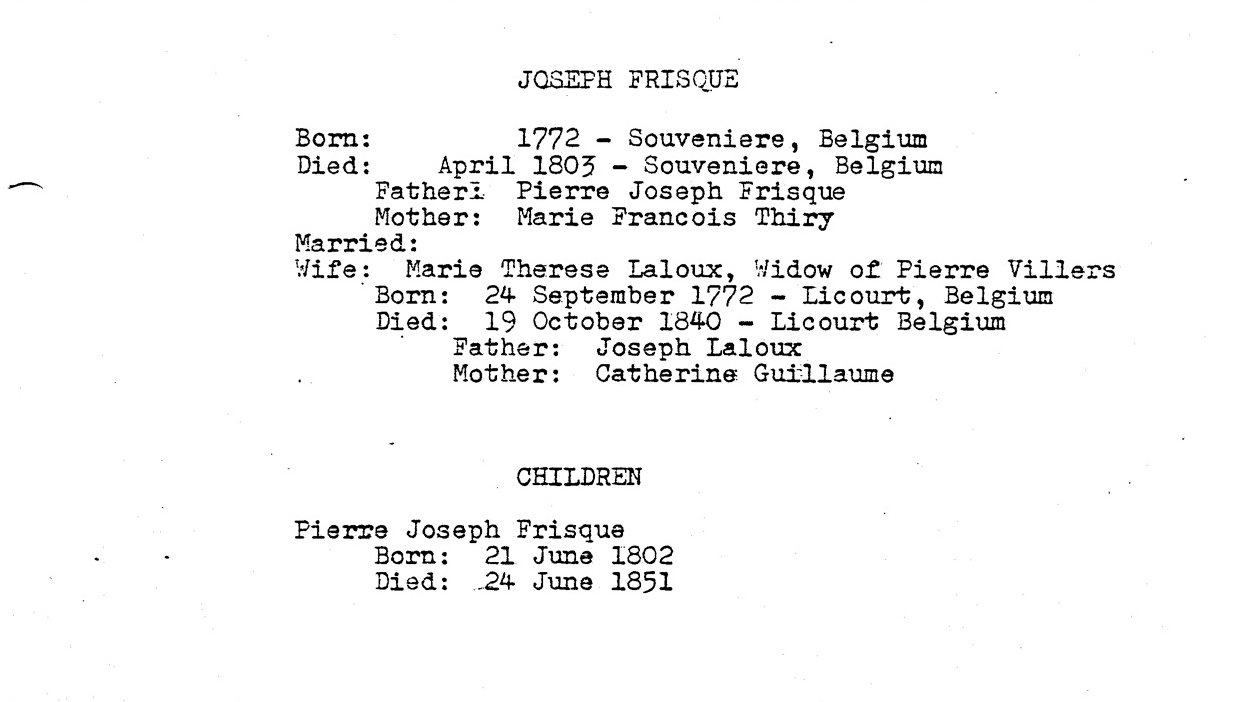
    My mother’s cousin and my father’s cousin researched family trees. Through the Frisque genealogy I discovered that my family was related to many, many people in Luxemburg, Wisconsin, the small town where my father grew up and we lived through part of my childhood. The Nockaert family information uncovered that my mother was mostly Belgian although she believed she was German. Names, dates, locations, relations fill pages. That’s it. The Belgian Heritage Center in Namur, Wisconsin may provide information to further the cousins’ research.

    The histories of these people, who permanently left all they knew for 40 acres of land and a better future, are probably lost forever. But this summer we are going to visit Belgium, specifically Walloon Brabant, and trace what is left of our Cravillion, Frisque, Nockaert, and VanderKelen ancestors. They were all small farmers who left Belgium in the mid 1850s so there is probably little left of their lives beyond cemetery headstones.

    We have nothing physical from their lives in Belgium and little expectation of connecting with other great-great-great grandchildren of the original immigrants. But one can always hope.
    Genealogy


  • Barbie, Midge, Robin and Me

    The father of my best friend Robin owned a tool business franchise which provided two young girls with opportunities to fill bins in his wonderful red truck, to bake cookies he could share with customers, and access to dozens of interesting empty boxes.

    Robin attended 95thStreet School and I went to parochial school, but we had matching pencil boxes in our desks. Most kids found a source for cigar boxes, but we had decorated paper boxes not needed in his truck into unique containers with compartments for pencils, color pencils, scissors and such. We didn’t know each other’s school friends, but we shared something deeper: hours of playing with Barbie, Midge, Skipper and Ken in wonderful houses, stores, airplanes and schools constructed out of even more empty boxes.

    When the weather was cold, Robin’s basement became a town for an afternoon of play. Her Barbie had a flight attendant outfit, mine had a tailored suit. We shared a plastic pseudo-Barbie car that took one to the airport and the other to an imaginary office. Neither of us knew anyone who worked in an office or flew on planes so eventually the story turned back to all the dolls sitting at little box desks with one Barbie, attired in a skirt and sweater, called teacher.

    Robin had an older sister and we both had moms so we knew real women weren’t built like our Barbie crew, but we didn’t know flight attendants, nurses, doctors, brides, or girls who wore wonderful ballgowns. Our parents didn’t buy us Barbie’s plastic house or bedroom furniture, but Robin’s dad shared tape and scissors and boxes to build furniture and a variety of workshop towels to make blankets. We stood next to him in his wood working shop as he made small frames and blocks that could extend our Barbie furniture building. We learned how to sand.

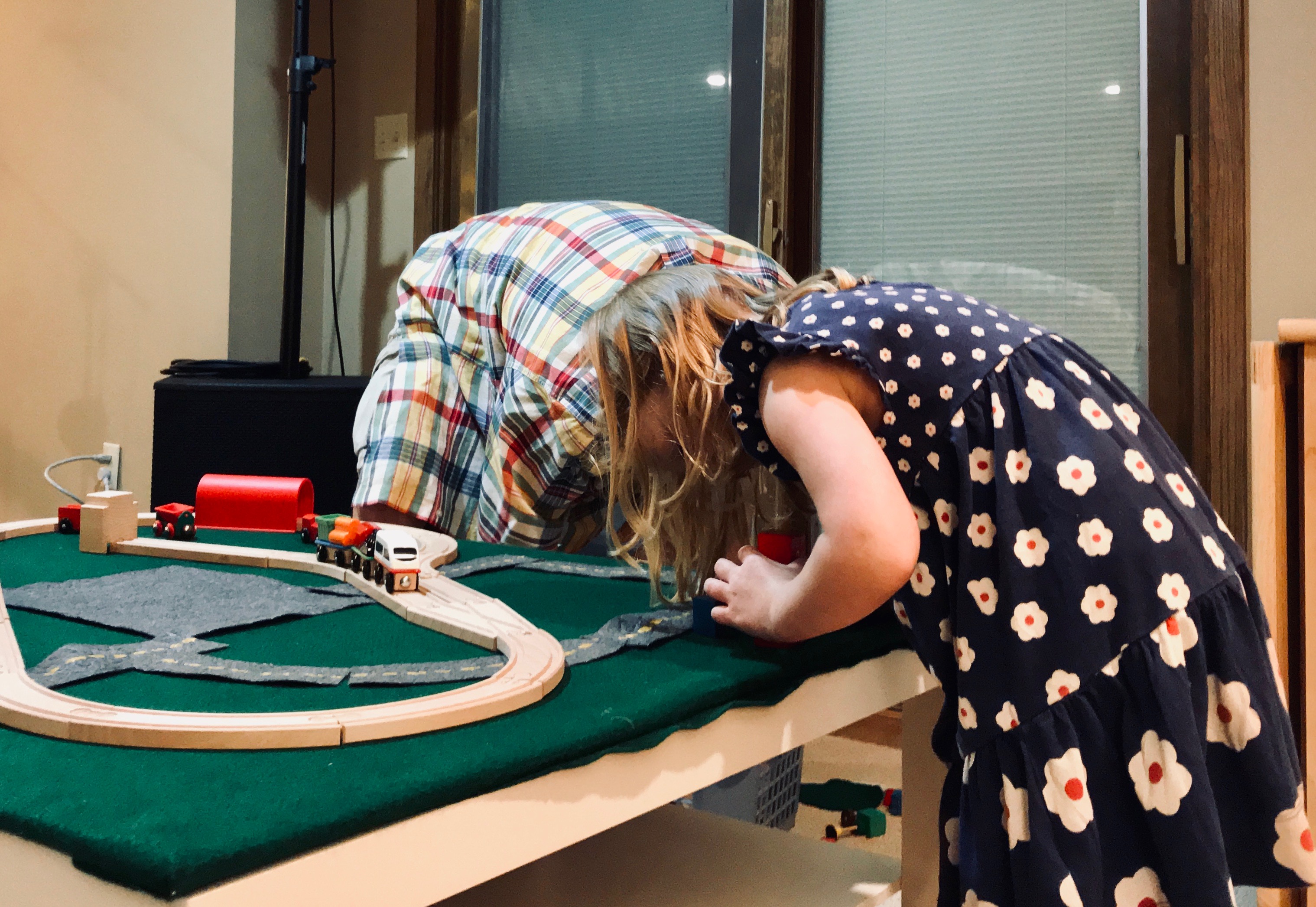
    Our Barbie phase lasted less than a year, a simple time when we creatively explored, built and did what kids are supposed to do. Parents helped feed our play then stepped back. And we did okay. And I wish I could say thanks to Robin’s father and all the other parents who stepped out over the years with camping trips or garden planting or an evening at the opera to expand the world beyond the girl toys of Barbie and her crew. And those who do that today as  they parent another generation of kids.

    IMG_5720

  • A Home for the Marys?

    The sound of breaking glass might have been heard beyond our garage walls. An hour of cleaning had yielded a large bag of stuff for Goodwill and a number of items that had no second use. The noise was the crash of an engraved mixed drink carafe with a matching stirring stick and two small engraved glasses. These were wedding presents that were very personalized and never used. The thought that there might be bad jokes in a stranger’s home because our name lends itself to humorous pronunciations didn’t feel okay.

    Like many Boomers, our cabinets are crowded with generations of glassware, quilts, boxes of photos and family Bibles. As our parents passed, their treasures became ours to maintain.  Anyone want a few sets of 50thanniversary champagne glasses with my parents’ names? Again, their last name has a few quirky pronunciations that are better kept out of strangers’ parties.

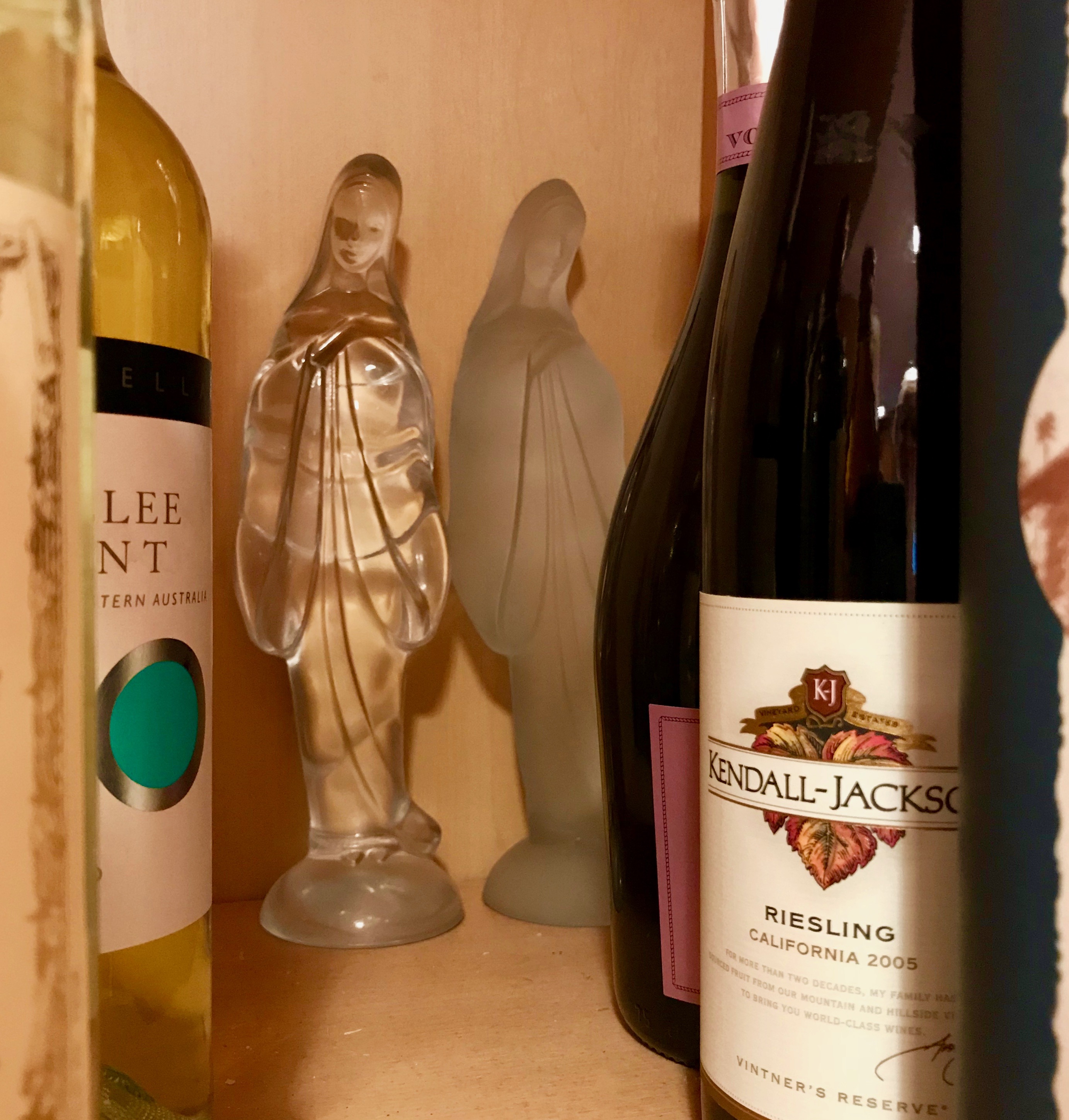
    A crystal statue of the Blessed Virgin Mary we received one Christmas has a sister that my mother owned. They both stand, hands folded, behind wine bottles on a top shelf in the pantry. Taking more shelf space was a beautiful glass Christmas ornament on its own pedestal that was once the most valuable useless item we owned. Add two clear glass platters decorated with horses and sleds to carry dozens of holiday cookies. Plus one that has a lobster engraving, a total mystery. And the green platter with Thanksgiving in a lovely scroll that I never saw used at my parents but came to rest in my home.

    That ornament will hang on our tree this year and later fend for itself in a box of its peers. The pedestal is gone. Someone will be thrilled with the glass platters. Maybe even use the Thanksgiving one. Three orphan wine glasses wait to be used on Thanksgiving before starting the next purge. They are lovely, but we already have dozens of lovely glasses. Let a bride-to-be furnish her wedding table with these things instead of throw away items and benefit Goodwill in the process.

    But those statues are another story like a box of rosaries upstairs. Is there a Goodwill equivalent for Catholic stuff? The Marys don’t really deserve to be mistreated or become white elephant gifts.IMG_5858