Category: American Culture

  • No More Guilt with Every Bite

    At the pottery studio where I take classes, someone recently brought in a box of donuts to celebrate a Hallmark holiday. They were left on the counter with a note that said—Enjoy!

    The conversation among women in the lunchroom that followed was depressingly familiar. “Ooooh, they look so good, but I shouldn’t be eating this,” said a woman who cut a chocolate frosted donut into quarters and took one. Another woman chose a whole plain donut, the smallest one she could find and said, “I worked out last night, so it’s OK.”

    I’ve seen this behavior again and again—among young women as well as older ones and with thin women and heavier women. Interestingly, I’ve rarely seen men do this. Most of the time they help themselves to a treat. Or they don’t. But men don’t seem to participate in the chorus of guilt, denial, and shame about eating and enjoying anything that has fat, sugar, or salt in it—in other words, anything that is considered a treat.

    Many people forego sweets or salty snacks because of concerns about diabetes or heart disease. I respect their need to abstain and recognize that the box of donuts—while meant to be a generous bit of fun—is a trial.

    But what I’m referring to is the ingrained habit many women have of not allowing themselves to simply enjoy a treat. First, they must apologize for wanting it, then if they have some, they feel excessively guilty. Or if they take a portion, they feel compelled to justify it: “I had a salad for lunch, so I can have a piece of cheesecake for dessert.”

    Why? Because in our culture, it seems like everyone feels they have the right to monitor or criticize a woman’s weight. We learn at an early age that what really matters is being thin and attractive, despite the many positive messages to the contrary.

    I’ve made those same apologies and given the same justifications. But seeing how often this conversational pattern occurs makes me sad. And angry. I wish women felt they had the agency to eat whatever is appropriate for our own health and weight without defending or apologizing for our decisions.

    I’d love to see a group of women savor a treat without guilty apologies. To refuse to characterize the moment as “pigging out.” To hear them exclaim, “This is so good!” and own their enjoyment.
  • Santa and the Spirit of Christmas (Spoiler Alert!)

    We began an elaborate hoax when our sons were toddlers. Santa lived with his elves in a toy shop at the North Pole. He drove a sleigh pulled by magical reindeer. Somehow Santa brought presents for kids all over the world all in one night. Sometimes I wondered why I was perpetuating the myth, when I would just have to explain it away later.

    As little guys, our sons couldn’t distinguish make believe from so-called reality. There was God, who they couldn’t see or understand, Power Rangers who got rid of bad guys, and Barney, a singing purple dinosaur. Why not Santa? Plus, the fiction was bolstered by family, at daycare, in stores, and by songs, movies, and books. The idea of Santa would have been hard to resist, especially since their friends and neighbors were also being indoctrinated. But when it came right down to it, we likedthe idea of magic and spreading joy.

    So, we were committed. When the boys mentioned toys they liked, we took note and occasionally reset expectations (Santa brings presents to so many kids. He probably can’t give 160-piece Lego sets to everyone.) We hung stockings and filled them with never-seen-before candy on Christmas Eve after the guys were asleep. Along with the wrapped gifts from us, we set out unwrapped gifts from Santa. We encouraged the boys to leave cookies and milk for Santa. My husband and I enjoyed the cookies, but left one with a bite out of it along with a thank you note from Santa. Christmas felt magical.

    Eventually, our sons grew older and began to wonder if Santa was real. Then I explained that Santa was make believe, but the spirit of Christmas isn’t. At Christmas, many people are more generous, more loving, and act better than they have to. Over the years, people have done incredible things in the name of Christmas, like the Christmas Truce of World War I in 1914. As part of my explanation, I also swore my guys to secrecy. They were under strict orders not to tell their friends what they had learned—they should let other kids’ parents explain it. Our sons understood the responsibility and wanted to help keep the magic alive.

    I don’t know how our sons will handle the topic of Santa if they have children, but if they carry on the tradition, I’ll be a willing co-conspirator.

  • A Home for the Marys?

    The sound of breaking glass might have been heard beyond our garage walls. An hour of cleaning had yielded a large bag of stuff for Goodwill and a number of items that had no second use. The noise was the crash of an engraved mixed drink carafe with a matching stirring stick and two small engraved glasses. These were wedding presents that were very personalized and never used. The thought that there might be bad jokes in a stranger’s home because our name lends itself to humorous pronunciations didn’t feel okay.

    Like many Boomers, our cabinets are crowded with generations of glassware, quilts, boxes of photos and family Bibles. As our parents passed, their treasures became ours to maintain.  Anyone want a few sets of 50thanniversary champagne glasses with my parents’ names? Again, their last name has a few quirky pronunciations that are better kept out of strangers’ parties.

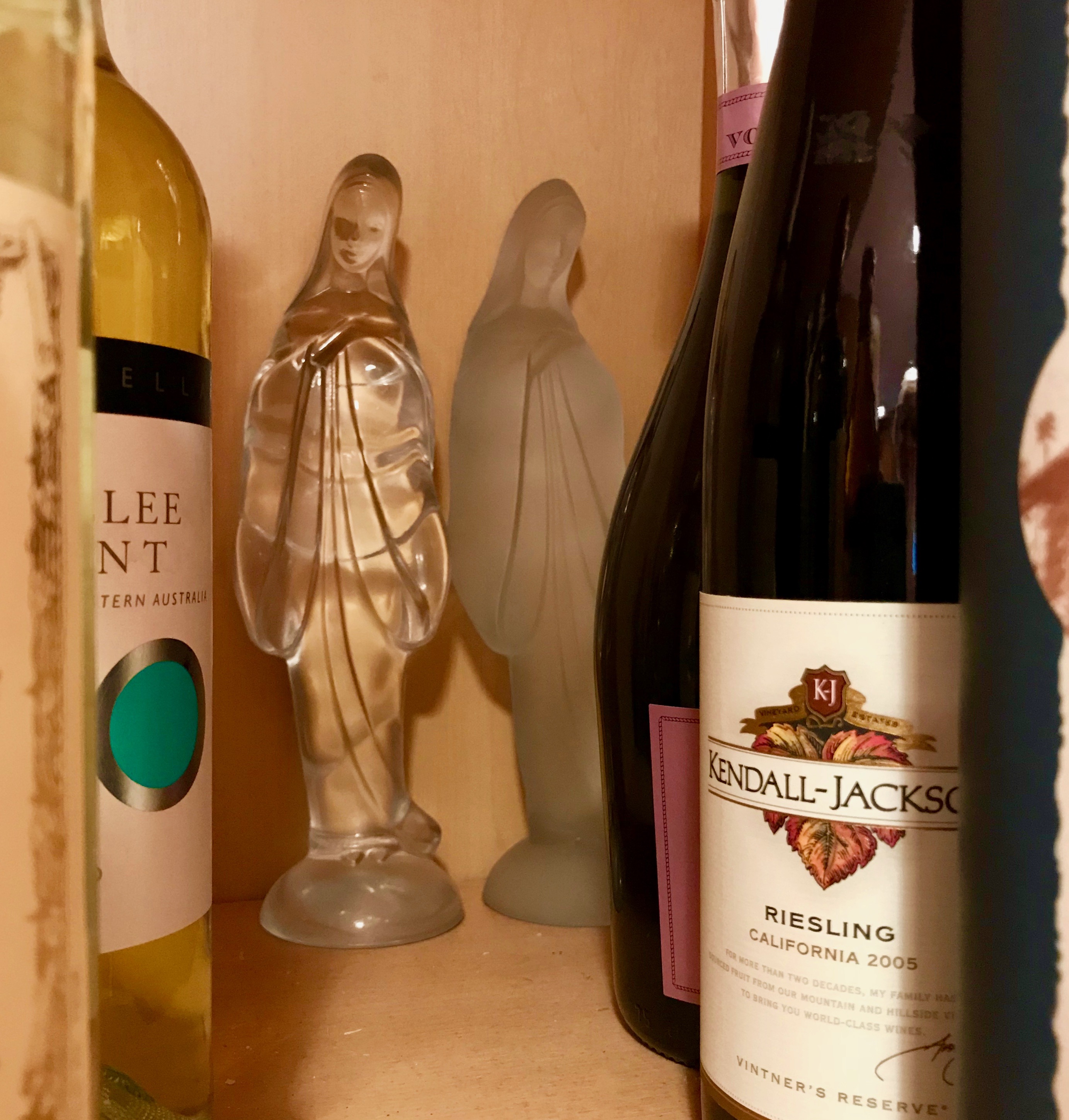
    A crystal statue of the Blessed Virgin Mary we received one Christmas has a sister that my mother owned. They both stand, hands folded, behind wine bottles on a top shelf in the pantry. Taking more shelf space was a beautiful glass Christmas ornament on its own pedestal that was once the most valuable useless item we owned. Add two clear glass platters decorated with horses and sleds to carry dozens of holiday cookies. Plus one that has a lobster engraving, a total mystery. And the green platter with Thanksgiving in a lovely scroll that I never saw used at my parents but came to rest in my home.

    That ornament will hang on our tree this year and later fend for itself in a box of its peers. The pedestal is gone. Someone will be thrilled with the glass platters. Maybe even use the Thanksgiving one. Three orphan wine glasses wait to be used on Thanksgiving before starting the next purge. They are lovely, but we already have dozens of lovely glasses. Let a bride-to-be furnish her wedding table with these things instead of throw away items and benefit Goodwill in the process.

    But those statues are another story like a box of rosaries upstairs. Is there a Goodwill equivalent for Catholic stuff? The Marys don’t really deserve to be mistreated or become white elephant gifts.IMG_5858