Scheduled vs. Spontaneous Phone Calls

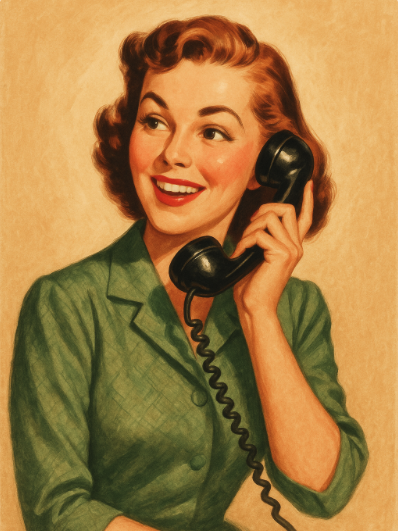
A spontaneous phone call from with a close friend or family member is a nice surprise. Depending on who it is, we might chat about upcoming plans, air out concerns (kids, siblings, work, the country), discuss a plant I’m excited about, describe a meal that turned out way better than expected, or grumble about how hard it is to find shoes that fit. 

After a good talk, I feel closer to the person and buoyed by our connection. I think the habit developed years ago when I lived 16 hours away from family and friends. Then the calls nourished and re-centered me. They were the logical extension to my in-person conversations—I definitely got the Shriner talk gene.

Recently, a few friends and family members have started asking to schedule a time to talk instead of trying our luck. That surprised me, since I like spontaneity. For some people, it’s a way of saying our conversation is important—let’s make sure we don’t miss each other. For others, it’s about being in different time zones. Fair enough.

But here’s the thing—I’ve also discovered unscheduled phone calls can irritate some people or make them anxious. There are varied reasons for this:

– Some rely on texting for casual chatting. A call signals trouble (Uh oh, what’s the matter?) Yikes! That never occurred to me since I prefer a call to a text. Calling offers nuance. Sarcasm, sympathy, irritation, worry, and amusement are easy to convey in a person’s tone of voice, but with texting, emojis have to do the heavy lifting of communicating emotional content. 

– A spontaneous phone call may seem intrusive. Well, it can be. If I’m making dinner, working in the yard, or on a walk with my husband, I might not want to be interrupted. Then I let voicemail signal, “Not now.” If I make an impromptu call, I never assume the recipient has time to chat. I always ask if my call is convenient. If not, no worries! We’ll connect another time.

– Texting to request a call time is now seen as more polite. The recipient will be spared the potential awkwardness or discomfort of saying, “Now isn’t a good time.” It took me a while to wrap my head around that idea, since I’m comfortable telling a caller I can’t talk if I’m in the middle of something. Or I just let the call go to voicemail. Apparently, that reaction isn’t universal.

Scheduled vs. spontaneous phone calls? It seems to be a stylistic difference, maybe even a generational one. I have my preferences, but the goal is to connect, so I want to be sensitive to others’ needs and adjust if it improves our communication.  

But if you’re thinking of me, just give me a call! I’ll let you know if I can’t talk.

To Louis and Octavia

An enthusiastic three-year-old ran craft materials to the kitchen table. She had a project in mind, a puzzle to build out of tongue depressors. 

I was not enthusiastic about the project which, as many projects, would lead to painting which might lead to painting herself. In fact, I was tired and working hard to be gentle as she taped sticks together. When a washcloth became necessary, I got it damp at the sink, looking at her head bent over a row of painted wooden sticks. 

The oak table where she worked on a protected area was made in 1902 when Louis Cravillion married Octavia Orde, my paternal great grandparents. How I miss my Grandma Tavy. My grandmother died following childbirth, so Octavia cared for her grandson. As a woman of the age, I am now, she cared for me. I sat on one of these chairs while she braided my hair, ate meals she cooked, or colored. My mother worked in town.

After my great-grandfather died, we had moved in with her. My parents remodeled the kitchen and dining area storing this oak table for a new Formica and metal model. Eventually an apartment was finished upstairs so she would have her own place. The table returned. Eating breakfast in my designated chair, it was possible to watch everyone come to the new post office across Main Street. Patterns were cut to make clothes, cookie dough rolled out, homework completed.

After her death, the table was refinished and set up as my parent’s game table. As they downsized, it came to be mine. Our children ate and did homework and projects on a glass surface that protected the oak. Today’s artist is one of their children. 

Stories of six generations of my family have been exchanged here. Men have returned from wars to a first home meal, baptisms and weddings celebrated, hard decisions made, children loved. Great grandma’s quiet and calm presence participated in half of its history. I see her hands now show in mine; her brown eyes look back from our mirrors. I can only hope I carry some of her wisdom to those who sit at this table, her blood mixed in their veins. I am not so tired.

Traditions Evolve

Great Aunt Wilma was a fixture at our Thanksgiving gatherings during her latter years. She was widowed with no children, so my parents invited her to join us. 

Elegant with her silver French twist, stylish earrings and deep brown eyes, she preferred to sit with the guys talking sports or politics (back when that was an acceptable topic). We had plenty of help and cooking wasn’t her forté, so she didn’t don an apron and join the women.

We gathered at my sister’s home in Ohio. After years of hosting, Mom was ready to let her kids handle holiday meals. Until my parents died, our sons, my husband and I traveled from Minnesota to celebrate Thanksgiving with my extended family. My husband’s family had different Thanksgiving traditions, so we didn’t have to choose.

For years, my husband and I have been the creators of holiday gatherings like Thanksgiving and Christmas. Days before, we’d clean the house, finalize the menu, make an epic shopping trip, check the table linens, plan the flowers, and start prepping dishes that could be made ahead, then cook and clean up on the actual holiday. As our sons got older, they and their wives also prepared key dishes. However, my husband and I were the event managers who were responsible for making the meal go smoothly. We were happy to do it.

But family traditions evolve. When our sons married, we began sharing them with their wives’ families. Each year we’ve had conversations about which day to hold our Thanksgiving and Christmas gatherings. After a bit of trial and error, we determined that Thanksgiving dates could be flexible but Christmas was less so. 

When grandchildren came on the horizon, my husband and I understood our traditions would change again. We are welcome and important, but as grandparents, we are stepping back to a supporting role for holiday gatherings. 

The focus has shifted to our granddaughters’ needs. Younger babies might be content to be held during a lengthy Thanksgiving meal, but older babies are not. They get bored and want to play. Ideally, both babies should have a quiet place to nap. This year, that will be at the home of our oldest son and his wife, where both babies can be accommodated. 

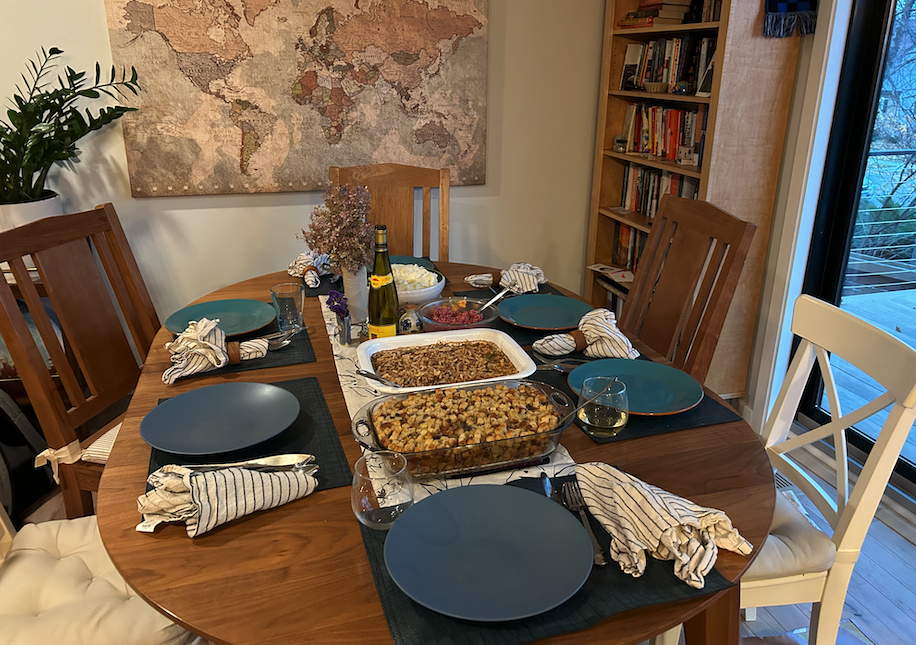
Shortly before the hungry horde descended last Sunday

Similar things are happening in the larger circle of my Ohio family. My sister no longer hosts a large family dinner at Thanksgiving. Now she visits two of her daughters who live in a nearby state. My brother and his wife will join friends for Thanksgiving since their children are also hours away.

My bachelor brother, who used to help my sister and me with cooking and cleaning up at our large Thanksgiving gatherings, is now slated to become a guest at a niece or nephew’s Thanksgiving table. When we spoke of the changes, my brother and I joked that now he has become Aunt Wilma. 

Navigating Life’s Turbulence: Lessons from a Country Walk

Candidate signs and Halloween decorations needed clearing November 7th along the country road where I walked. My feet moved slower than my thoughts of how to accept election results. 

Five hundred feet ahead, at least a dozen large, wild, turkeys covered the road as well as both shoulders. They can be mean in a standoff. Future concerns fell to immediate safety. Should I turn around, my clap hands, swing a fallen branch to clear a path? Yelling and singing haven’t worked in the past. My walk was over.

Two deer bounded out from woods on one side of the road, gracefully crossed the asphalt, and entered deeper tree growth in beautiful synchrony. The turkeys scurried behind the white tails. Here, then gone. The walk cleared.

 “Awesome” I said out loud at the display of natural beauty. Unattractive turkeys had been swept into a brief glimpse of something amazingly natural on another day of unpleasant election rhetoric and deep discord.

Decades ago, St. Mary’s in Luxemburg, WI began my Christian orientation. Small towns, filled with relatives, made it easier to accept a set of beliefs and traditions. What I still carry is a careful relationship with God. Call it spirituality or faith, old-fashioned or unnecessary, I value the foundation. At the turkey and deer moment, I followed the spoken word with a silent “Thank you, God” for a reminder of good possibilities.

In November, regardless of voting on the winning or losing side, many people remain thankful for family, friends, freedom to have a public opinion. I dread how politics and powerful men with money will affect the quality of life. 

Fear feels like too powerful a word at a time when caution is critical. Fear was two years ago when I had major surgery to save my life. I knew what I feared that day. I could balance fear and hope. Today I can’t name what to fear beyond unpleasant changes. Fear and dread appear in definitions of each word, but fear has a more expansive description. 

I’d love to be one of those deer easily running through the woods. I can accept moving closer to the speed of the wild turkeys shuffling through fallen leaves or awkwardly flying up to their nightly roost. During the day I will keep looking for ways to move the threatening turkeys out of the way of my walk and yours.

Two years of thankfulness. More to come.

“Why, in my day . . .”

Growing up, I recall elders recounting tales about life before some innovation. Today, the advent of artificial intelligence (AI) is a hinge moment like so many technological advances I’ve experienced in the last 40 years. I look back on past breakthroughs with wonder and nostalgia. I’m trying to come to terms with current developments.

1984 – Desktop Computers

I roll my eyes when young volunteer coordinators enquire if I’m comfortable with computers. In 1984, my boss handed me boxes for an Apple IIe desktop computer and an amber monitor (orange type on a black screen) and told me to set them up so I could write marketing and training materials. 

1989 – Internet

Today, that old setup is quaint and humorous—a one-color monitor, 5¼ inch diskettes, a computer that didn’t connect to the Internet . . . because the World Wide Web wasn’t mainstream until 1989-90.

When the Internet became commonplace, we used painfully slow telephone dial-up modems with their crackling static and rubber band sound. Modems meant I no longer had to courier work product files to my customers on diskettes, which had shrunk to 3½ inches. 

1994 – 2001 – Search Engines and Websites

In the mid-1990s, search engines like Yahoo, AOL, and Netscape came on the scene and Search Engine Optimization (SEO) helped people, products, and businesses get found. Google started in 1998. It’s hard to imagine a time before Google, when research meant visiting a brick and mortar library to use printed resources that might be checked out to someone else.

As websites grew common, having one for my business became important. A friend and I designed and rolled out mine in 2001. Several versions followed until I retired it several years ago.

1996 – Cell Phones 

For me, the next technological cliff came around 1996 or 1997 when small cell phones arrived. They made calls. That’s it. If you had the patience to tap number buttons repeatedly, you could eke out texts. No camera. No Internet. No email. No music. No maps. Next, I owned a different dumb phone that opened to a qwerty keyboard. Around 2005, I acquired a fancier flip phone with a camera. Woohoo! Before long my 35mm digital camera was obsolete.

2007 – Smartphones

The world shifted dramatically again when the iPhone was introduced in 2007—the best of the available smartphones. Cell phones had enabled me to keep up on client calls and emails seamlessly when I was away from my home office—in other words, an early version of remote work. Staying connected with family became immensely simpler too.

2007 – 2008 – Facebook & Twitter

The advent of social media—Facebook and Twitter along with their many step-children—has transformed the world. How we discover, understand, and consume news. How we see ourselves and connect with or demonize others. There’s no denying social media’s far-reaching impact. Despite my mixed feelings about Facebook, it’s where a number of readers find our blogs. 

Now – Artificial Intelligence

Evidence of artificial intelligence is everywhere—Siri and Alexa, helpful spelling prompts in texts and emails, blank-eyed, AI-drawn models in ads, and who knows how many AI functions we are unaware of. 

AI makes me uneasy. But I don’t want to be a Luddite, so I’ve told myself I really ought to dig in, try to understand its scope, possibilities, and implications . . . insofar as any non-AI developer can. I’ve begun experimenting with ChatGPT as a research tool (think of all the data it accesses), but it’s never going to be writing my blogs! Count on 100% Ellen, all the time.

Five years from now, when the next technological wonder launches, who knows what we’ll be saying?