Author: Ellen Shriner

  • A Closer Look

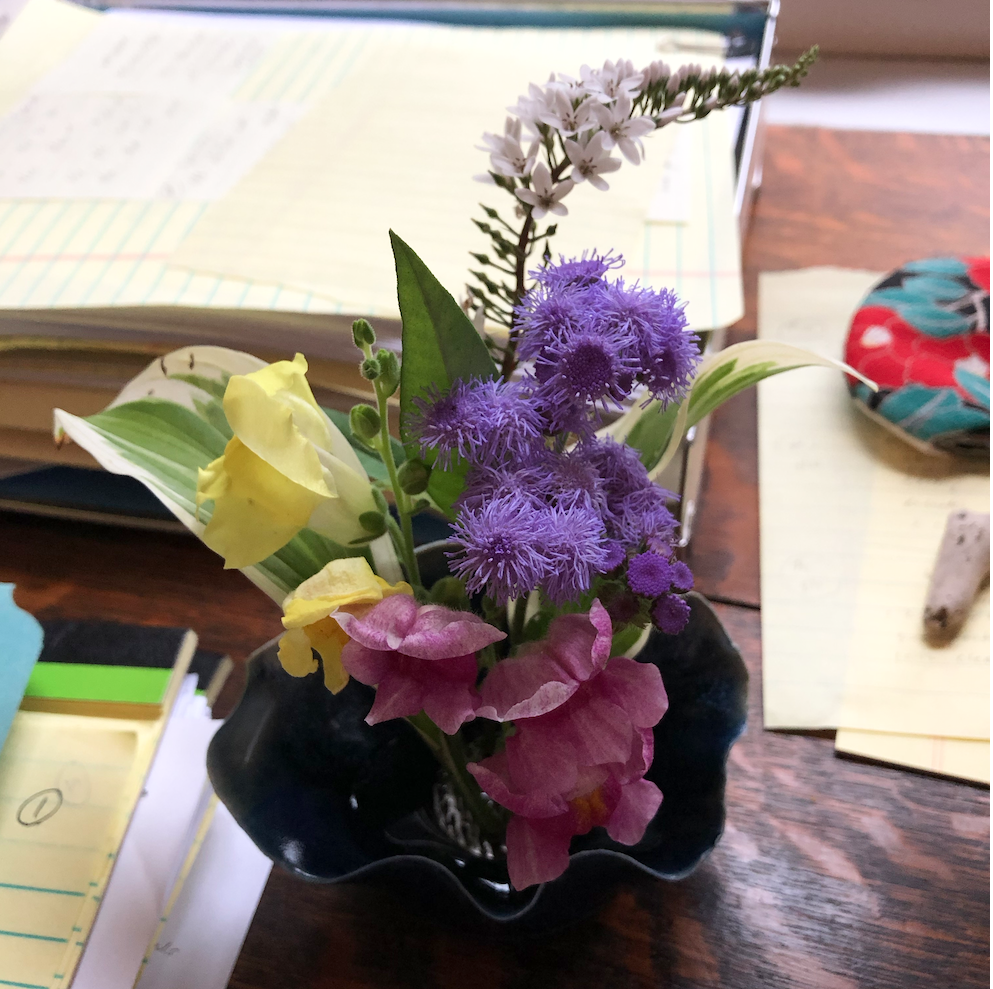
    I’ve recently discovered the joy of flower arrangements small enough to fit in the clutter of my desk. A gift of an ikebana vase encouraged me to assemble pink and yellow snapdragons past their prime for the drama of a large vase, but fine in this setting. Since the petite vase is inches away, I see more details. To the right of the fading yellow flower are hopeful buds trying—as nature always does—to assert itself and establish another generation.

    The blue ageratum, so short that it’s usually overlooked for most bouquets, holds its own here. Its exuberant fuzzy mop has lasted for days, and more buds are opening.

     I’ve never noticed the sweet florets of the white loosestrife behind the green spear of its leaf. More often I’ve meditated on its name—loosestrife. Loose strife? I inherited this unruly perennial with the house, and it certainly has loosed strife in my garden, mobbing and obscuring several large peonies. Yearly, I root it out, but it comes back. Up close, it’s so dainty, it almost seems innocent in its mute insistence.

    And hosta, a determined survivor. Neither polar vortexes nor voracious bunnies can kill it, though sometimes I wish one of them would. In the yard, it seems so ordinary, but close-up, I’m struck by how graceful its cream and green leaves are and the way they mimic the loosestrife’s curve.

    This miniature holds the persistence of strife loosed in the world but it’s outweighed by enduring delicacy, grace, and beauty. In that I find hope.
  • Time to Rewire My Brain

    Now that hands-free cell phone use is the law for Minnesota drivers, I was faced with a choice: A) buy a new car with built-in Bluetooth technology or B) retrofit the one I have. I have no quarrel with the intent of the new law, but my mind boggles at how awkward the retrofitting is.

    I have an old car.

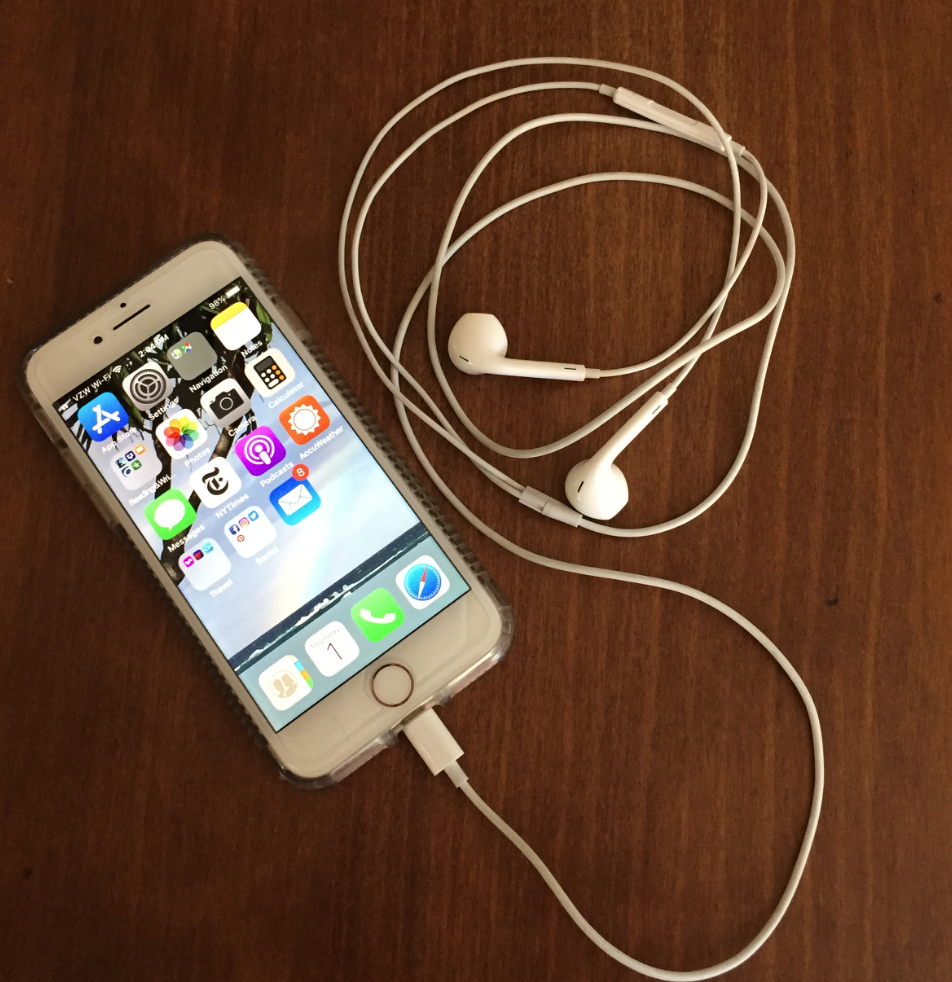
    My 2011 RAV4 is a prehistoric gem with only 75,000 miles on it. Definitely pre-Bluetooth technology. Until now that wasn’t an issue, because I seldom used my cell phone while driving. When I made or received calls, I connected my phone to my old-fashioned earbuds (the kind with wires) and stuck the buds in my ears. Simple hands-free calling. Decent quality sound. Yay!

    Now that’s unlawful, so I had to get a phone holder. The several articles I consulted pointed out that attaching a holder to a vent is hard in a RAV4. Besides, I don’t want to block the AC during Minnesota summers or the heat during Minnesota winters.

    My best bet was a holder that attaches to the CD slot. Mmmmk. I don’t play CDs anymore. I listen to the radio, not even Sirius. Or I use the oldest iPod you’ve ever seen for music and podcasts. The Smithsonian museum probably has one in their ancient technology display. Originally, I was saving all that memory on my phone for photos, not music.

    That’s only half of it. I also needed a Bluetooth speakerphone thingy to clip onto the visor.

    I have an old brain.

    Retrofitting the car was step one. My brain needs rewiring, too. In the olden days, cell phones were for talking, iPods were for music, and Garmin was for directions. I do realize that my iPhone 8 can do all of that—in one delightful device—but I have an unreasonable and balky reaction to being bossed around by devices even when they’re trying to help me. Until now, I hadn’t taken advantage of all that seamless wonderfulness.

    Now, if I want to call while driving, I’ll need to tell Siri (Dang! I never use Siri, so I’ll have to learn that.) How long before Siri mistakes, “Call Margo S.,” for “Call Martha Stewart,” who I’m pretty sure doesn’t want to talk to me.

    For music, I’ll have to reach under the cell phone holder to press radio buttons or convince my elderly iPod to talk to the Bluetooth speakerphone. (Oh wait, my beloved iPod doesn’t have Bluetooth capability, so it and the speakerphone aren’t friends. Sigh.)

    It’s 2019. Time to rewire my brain and how I approach calls, music, and directions. I bought the devices and they work–sort of–but they certainly aren’t simpler.

    Maybe I just should have bought a new, fully-equipped car!

  • Pure Nostalgia and a Weird Convergence

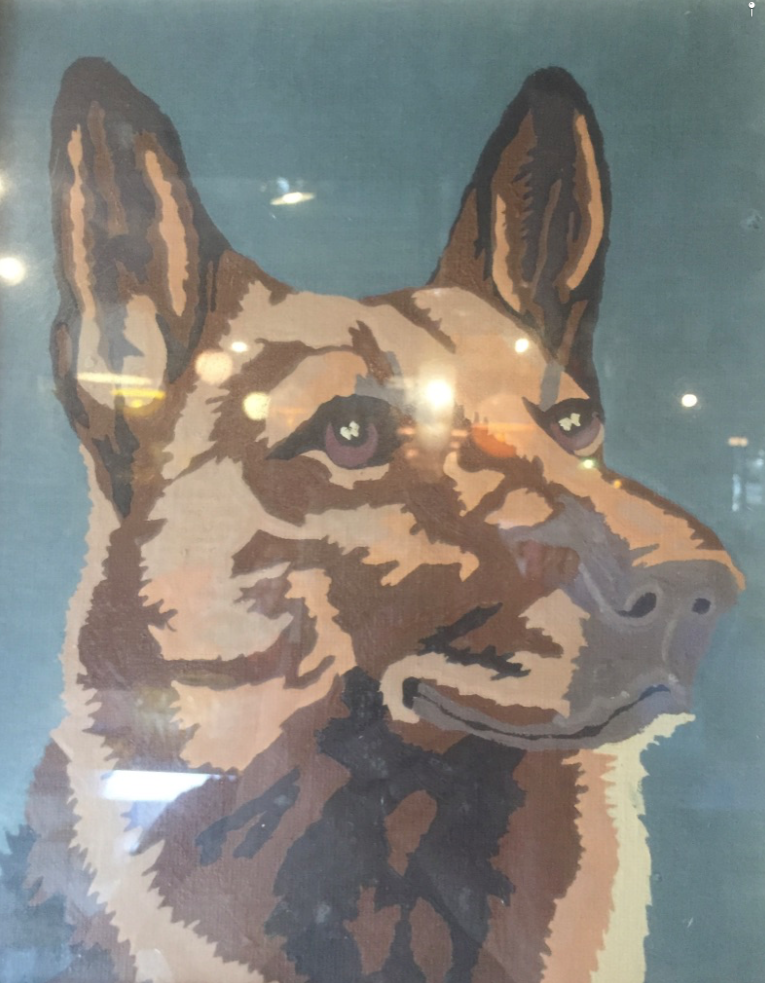
    Seeing the paint-by-number ‘artworks’ decorating Hot Plate, a neighborhood breakfast place, plunged me into nostalgia.

    At 10, nothing was better than making art that looked ‘real’ or perhaps I should say, ‘recognizable.’ Horses fascinated me and I labored at drawing them, using my horse statue for reference. One birthday, I received a paint-by-numbers kit for a horse portrait. Dip the cheap brush into the dime-sized plastic pots of paint, dab it in the blue-outlined shapes and voilà—my horse looked like the one shown on the box! Success!

    A weird convergence.

    Until my husband read the historical note in Hot Plate’s gallery, I’d never known that the Craft Master Corp., which made the paint-by-number kits, was headquartered in Toledo, my hometown. At first I thought, “That figures,” then I reminded myself that Toledo is also home to the Toledo Museum of Art, at the other end of the art world spectrum.

    While crunching home fries and laughing at the paintings of questionable landscapes, sad clowns, and plucky dogs, I marveled at the paint-by-numbers concept. Someone had to curate images, analyze and isolate the placement of highlights and shadows, and choose the appropriate colors. Today, that function can easily be done in a graphics program, but in the 1960s that wasn’t the case.

    The appeal of paint-by-number kits (popular in the 1950s and 1960s) and Bob Ross’ PBS show, “The Joy of Painting”(mid-1980s to mid-1990s, now immortalized on YouTube and in popular culture) is the idea that ordinary people with little or no artistic training can have an outlet for their creative impulses and paint something they’ll be pleased with.

    On the paint-by-numbers box was the slogan, “Every man a Rembrandt!” We l l l, not exactly. But for my 10-year-old self, there was a real pleasure in making a painting that turned out.