My recent trip to Paris, Chartres, Bayeux (near D-Day landings), and Versailles was wonderful. A lot has changed since I visited decades ago—much of it in good ways.

1. Parisiennes don’t mind speaking English.
When I visited France years ago, I would attempt my poorly accented high school French, and whomever I was speaking to would wince and reply in heavily accented, rudimentary English. Some people would shake their heads and speak rapid French in a scolding tone, which didn’t improve my understanding. Consequently, I downloaded several phone apps, including one that would say phrases in perfectly accented French, before this trip.
During our recent visit, my “bonjour” was met with a smile, and the person I was speaking to would offer to speak English. Young people, who often staff hotels, restaurants, shops, and tourist sites like museums, were particularly fluent and gracious. Some wanted to practice their English and make sure they were speaking correctly. Wow. I never used my French app.
2. American fashion was widespread.
I expected to be surrounded by stylish Parisiennes who wore the height of fashion. Instead, I blended in, especially on the days I wore my skinny jeans. My clunky walking shoes were also mainstream. Most women wore comfortable shoes like sneakers on the metro. Maybe they had dressy office shoes in their bags? The guys wearing t-shirts branded Levi’s or U.S.A. were native French speakers, not Americans.
The small hotel where we first stayed was quite a distance from popular tourist areas, so the people I saw on streets and in the metro were natives, not tourists. It was a little dispiriting to realize how pervasive American fashion is.
3. The scale and craftsmanship of “neighborhood” parish churches was astonishing.
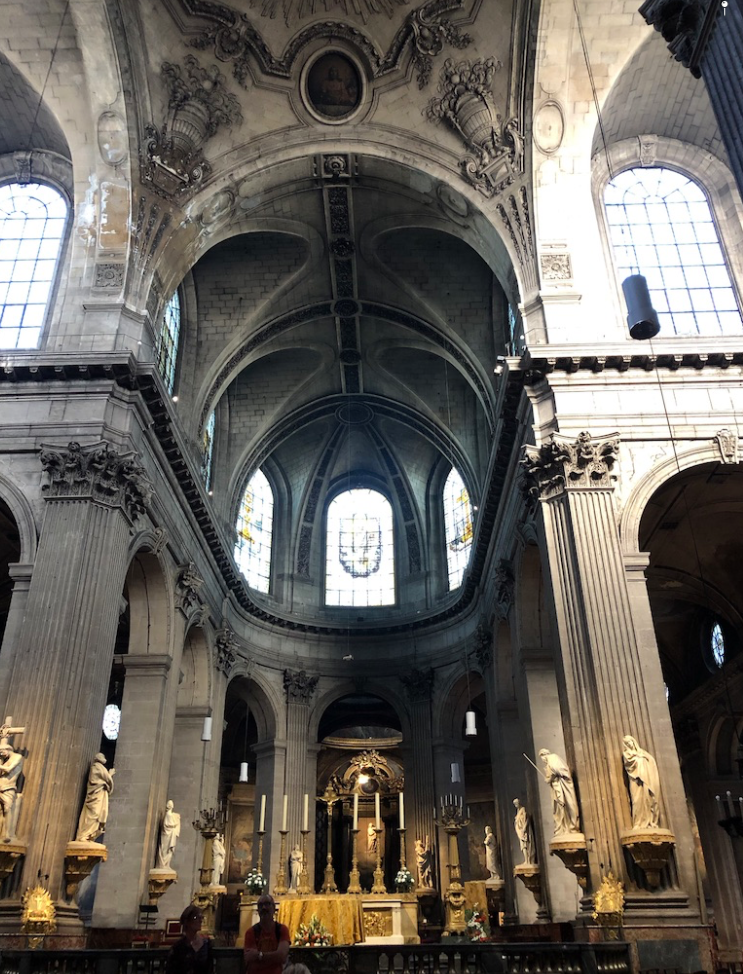
We made brief visits to several neighborhood Catholic churches (my husband loves architecture). Inside were soaring Gothic spaces filled with intricate mosaics and stained glass windows, elaborately carved pulpits and choir stalls, along with altars and candelabra trimmed with gold. Some dated from the 1400’s. Many took several hundred years to complete. Along with the gilt-edged art and stained glass were announcements about parish activities—in other words, these are parish churches, not just historical sites.
4. Order and geometry reign in many French gardens and parks.
We wanted to spendlots of time outdoors enjoying the September sunshine so we visited several gardens and parks, and a distinct French gardening philosophy emerged. Nature is meant to be tamed and organized, preferably into geometric shapes. I expected that in famous formal gardens like Jardin des Tuileries and at Versailles. There, short, narrow boxwood hedges enclose long strips of flower gardens. Gardens are laid out in severe, straight lines, contrary to what’s natural. There’s grass between flower beds, but walking on it is forbidden!

However, that philosophy was also apparent in Paris’ ordinary city parks like Jardins des Plantes and Jardin du Luxembourg. A vegetable garden displayed espaliered gourds trained over arches to form a green tunnel. Trees were trimmed into rectangular boxes! Perhaps in Provence gardens are looser and more natural looking.


5. Traditional French cooking was harder to find in cafes and bistros than I expected.
When I’d visited before, every meal I ate consisted of traditional French cooking—interesting sauces, tender meat or fish, and creative sides.
This time I was surprised at how often burgers with pommes frites appeared on menus, even when we weren’t in tourist areas. Whoa, I didn’t come to Paris for a burger! Or smoked salmon on a bagel. Perhaps Parisiennes get bored with traditional cooking and want something different. We did find several classic restaurants and ate wonderful meals there. No matter where we went, the bread, pastries, coffee, wine, and cheese were excellent.
6. My high school French resurfaced.
I expected to know food words like “poulet” for chicken and “fromage” for cheese. But after a few days, I began thinking long-forgotten words and phrases: “maintenant” (now), aujourd’hui (today), dejeuner (lunch), “moi aussi” (me too). I grew comfortable smiling and saying, “Je ma-appelle Ellen” (Myname is Ellen) to waitstaff who tried to hand credit card receipts to my husband for a signature. We were using my card since it waives fees on foreign transactions. And there’s all those miles, baby!
7. Apparently, there’s no end to the number of photos of stained glass I can take.
Well, that really wasn’t a surprise. Despite my limited faith, I love churches’ stained glass windows.