Author: Elizabeth di Grazia

  • What A Day We Had with the Indigenous Mayans of Lake Atitlan

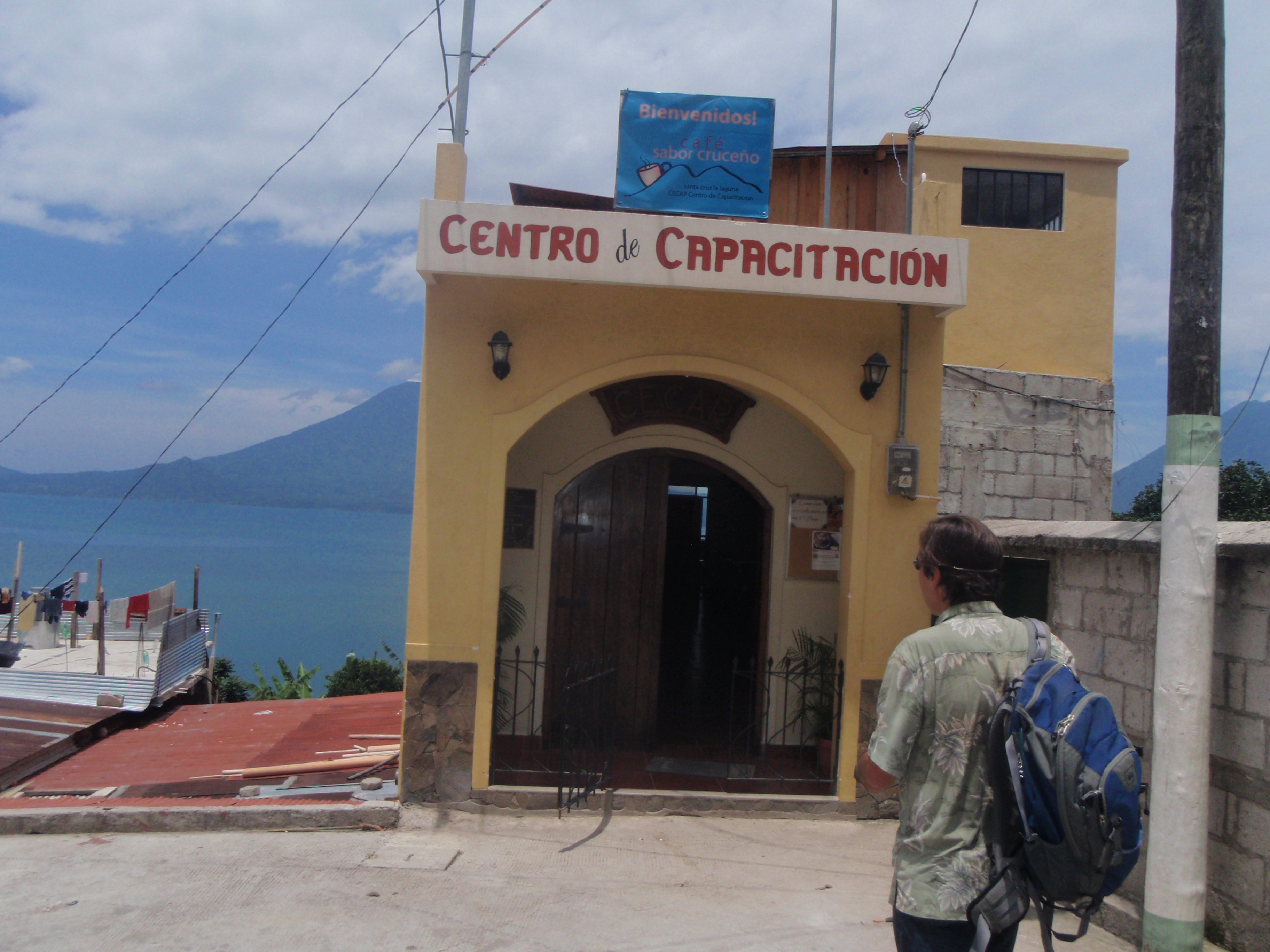
    CECAP Training Center and Cafe Sabor Cruzeno

    I walked into Cafe Sabor Cruzeno in Santa Cruz la Laguna, Lake Atitlan with trepidation. Not because it was recently opened. Not because it wasn’t yet rated on Trip Advisor or that it was a student-run café. And not because it was part of an NGO, Non-Government Organization.

    Café Sabor Cruzeno was the result of the CECAP (Centro de Capacitacion) Culinary Arts program of Amigos de Santa Cruz foundation. The goal of the program is to train young people for successful employment in the restaurant and tourist business.

    No, it was because I had my doubts that the culinary arts program would be successful with Antonio. I had a suitcase of dried pasta betting on it. Some people might pack extra clothes and shoes to match each outfit. I was more concerned that we have a food supply tucked away. When we traveled to Guatemala in 2010 I had forgotten to pack Crystel’s swimsuit. She ended up swimming in her Hello Kitty pajamas. But, I didn’t forget emergency rations for my son.

    View from Café Sabor Cruzeno

    Antonio is a healthy ten-year-old. He will eat a salad. Just don’t make a pyramid out of the raw vegetables. Instead, imagine a horizontal sundial and align the fixings uniformly around his plate. No dressing wanted or required. When Antonio and Crystel were in highchairs Jody and I would put food on each tray and what one toddler didn’t eat the other would. Being low maintenance, Crystel’s sundial can be any shape: cylindrical, conical, or vertical with a dab of ranch dressing. She’s satisfied with a ham sandwich. Antonio came to us waving a chicken leg in the air. He has never eaten a sandwich in his life. But give him a Sweet Hawaiian bun in one hand and a slice of salami in the other and he will happily eat them separately.

    Our table waiting for us

    We cater to Antonio and Crystel because we can, though sometimes I remind him that he was born in Guatemala.  Tamales made of corn and filled with beans are eaten with nearly every meal.

    Lee Beal, our guide, originally from Texas, has lived around the world over the years, with Colorado being his home base. His wife, Elaine, and he have been full-time residents of Santa Cruz for the past 5 years. The couple came to Guatemala looking for a simpler and more fulfilling life and found it on Lake Atitlan. Lee originally started working with Amigos de Santa Cruz foundation and now serves on the board of directors. As he learned more about the people of Santa Cruz he realized there was a need for jobs creation. A part of this is now being fulfilled through the CECAP vocational training center.

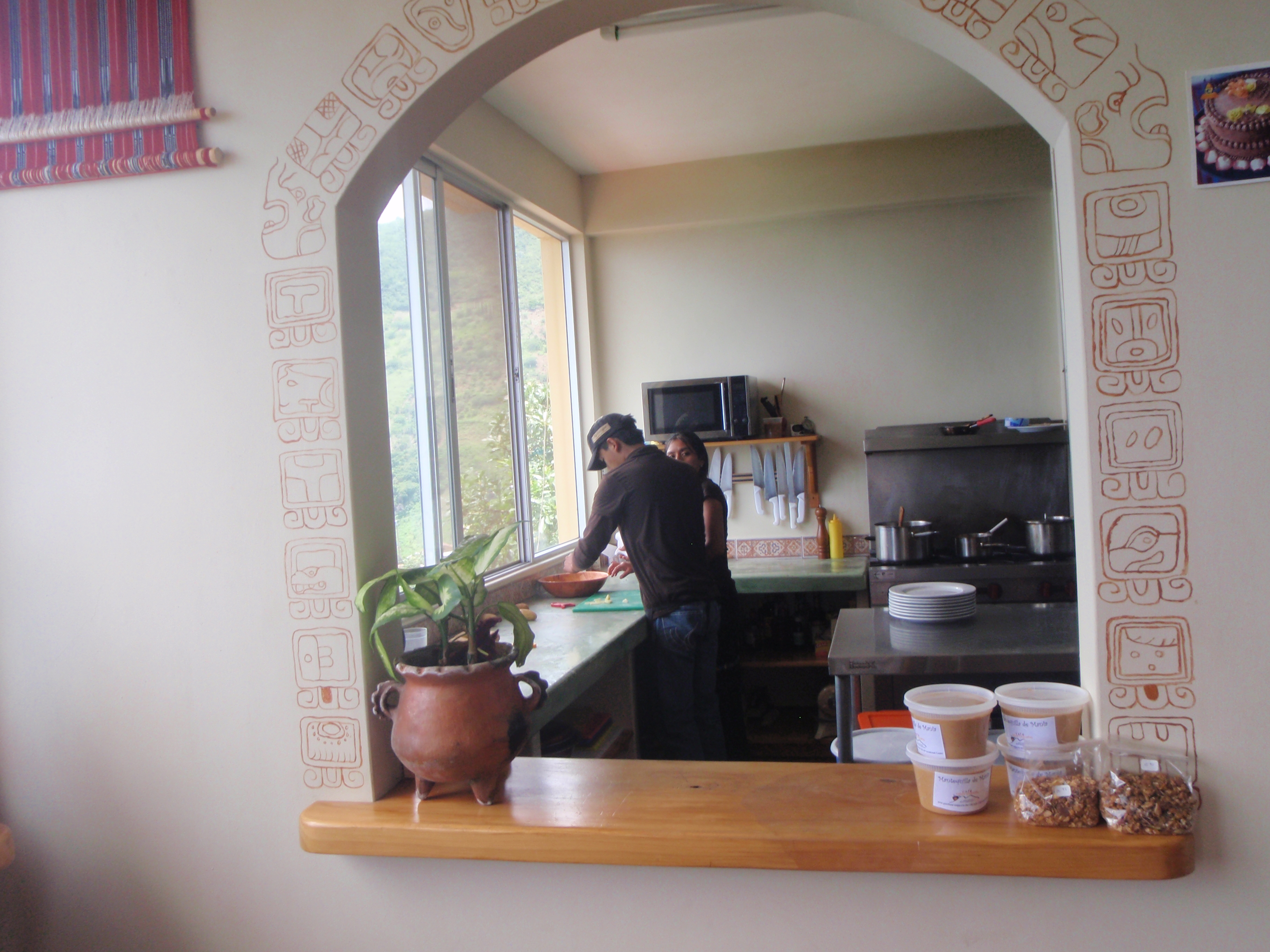
    The kitchen

    Walking into the restaurant, I was surprised how open, clean and fresh it was. I felt as if we were on top of a mountain and we were. Two graduates of the culinary arts program were busy in the kitchen completing our authentic Guatemalan meal. They would also be serving us.

    I don’t out Antonio unless I have too. Usually I just take him aside and remind him that we have food at home and simply be polite and say, “No thank you” if he doesn’t like what’s served. No funny noises or grotesque looks necessary.

    After snapping a picture of our seating area, I took a deep breath and sat down. We had our choice of freshly made cold tea, several sauces, mashed potatoes, and a mixture of glazed vegetables and chicken with pulique sauce. At first glance, there wasn’t anything that I thought Antonio would try. Pulique is a common dish of the Guatemalan highlands. It is often served at holidays, anniversaries, and yearly fairs. Alex, our Guatemalan guide, explained how special it was that our chef had made the pulique for us. (Lee has been employing local guides trained through INGUAT. His goal is to create well-paying jobs that fit with the Mayan culture.)

    Antonio with Alex paying our bill

    The pulique sauce was mild, gentle, and creamy. I watched Antonio as he scraped a bit of it off his chicken.He tried a bite, finished his chicken, and asked for more.

    Antonio had proven that CECAP’s culinary arts program was headed for success.

    The café is located in the vocational center which houses carpentry, welding, computer education, sewing and weaving. The training center was buzzing with students sewing on Singer sewing machines and students welding on the rooftop.

    What makes CECAP unique is that it has always been a community-driven vision and not a government project. Amigos is helping CECAP become self-sufficient.

    Singer sewing machines. Girls and boys sewing.

    Touring the vocational education center, watching students sew and weld, and dining at the café were some of the many highlights of our trip. We were getting a glimpse into the future of Santa Cruz la Laguna. Santa Cruz is one of the 45 poorest townships in all of Guatemala with illiteracy and malnutrition among the highest in the country. Amigos believes that education is the key to breaking the cycle of poverty for the indigenous people of Guatemala. Their primary focus has been on education both at the primary and secondary level. We were fortunate to see it at work.

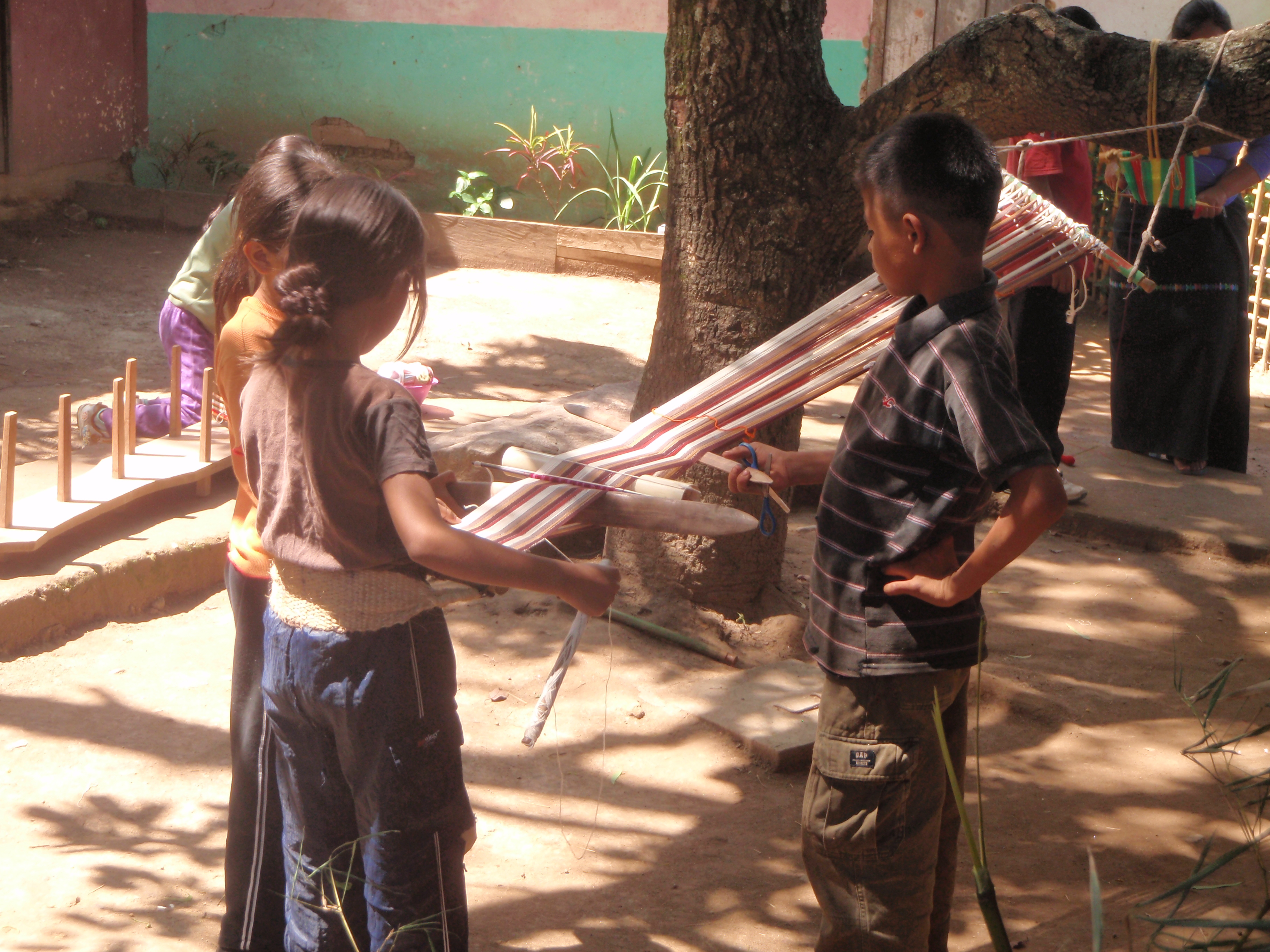
    Before we left Minnesota, Crystel had told us that she wanted to learn how to weave while in Guatemala. Lee contacted a local Guatemalan and set up a time for us to meet with her in her home. Both Antonio and Crystel quickly became engaged in learning to weave. They returned to her home several afternoons to complete their projects.

    While Antonio and Crystel were weaving, Lee took Jody and me on a tour of the town church and also to Casa Milagro. Casa Milagro (since 1992) is an NGO that supports widows and children. Thilda Zorn, founder and manager of the project, focuses on providing an environment for creativity, joy, and freedom. Jody and I purchased handicrafts that the children had made.

    Casa Milagro – children learning to weave

    By the time Jody and I returned to our children, Antonio had left with Alex and Zach to play soccer in the village square, and Crystel was making fast friends with the girl of the house.

    Antonio rushed in breathless and excited. He was poking fun at Alex and Zach, “Those kids were smaller than me,” he laughed. “We lost 10-7. It cost us 3 quetzales (50 cents).” Apparently, there was a side bet and the local children came away the winners. “Alex, they blew right by you,” Antonio added. “And, Zach he couldn’t stop anything.”

    Antonio and Crystel learning to weave

    Antonio and Crystel were being changed. And, it had nothing to do with their parents and everything to do with their parents. We had brought them here – to their birth country to have an opportunity to connect with other Guatemalans.

    The boy who wouldn’t look at the kids in the square the first night was now facing off with them in a soccer match and for a short time he had two older Guatemalans, Alex and Zach, that could brother him.


    Antonio’s bud’s – Zach and Alex
    Crystel’s new friend

    This very fine day would finish in a hot tub and swimming pool in the next village, El Jaibalito. A ten-minute launch from Los Elementos.

  • Truth Telling

    Truth: Antonio doesn’t know that Crystel is providing rabbit ears. Truth: They love each other and are best friends.

    I am adding an extra post this week and skewing a bit off the Guatemalan trail and onto the mommy track. I will be back online with another post on our Guatemala trip in a couple of weeks.

    Truth Telling

    I had been waiting for the right time to broach the subject with the children. I thought this was it: Sunday morning, quiet, not a lot going on yet, and we were all together. That’s another way of saying that I had them captive at the breakfast table. Antonio was reaching for more bacon, Jody was buttering her toast, and Crystel was eating her cereal.

    I went to the livingroom and grabbed the book, My Two Moms, by Zach Wahls.

    Sitting down, I flashed the cover. The front showed a young man in a suit jacket and tie being kissed on the cheeks by two women. This book wasn’t new to them. I had been reading the library book the past two weeks and it had sat around the house in plain view. One evening Antonio asked me what it was about. “This guy has two moms just like you,” I said. “He also has a sister. I am reading what it was like for him growing up. He’s in college now.”

    There were a couple of things I read that surprised me. One was disturbing. I told Jody about it while we were walking the dogs. Zach said he felt bad that sometimes he lied about his home life when he was growing up. He wasn’t always truthful in responding to other children when they asked about his father (artificial insemination) or his family. This started when he was about the same age that Antonio and Crystel are now.

    I was surprised to know that Antonio and Crystel might already be getting awkward questions. And if they are like Zach Wahls, they might already be making up answers. I told Jody that I didn’t ever want our kids to feel bad about being less than truthful about their personal stories. Children have enough weight to carry on their short little shoulders. I think it’s unrealistic to expect children to say, “I don’t choose to answer that question. My story is my personal story.” Sometimes it is easier for children to lie and that is the route they go.

    Certainly that was the route I took when Antonio and Crystel first came home, as infants, even though I hold honesty in high regard. I got a lot of questions while standing in checkout lines. The most frequent was, “Are they twins?” At first, I answered with the truth and nothing but the truth. “No they are six weeks apart”. The truth didn’t feel right. It was incomplete and not acknowledging their bond as brother and sister. So I added, “They have been together since they were born.” I’d look at these two infants in their stroller shake my head and wonder what they were making of my conversation. I’d chastise myself for giving too much information. Information the children didn’t even have yet. I was afraid that I had a grace period to get the answers down before the children understood what I was saying. Sometimes I would just say, “Yes, they’re twins.” Neither answer was comfortable.

    Since I had trouble responding to even the most basic inquiry, I didn’t hold any illusion that Antonio and Crystel could negotiate every question that came their way as grade-schoolers. Sometimes the questions weren’t so simple. One time, while bagging our groceries, I was asked, “How much do they cost?” They were referring to the toddlers and not the milk and eggs.

    On our walk I let Jody know that this was a discussion I meant to have with Antonio and Crystel. It wasn’t a complete surprise to her when I came back to the table with the book.

    “I want to talk to you guys about something,” I said. “You know this book? This is about a guy just like you who had two moms. He wrote about what it was like for him growing up. He said he felt bad when sometimes he would lie about his family.”

    Crystel turned away from me, waving her hands, “Why do we always have to talk about this . . . ” she started.

    I stopped her, “No, this is important.” The children know how I feel about them being honest. I think she was expecting that I was going to tell her and Antonio that no matter what, I never want them to lie, even if it is uncomfortable, even if it is intrusive, even if they don’t want to answer.

    “If someone ever asks you about your personal story and you don’t want to talk about it, and you lie, that’s okay. I don’t want you to ever feel bad about that. You love your moms, we love you, and that is all that counts. When it comes to your story, it is your story. Don’t ever feel bad about not being truthful. We know you love us. We love you.”

    Finished, I got up and put the book back on the shelf. Sitting down, we continued on with breakfast.

  • Hiking the Canyon

    Starting our hike up Pampatin Canyon, Santa Cruz la Laguna

    Antonio had mumbled and grumbled up the zigzag paved road to the village square the first evening at Santa Cruz la Laguna and often brought up that traveling by tuk tuk was an excellent way of going from point to point and why didn’t we do that more often. He hadn’t warmed to the idea that we were a-people afoot. Still, I was hopeful when he was handed a walking stick for our hike up Pampatin Canyon. He could poke, stab, and slash his way through the jungle, over the creeks, and up the gorge that starts its accent from the backyard of Los Elementos. In my suitcase back at our suite were the guide books Moon Guatemala and one that I thought would be particularly helpful on our trip, Moon’s Guatemalan’s Western Highlands Including Chichicastenango & Lake Atitlan. But I didn’t crack the handbooks open our entire trip. No need. Lee Beal and our Guatemalan guides were our experts. They went into detail about the age-old traditions of the Mayans, the colorful mountain villages, the indigenous Guatemalans, and the forest jungle.

    The jungle

    After I started blogging about our trip, I quickly learned that even Google couldn’t provide the information about the area surrounding Lake Atitlan that Lee and the guides did. It was through Lee that I learned that the old and original name Mayan of the village of Santa Cruz (Spanish for Holy Cross) is Pampati. The name of the canyon is from this origin.I shrugged when handed a walking stick by our guide, Alex. I’m not a grumbler. I’m agile. I can skip up rocks. I survived Kor Am Tae Kwon Do black belt camp. Quickly, I learned the poker was useful for pushing aside large leaves that I termed itch weed. Alex told us the correct name of the leaf but my head is only so big. As far as I was concerned it was itch weed and I shouldn’t touch it. We stopped often on our trek up the canyon as he pointed out a fruit, a plant, a leaf, and coffee plants.

    Alex showing us the pitaya fruit

    Alex nodded to our left towards two children, who looked to be about 5 and 7 years old, resting, tucked under a tree with a bundle of wood made up of dead twigs and branches. Alex told us that any child who wasn’t in school or working had the job of fetching wood from the forest for cooking fires or to sell. Of course, I hoped Antonio and Crystel were hearing this.

    When we received photos from their birth families, I sat with them, and told them to look past what their eyes first saw. “See your family sitting around the table and on the bunk bed?” I said to Crystel, “From this photo you can tell that this one room is the family’s living room, bedroom, and kitchen. The room is smaller than your bedroom.” I added, “Look past your family and see the toothbrush on the window sill? There is only one toothbrush. It is likely that your family is sharing that toothbrush. If you look at the walls you can see that they aren’t painted. The walls are plastered or whitewashed.”I wanted Antonio and Crystel aware on our Guatemala trip. This is their birth country: beautiful, vibrant, rich in culture, poor and illiterate. Alex and Samuel our guides, would receive 200 quetzales, about $25.00 per day for their service, their skill set speaking English, is marketable. The average Guatemalan earns 50 to 60 quetzales a day, about seven dollars.

    Antonio, Crystel, Jody, Elizabeth

    Alex showed us a pitaya (Mayan word for the color of the inside of the fruit) also known as dragon fruit. When he opened it with a machete I could see that it was a fruit that had been offered at our breakfast buffet at Hotel Grand Tikal Futura, zona 7, where we stayed for three nights in Guatemala City. Jody and I encouraged Antonio and Crystel to try at least a taste of something new at each meal. The pitaya tasted like a cross between kiwi and pear.

    On our hike we met a local Mayan woman who was picking pitayas to sell at the market.Our trip in June of 2012 was very different than our trip in June of 2010 for many reasons. One of them was the fact that we didn’t take any pictures of the Guatemalans that we saw in remote villages. Having Alex, Samuel, and Lee as guides meant that taking photos was possible because with their Spanish we could ask permission. Antonio and Crystel have more than four years in a Spanish dual language school but their grasp of the language was most evident when they were buying boom booms (lollipops) in the tienda (store).

    Locals carrying firewood down the canyon

    When Alex asked the children if we could take a photo they smiled shyly and shook their head no. Later we met the woman who had been picking pitayas and we learned that the two children gathering wood were hers. After visiting with her, Alex asked if we could take a photo of her and her children. For a few quetzales, she agreed.

    Our goal for the canyon hike was to reach the waterfalls. We didn’t make it before Alex called Lee and found that it was time to meet up with him to visit our first NGO (non-government organization). It was odd to me that we were in a third world country yet you could use a cell phone to call someone. Cell phones are inexpensive in Guatemala. You can buy one for less than $20 dollars. This is something I will do on our next trip if only to be able to call within the country.

    Later that evening, Zach took Antonio and Crystel back up the canyon to see the falls. The 14-year-old and two nine-year-olds returned breathless, happy, and flushed with energy. The grumbly nine-year-old boy had transformed into an adventurer. And truly, he didn’t grumble the rest of the trip. But then again, on a few occasions in villages we all piled into a tuk tuk to get from point A to B. Funny thing, his Spanish came alive when I told him it was up to him to ask for a tuk tuk and find out where it would pick us up. Ah, kids.

    Our first NGO visit, Mayan Medical Aid, opened by Dr. Craig A. Sinkinson, M.D.,  in 2004 serves the 99% native Mayan Indians that make up the population of Santa Cruz. To help subsidize the clinic, he gives private Spanish lessons along with his Guatemalan wife who is also an M.D. Dr. Sinkinson developed a medical Spanish accredited program that also brings in funds. The benefits of the program for medical students are the

    Lee Beal and Dr. Craig Sinkinson, M.D.

    one-on-one attention, the ability to participate in the clinic, and the immersion experience. Prior to Dr. Sinkinson coming to Santa Cruz, 12 to 15 Guatemalan women died each year in childbirth. Most years they now have 0 deaths. The locals come to the clinic for medical assistance with digestive, reproductive and skin concerns, diabetes, and emphysema.I found the doctor to be very hospitable and knowledgeable with a respect and passion for the Mayans that was similar to Lee’s. One of Dr. Sinkinson’s goals is to teach the Guatemalans working with him to operate the clinic. In this way if something were to happen to him, the clinic would be self-sustaining.

    The goods we brought–gloves, vitamins, aspirins. Oh, yes, and suntan lotion. Dr. Sinkinson was happy we left the large blue suitcase on the cardboard box for him to use.

    Antonio and Crystel sat patiently while we visited with Dr. Sinkinson. Though Lee and his wife Elaine don’t have children, they have a sense for when it is time to move on. Prior to leaving the clinic, we stuck our head into an office and saw the suitcase we had brought filled with sterile gloves, Centrum, and Ibuprofen for the most part. Alex asked what was in the spray cans. I explained that it was suntan lotion for the clinic. He laughed and pointed to his skin. All I could do was raise my hands and tell him that it was on the list. Funny foreigners.

    What are Antonio and Crystel doing and where are their mothers?!? You can see a typical casa in the foreground. Tin roof, chickens, dogs, firewood, dirt yard.

    Walking across the village square, Lee said lunch at Sabor Cruzeno Restaurant was next. The restaurant is part of the CECAP Culinary Arts program that trains young people for successful employment in the tourist business. CECAP is supported by Amigos de Santa Cruz foundation of which Lee is on the board.

    Local tienda where Antonio and Crystel buy their boom booms. This Mayan is a graduate of the CECAP vocational training center run by Amigos de Santa Cruz

    Though not yet totally immersed in village life, the di Grazia family was beginning to place their fingertip on the local culture. We were closer than we had ever been before to the Guatemalan way of life.

    If you like my blog writing hit the subscribe button on WordSisters. You will automatically receive my posts every other week. Also, I find Lee Beal’s blog very interesting.  He writes about his meanderings in Guatemala, Lake Atitlan, and the Mayan culture. http://lakeatitlantravelguide.com/blog/