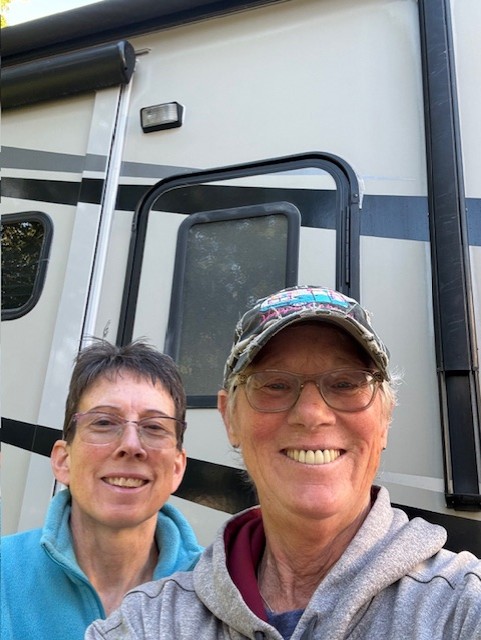
“We’re doing this,” we both said. Fist bump.
On September 30, Jody and I backed out of our driveway in our 29 ft. Class A RV. Destination: Zachary Taylor RV Park, Okeechobee Fl., 1,671 miles away. Hurricane Helene had made landfall and Milton was threatening. We were driving towards chaos, towards uncertainty. In 16 days, our 6-month workcamper job started at the RV park.
Would we enjoy living in an RV for six months? Would this lead to full-time RVing? How would Jody and I do living in such close quarters … all the time? Would we enjoy the RV community? Would we be interested in boondocking (camping in a remote location)? Would our two small dogs accept RV life?
Four days after we left home, 215 people were known to have died as the result of Hurricane Helene since it made landfall in Florida. Hurricane Milton would make landfall in 5 days, a possible category 5 hurricane.
Months ago, we made camping reservations at state parks and planned to visit relatives. We limited our travel to 4-5 hours a day and camped for no less than 2 days.
Flexibility and being comfortable with unknowns were our mantras. We continued south, while relatives updated us daily on the weather.
“It’s an adventure. We’re doing this.” Fist bump.

Our first destination was Sugar River State Park in Durand, Illinois. We weren’t expecting answers so quickly—darkness, quiet, and remoteness left us feeling vulnerable. 82 campsites with only 3 other campers. Jody and I agreed that boondocking was not for us and we would be happy to return to our sticks and bricks home after six months. Hiking was excellent amongst the woods and prairies where we could let the dogs run off leash. Buddy and Sadie were proving to be good travelers.
It was at our cousin’s home in West Frankfurt, Illinois where we truly felt retired for the first time. Sitting outside next to their pool, visiting for hours, was self-indulgent. Before, our retirement plan seemed to have been volunteering at sporting and music venues to financially contribute to Juan and Crystel’s college education. Heading south brought that to a hard stop. Our paradigm had shifted. This was about us.
Continuing south we camped at Bennett Spring State Park in Lebanon, Missouri. Stocked daily with rainbow trout, the park attracted anglers who lined the shores and stood knee and waist deep in the water casting lures, flies, and spinners. Jody and I remained on land and enjoyed the miles of hiking forests, woodlands, bluffs, sunny glades, and dry stream beds with the dogs.

War Eagle Creek falls off the top of an Ozark Mountain. The 59-mile flow is never dry, and changes through four seasons. The headwaters form in the hardwoods of the Ozark National Forest and streams through Jody’s sister and brother-in-law’s pastureland before spilling into Beaver Lake, the water supply for Northwest Arkansas cities and towns. Jody, the dogs, and I rode a four-wheeler with her sister driving amongst the grazing bulls, cattle, and calves until we reached a sacred area: bluff shelters on the right that the Native Americans, Osage, Quapaw, and Caddo used for protection against the elements and the creek on the other side. Men, women and children camped here to fish, hunt animals, and collect plant foods. Fire scars remained on the rock shelters from their fires.
Wall Doxey State Park in Mississippi had few campers. A couple was escaping in their camper van from Hurricanes Helene and Milton. Hiding out until it was safe to return to their home in Punto Gorda, Florida. While at the park we were informed that our reservations in Florida– Florida Caverns State Park, Alfia River State Park and Lake Manatee State Park were cancelled due to unsafe conditions. Instead of extending our stay at the state park, we continued south 270 miles to a KOA in Hattiesburg, Mississippi. Inching ever closer to our final destination of Okeechobee, Florida.
At the KOA, Gus-Gus the cat chose me. Gus followed Jody, the dogs and me home after a walk. I took note of his concave belly, told him to wait outside our RV, and got a can of wet dog food. After he ate, I gave him a bowl of dry dog food. Gus joined me in the dog pen, lounging on the dog bed as if he belonged. Buddy and Sadie were accommodating. This may have been because Gus looked like Juan’s cat at home and his name is also Gus-Gus.

My bond with the cat was making Jody increasingly nervous. She reminded me that there was not space in the RV for a litter box. For the next several days, Gus got to be a cat, laying in the sun, safe, purring when I stroked him, contented that he was being fed and watered. There were several stories making the rounds about Gus. The one I decided to believe was that a lady had brought her cats from her house in Florida, van camped for a few nights – set up a tent and play station for her many cats, and Gus wasn’t ready to return when she was, and she inadvertently left him. It was difficult for me to say goodbye to Gus. I racked my brain for how two people, two dogs, and a cat could survive in a 29 ft. RV and decided that we couldn’t. I said a prayer and left Gus in the care of the living and the spiritual realm.

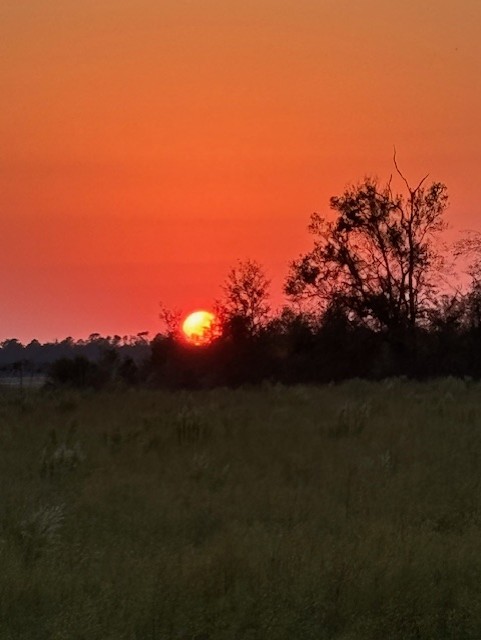
There weren’t any cats claiming me in the Perry, Florida KOA, our last stop before Okeechobee. It was the first location that we could see the damage wrought by Helene. Piles of debris were on the roadway. Electrical trucks ferried up and down the highway. The sunset not damaged by the hurricanes was a gorgeous hue of oranges.
Our final l289 miles to Okeechobee were uneventful. Driving into Zachary Taylor RV Park, I honked the horn marking our arrival. I hollered, “The Minnesotans are in the house!”
Let the adventure continue. Fist bump.