Tag: wordsisters

  • The Mirror

    What a twelve-year-old learns to survive sometimes becomes the skill she uses decades later at a poker table.

    Lying didn’t come naturally to me. I was twelve when I realized, quite suddenly, that I wouldn’t survive my family’s chaos if I didn’t learn how.

    I stood in front of the assistant principal, heat climbing up my neck and into my face. I could feel the redness spreading across my cheeks. The corners of my mouth twitched. My eyes kept sliding away from his.

    He asked the question again.

    I tried to answer, but the truth was written all over me. My breathing had changed. My hands shifted at my sides. My face burned like a signal light.

    I remember thinking: This is a problem.

    That afternoon, when I got home, I went straight into the bathroom and closed the door behind me. I turned on the light and stood in front of the mirror. I shut the household noise off and stared at my reflection.

    I knew exactly what to do.

    I looked into my own eyes and said the words out loud.

    “I didn’t do it.
    I wasn’t there.
    It wasn’t me.
    I don’t know how that happened.”

    My face flushed immediately. My mouth tightened. My eyes shifted away.

    So I tried again.

    And again.

    I practiced until the red stopped rising in my face. Until my breathing stayed steady. Until I could hold my own gaze without flinching. I practiced until my shoulders relaxed and my voice sounded ordinary.

    I practiced until my body stopped betraying me.

    That was the day I learned that unless someone actually saw me do something, I could lie convincingly.

    When I was nineteen, I had a different realization.

    I was mowing the lawn on a nice summer day. I paused, looked to the sky, and watched the clouds drift.

    And it hit me.

    I was exactly where I had said I would be.

    No excuses.
    No stories.
    No explanations.

    Just the truth.

    There was freedom in that.

    A lightness.

    I remember thinking: This is better. I have no reason to lie anymore. I’m safe.

    I went back to the mirror. I stood there looking at myself and said, quietly at first, “I love me.”

    My eyes slid away from my own reflection.

    So I said it again.

    “I love me.”

    I stayed there repeating it until I could look myself straight in the eyes without my gaze moving off the mirror.

    “I love me.
    I love me.
    I love me.”

    It felt strange. Uncomfortable.

    Slowly the words settled.

    I believed me.

    Today, I still practice with a mirror.

    Before a poker tournament starts, I give myself the same quiet talk.

    “I love me.
    I’ve beaten everyone at this table before.
    I can beat them today.
    Play my cards.
    Trust myself.”

    Poker is about many things—math, probability, timing—but there is another part of it people don’t always talk about.

    Control.
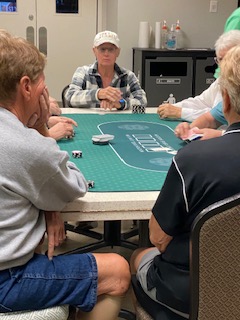
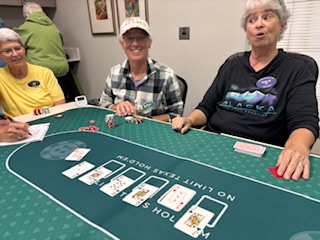
    At the poker table, I can keep my emotions exactly the same whether I’m holding a seven and a two or a pair of aces. My breathing stays steady. My hands rest in the same place. My face doesn’t give anything away.

    No tells.

    Sometimes I think about that twelve-year-old girl standing in the bathroom mirror, practicing how not to show the truth on her face. She didn’t know it then, but she was learning something about herself, about discipline, about control, about surviving difficult moments without falling apart.

    Poker uses those same muscles.

    But it also asks for something more.

    It asks me to stay present.

    Every hand is a surprise. Every card an unknown. Sometimes the deck gives you everything. Sometimes it gives you nothing.

    And when it gives me nothing, that’s okay too.

    I can push my chair back, smile across the table, and say,

    “Nice game, ladies.”

    Because the real victory happened long before the cards were dealt.

    It happened the day I learned to look at myself in the mirror and tell the truth.
  • Moving On

    Moving On

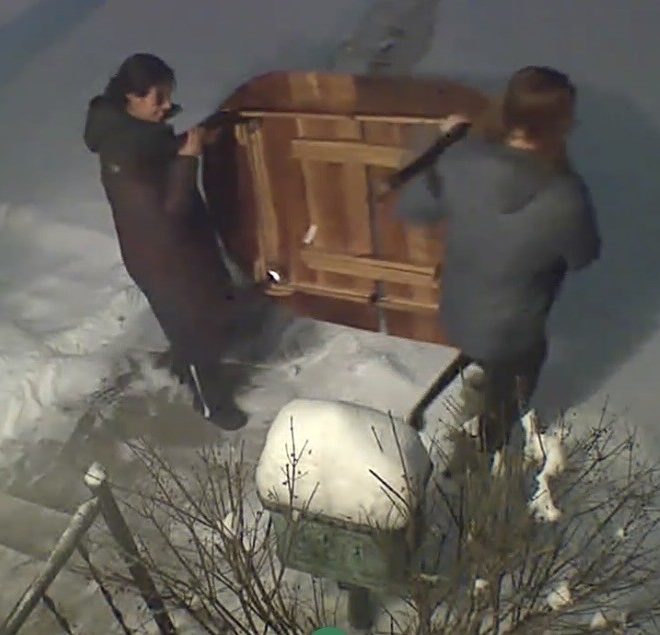
    “Crystel’s carrying the dining room table out of the house!” Jody said, a note of panic in her voice. “Now the chairs!”

    Quietly, I felt proud of Crystel. She was going ahead with gumption, emptying our house while we were in Florida, not asking permission, not making a fuss. Jody kept tabs on the coming and goings through the Blink footage, watching life continue without us. In what felt like solidarity with her alarm, I said, “Yeah… she could have told us before she did it.”

    “Well, you did tell her to give everything away,” Jody said, somewhat accusingly.

    “Yeah,” I said. “I did say that didn’t I?”

    I imagined walking into our house when we returned in May and not seeing our dining room table. Juan wouldn’t be assembling a Lego set or Crystel stitching at the table. Our final board game had already happened.

    The two girls turned the table sideways to fit through the door, and the leaf extension opened awkwardly.

    “We better remind her to get the table leaves from the basement,” Jody said.

    “You’d think she’d know that” I said, cocking my head studying the video clip. The extension fell completely open now. It was like watching a movie reel, silent, irreversible.

    “Yeah,” Jody replied. “You’d think so… but.”

    Later, we got a photo from Crystel. She was sitting at the table in its new home. She had gifted the table to her friend who was moving into a new apartment.

    Quickly, Jody texted a list: These are the things I want from the house—do not give away. Heart-shaped end table from her mother. Charging side table in living room. Lounge chair the cats sit in.

    Our house will go on the market by summer. Juan and Crystel are turning twenty-four this year still living at home. Juan has a plan to move into an apartment with his girlfriend. Crystel’s plans are fluid. It’s as if the house is still raising the kids, negotiating garbage duty, washing dishes, cleaning house.

    After the house sale, Jody and I plan on living in our RV. Maybe sooner than expected, judging by how quickly our household items are leaving through the front door.

    “I think it’s a good idea,” I said to Jody, “that Crystel is helping give things away. With the dining room table gone, there’s no pretending we’re not leaving.”

    Twenty-five years, we lived in that house. The only home Juan and Crystel knew. They are dismantling their childhood while still living inside it. Crystel has sewn her t-shirts into a quilt; Juan is going through his sweatshirts one by one.

    Maybe this is how it happens. Not with one final goodbye, but piece by piece. A table. A chair. A room that echoes a little more than it used to.

    For years we filled that house with noise, laughter, birthdays, school and neighborhood parties. Arguments and apologies.

    Now they are emptying it.

  • Borrowed Time

    Rain hammered the passenger van, rattling the metal like gravel tossed against a tin roof. Each burst sounded closer, louder, as if the storm were trying to break its way in. Why today, of all days, when Juan was visiting his birth family?

    We had planned it so carefully. We’d even had a kind of rehearsal the day before with Crystel’s birth family. The sun shone right up until the moment we left the amusement park. It couldn’t have been more perfect, her birth family and extended family gathered for lunch, then rides. Laughter. Fun. Unity. All the while, Jody and I worked quietly together, reading each other’s cues, me opening the bright orange Pollo Campero boxes, warm with chicken and fries, and her spreading the food across the tables and twisting open bottles of soda.

    Outside, the rain was relentless, steady and unforgiving, as if reminding us again and again: there is no escaping the comparisons, no matter how hard we tried.

    Jody and I insisted, repeatedly, “You can’t compare, kids. Your birth families are different. Circumstances are different. You are both deeply loved by your birth moms and families, that’s what matters. No one is better, and no one is less. What you can do is help each other through these visits.”

    That became our refrain across five birth-family visits, beginning when they were nine.

    Guatemala was both their birth country and our vacation destination. We hiked. We cliff-jumped. We wandered through villages. Volcanoes rose near and far, and water threaded our days, rivers, lakes, sudden downpours. We even considered buying a home there, going so far as to meet with realtors and walk through properties for sale.

    Some days ended with rainbows.

    Juan and Crystel, now twenty-one, encouraged and supported each other during their visits. Crystel insisted Juan stay close to her, and Juan counted on her to be the cord connecting him to his birth sister.

    Comparisons drizzled in. Rain or sun. Large family, small family. City or remote mountain village. Kiosk trinkets or hand-woven cloth.

    Juan traced circles on the fogged window and said nothing. With his other hand he held tight to his girlfriend Aryanna, pressed close beside him, as if neither of them wanted to risk losing the other. It was her first time in Guatemala, and in a short while she would meet his birth mom.

    Rain pressed in from the outside, forcing us closer together. The windows wouldn’t clear. Plans changed again and again. Finding Juan’s birth mom, Rosa, and explaining where we could meet her became a chore. We had to rely on others for communication. Juan and Crystel, after years of schooling, spoke Spanish hesitantly, enough to get by, not yet fluent.

    Crystel kept checking her phone, chuckling to herself, probably on WhatsApp with the group chat her oldest birth sibling had created. I watched her, the quick way her fingers flew across the keypad, and felt a swell of relief. She was in charge now, exactly what Jody and I had hoped for. Beneath that relief was an ache I couldn’t quite name. Her spirit, bubbly, light, unrestrained, lit the van. It was the best part of her.

    I wasn’t in control. Exhausted, I leaned my head against the damp windowpane and let my knee rest against Jody’s. She reached for my hand and held it tight. Our warmth gave me a moment’s reprieve, just enough. I had done so much research before our Guatemala trips, planning the vacation and each birth-family meeting. There was always something new to look forward to, some adventure we hadn’t tried yet. Hang gliding off a volcano was supposed to be the latest, a plan the rain scrapped at the base of the mountain road.

    What Jody and I could control was bringing the kids to see their birth families. Before every visit there was a crescendo, the build-up, the tension, the pressure to get it right. We had only four to six hours. And then we took our children back home.

    How is that fair?

    We had the children for a lifetime. We could bring them for a visit and then leave. I wonder now if each visit left a bruise we couldn’t see, a reminder that reunion was always followed by another leaving.

    All of these thoughts churned in the relentless rain. Plans shifted to meeting at a mall.

    Would the visit be enough? It had to be.

    The mall rose out of the sprawling city, volcano silhouettes in the distance and palm fronds brushing the edges of the parking lot. Jody squeezed my hand, then let go. “We’re here,” she said, gathering the gift bags. Inside, the rush of air-conditioning wrapped around us, a shock after the humid air that smelled faintly of rain and exhaust. Spanish pop music echoed off the tiled floors, layered with bursts of laughter. My eyes widened like a kid at Christmas. Bright storefronts glowed in rows, mannequins in glossy shoes, phone screens flashing. I hadn’t expected this in Guatemala. It could have been the Mall of America. A kiosk brewed coffee dark and sweet, the scent mingling with fresh bread and fried empanadas.

    “Beth,” Jody urged, “keep walking.”

    “Yeah, you’re staring again, Mom,” Crystel said.

    Rosa, Juan’s birth mom, and Ani, his sister, spotted us first.

    Rosa reached for Juan’s hand. “Mi hijo,” she whispered.

    I saw Jody step slightly back, giving them space, her eyes shining but fixed on Juan, as if she were willing him courage.

    Juan’s smile was small, careful. “Hola.”

    We had come for adventure, hang-gliding off volcanoes, cliff-jumping into clear water. The real leap was here, in a mall court, watching our son meet the woman who first held him. I held my breath.

    Aryanna, full of anticipation, studied Rosa’s face, wanting this distant mother to see her as Juan’s special person. Crystel had already sidled up to Ani, a few years younger than she and Juan, slipping an arm through hers. They stood there together, comfortable as sisters. Each of them loved Juan in their own way.

    In that bright, echoing mall, families shopped for shoes and phones while ours tried, in four short hours, to stitch together a kind of love that would hold until the next visit.

    Visits that were never promised. Only hoped for.

    On the drive back to the hotel, a faint arc appeared in the clearing sky, the beginning, maybe, of double rainbows. I wondered which of us would feel the bruise first, and how long it would linger.

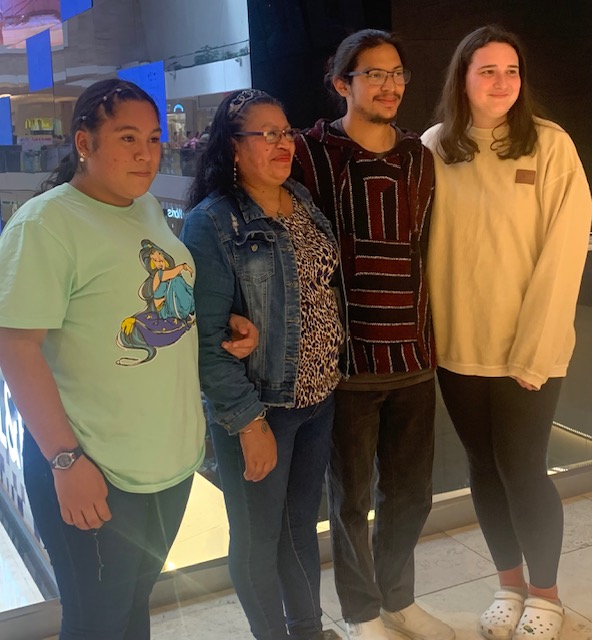
    Ani, Rosa, Juan, Aryanna
    Ani, Rosa, Juan, Aryanna (Juan’s girlfriend)