In Honor of Those Who Teach

Marquette University’s development rep wanted to visit (aka ask for a donation). On a hot summer day Samantha Adler and I sat down with iced drinks to chat about education before the pitch. First, we circled topics searching for things we had in common beyond my alma mater and valuing education. We wandered into talking about growing up in small towns.

She grew up in Monticello, Indiana, the same small town as my husband. She had attended Meadowlawn Elementary. I mentioned my mother-in-law spent decades there as a third-grade teacher.

Samantha asked for her name. 

“Mrs. Kraack.”

Her eyes got wide. “Mrs. Kraack! She read to us after she retired.”

“That would be her.”

“She was amazing. She made me want to read.”

There we sat, two strangers across a table, connected by the kind of educator who could make small children want to read.

“I read Winnie the Pooh books to my children, and I do all the voices like Mrs. Kraack. I haven’t thought of her for so long. This is amazing.”

We both had goosebumps while sharing Mrs. Kraack stories. I told her truthfully that this opportunity to talk about my mother-in-law was a wonderful gift. 

Helen Kraack taught at least a thousand elementary school children during her career. She was on her third generation of students in some families. Teaching was not a job for her, but a mission. She worked hard to be sure every third grader leaving her classroom could read, manage their time, know how to be kind to others, and dream of their futures.

How do you measure the success of teachers like Mrs. Kraack? Many tried when she received an Indiana Shining Star for Excellence in Teaching, when she retired, when she passed. Stories about kids who went to college, who became professionals, who held leadership positions, won awards. 

Then there are untold stories about little girls like Samatha who learned to love reading while listening to Mrs. Kraack. A girl who would earn a full scholarship to St. Mary’s College and develop a career making college possible for other kids. A mother who reads Winnie-the-Pooh books to her children. 

Many thanks to all who enter classrooms this school year or teach in other ways. Know that even on your most lackluster days, your influence may brighten a child’s day and well outlive you. There are people who have your backs and wish you all the best. 
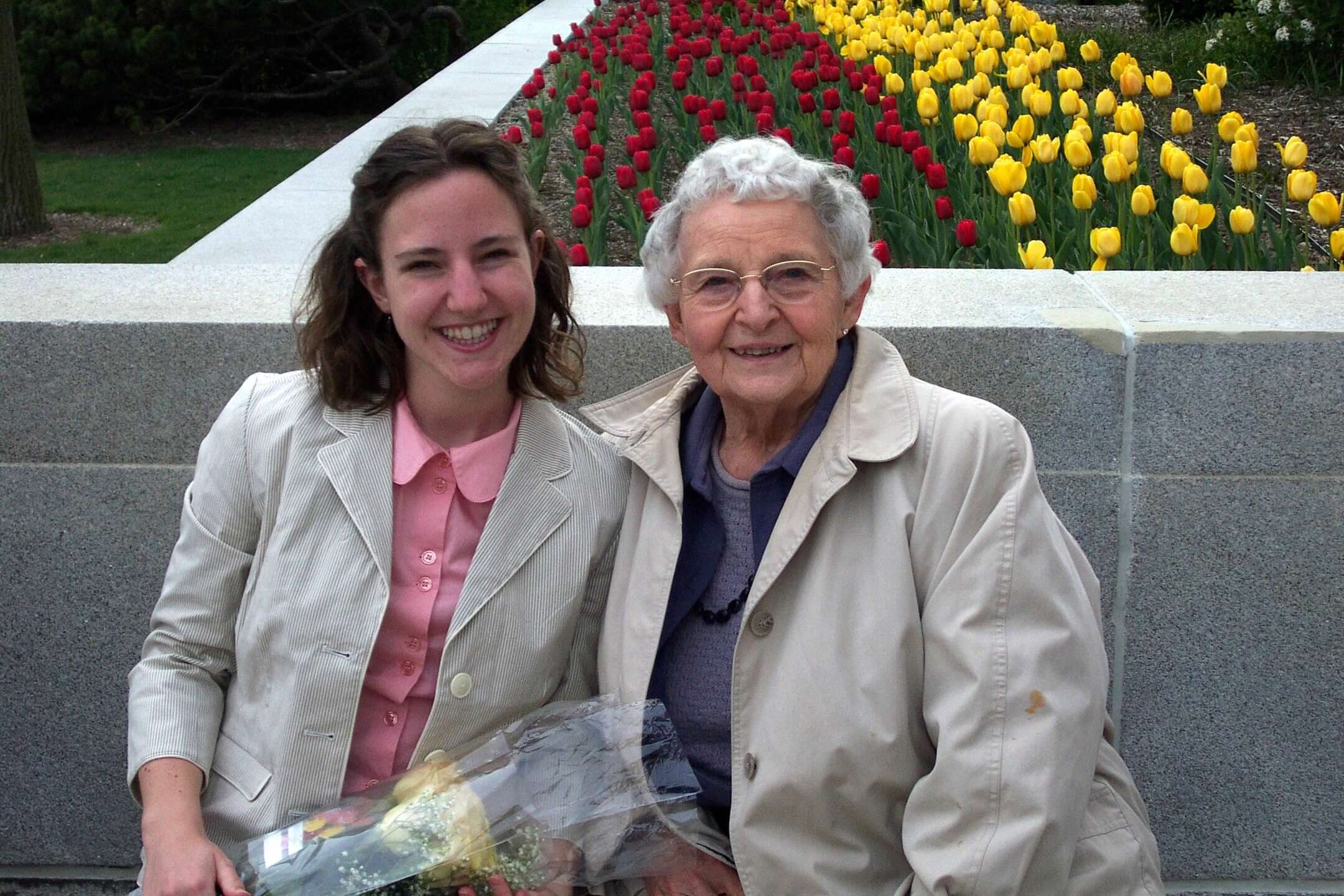
Emily Kraack Chad and Helen Kraack

“Some people care too much. I think it’s called love.”
― A.A. Milne, Winnie-the-Pooh

Anything I’d Recognize?

Writing paid part of my tuition and living expenses in both high school and college. Stringer work, editing school publications, working in media relations, internships, freelancing. I stepped out of journalism school into local newspaper work then the wild world of advertising before settling into corporate communications.

Now, a retiree from the briefcase world, I would love to have some years back from when creative writing took second, third or fourth place behind big obligations. There have been successes, some brilliant like being a part of a regional Emmy award-winning team, Midwest book awards, C-Span Book TV. Maybe there could have been more.

When Joe Tachovsky and I wrote 40 Thieves on Saipan, folks who discovered I was co-writing a World War II history book had many questions. Some would follow me to share personal stories about uncles or grandparents who served in the war. I handed out business cards like a realtor at an active open house.

Response is less enthusiastic about freelance work and falls dramatically into the same interest zone of talking about high school dance competitions in a gathering of day traders when I share that I write contemporary fiction. “Anything I’d recognize” is a standard response or its companion “Would my wife recognize your books?” If lucky, someone asks how you think up your stories and a brief conversation opens. 

It’s probably fair.  Social media, family, sports, travel take a lot of time. Bumping into a writer is kind of like listening to a bar band. If they don’t know how to play your favorite song, you disengage. 

Anonymity isn’t limited to B list writers. Years ago, I stood next to a crowd growing around a hotel counter at a major conference. Voices were rising as news spread that the staff did not recognize Nikki Giovanni when she attempted to check in without a reservation. Giovanni, who died in 2024, was one of the world’s best-known African American poets and someone who spoke out on social issues. But chances are mixed that that reservationist was one of the 50% of Americans who read at least one book a year and even more minute that she was in the 12% who read poetry.

Some days a writer may as well talk with their characters, cause few other people are paying attention. But I wouldn’t stop working just because of that. 

Saying Goodbye to My Books

In preparation for a someday move, I’ve been parting with my books. Hundreds of them over the past three years. Most have been collecting dust for decades (I bought my house in 1989), while others are recent additions. Some are quick reads I started and finished while drinking a cup of coffee, while others took me more than a year to make my way through.

Many are still on my “to read” list while others have been read and reread, by me and by the family and friends I’ve shared them with. Some were gifts, though most were bought by me at local bookstores or while traveling.

One reason I have so many books is because the upstairs of my house, which once belonged to the owners of a local used bookstore, is a 45- by 15-foot half-story lined with—no surprise—bookshelves, 150 linear feet of them, plus three standalone bookcases.

Although I’ve loved owning my books, some of which date back to my years as a college English major, now that I’m on Medicare and beginning to think of moving, it’s time to let them go.

But parting isn’t easy, in large part because I still treasure the stories they told, the memories they hold and the lessons they taught. There are books about saints that I read while in Catholic grade school, and books about the sea I read while in Florida on family vacations. There are books I used to motivate myself, and others I turned to for solace after the deaths of my parents.

There’s a shelf of books that include autographs from people I admire and heartfelt messages from people who love me. There’s even one shelf dedicated to books written by people I know, and whom you may know as well: Marly Cornell, Kate DiCamillo and Cathy Madison to name a few. Plus, books by Natalie Goldberg, Mary Carroll Moore and others from whom I’ve taken a Loft class or gotten to know because of a writing workshop.        

Just seeing the books brings back a flood of memories of the books themselves—the characters, the settings, the twists and turns of their plots—as well as where I was when I read them: while packed in the car with my parents and four younger sisters on our way to Florida for a family vacation, while taking college English classes, while flying to China, while spending a month on a Panama beach, while sitting bedside during my father’s final hours.

Others such as How to Forgive When You Don’t Know How and Living Proof: Telling Your Story to Make a Difference home in on my desire to be a better person and to advocate for causes I care about.

And, no surprise to anyone who knows me, there are also dozens of self-help books, many of which inspired me to write my own book, What Do You Really Want? How to Set a Goal and Go for It, A Guide for Teens.

While I’ve treasured all my books, I’ve recently begun sending them back out into the world. I’ve donated hundreds to Rain Taxi, a local non-profit that sponsors the annual Twin Cities Book Festival, which includes a book sale. I’ve also put dozens in the Little Free Library down the street.

Still others I’ve passed on to family and friends whom I hope will enjoy them—or learn as much from them—as I have. They range from true crime to travel guides, from books by (and about) artists to how-to books on everything from fishing and stargazing to tying knots and learning Spanish.

And because I now do most of my reading on my phone thanks to the Kindle and audiobooks I borrow from the Hennepin County Library, my shelves are becoming empty.

Thankfully I have one thing that will keep my book memories alive: the annual “books I’ve read” lists. I truly treasure these lists and the many fond memories they prompt of the nearly 2,000 books I’ve read since I started keeping track back in 1982.

As author Italo Calvino has written, “Your house, being the place in which you read, can tell us the position books occupy in your life.” And although there are now far fewer books in my house than there were in the past, I hope you will always be able to see the important place they hold in my life.

Everything That Rises Must Converge

405My experience as a Loft Mentor Series speaker.

It had been going on for some time before I noticed. My daughter was choosing an adult out of the people milling about at the Loft Literary Center after the Mentor Series Reading, taking him or her by the hand, and leading the person to open floor space. Once there she generated a dance routine for the adult to follow. After their two-minute routine was complete, she released the adult back into the gathering and chose a new person. Each person learned and performed a never-done-before dance routine. My son followed along videotaping each jig.

Who is this girl? And what magnetism does she possess that adult men and women will willingly leave the fold (and food) to dance with her? Even Jerald Walker and Mark Anthony Rolo, acclaimed authors and mentors, followed her as did many others.
All I could do was stare and see if anyone needed saving. They didn’t. They were enjoying the girl.

At three-years old, this girl could not talk intelligibly. Part 3 of my memoir, House of Fire, speaks to this. Thank God for the goat, it begins. During one of our camping trips, both my partner Jody and I thought that the other person had the girl. When I understood that neither one of us did all I could think was, The girl can’t tell anyone her name, where she lives, or who her moms are. We sprinted back to the the animal pens, which was the last place we saw her. She and the white double-bearded goat stood in companionable silence, the goat chewing her cud, the little girl waiting for her mothers to return.

The girl was diagnosed with articulation disorder and on two occasions we were asked by the school district to have her tested for autism. Jody and I refused. We were afraid she’d be mislabeled.

I mentioned this to a fellow mentee on Friday night, told her that I was in awe of the girl. She said that the girl just needed the right fertilizer and that Jody and I provided it for her.

I think she’s right.

I thought about myself. How my life’s work has been to be visible, to stand and speak my truth.

All this love, this fertilizer, brought the very best out of the girl and me on Friday night, the night of my Loft mentorship reading.

I recalled a quote,

“Remain true to yourself, but move ever upward toward greater consciousness and greater love! At the summit you will find yourselves united with all those who, from every direction, have made the same ascent. For everything that rises must converge.” Pierre Teilhard de Chardin

Yellow tulips flowers. (3)[1]I did the only thing that I could do when we got home. I presented the girl with a bouquet of tulips that I was given. After all, she gave quite a performance.

“Whose belly did I come out of?”

dsc00095[1]July, 2013. My cell phone rang. I stepped out of the dining hall at Tomahawk Scout Reservation, in Northwestern Wisconsin, wove through dozens of 10-year old Cub Scouts to reach the flagpole. “Hold on, hold on,” I said to the caller. I looked up to the sky hoping that a satellite would keep us connected. Jerod Santek from the Loft Literary Center was on the other end saying that I had won the 2013-2014 Loft Mentor Series for Nonfiction. “Can you hear me?” he said. I could. But after submitting to the competition for over ten years and being a finalist four times, I didn’t know what to say.

Friday, April 18th, at 7 p.m. I will read an excerpt from my memoir, HEALING FIRES.

“Whose belly did I come out of?” five-year old Crystel asks. “Yours or Mama Joey’s?” Milk spills from her spoon into her cereal bowl.

Thirty years of breaking free from the cycle of violence and discovering my true self prepare me to start my adoptive family. The challenge of creating a home of love, safety, and joy is tested by dysfunctional ghosts and dark memories from the Wisconsin farm where I was raised.

It’s the culmination of my work with mentors Mark Anthony Rolo as well as my work with Loft Literary Center instructor Mary Carroll Moore.

Also reading is Jerald Walker and my fellow mentee Pamela Schmid.imagesGECE7253

Mark Anthony is an enrolled member of the Bad River Band of Lake Superior Chippewa. His memoir MY MOTHER IS NOW EARTH won the 2012 Northeastern Minnesota Book Award and was nominated for a 2012 Minnesota Book Award.

When I opened Mark Anthony’s book and read his first lines, “My mother wants to be buried in fire. She races into a burning farmhouse, letting serpent flames twist around her legs,”my mouth fell open. I had submitted a writing sample that started with these words, “I’m on fire. I scream. I run. Flames chase me. I fall to the grass, slapping at my shoulders, my back, my side. Digging my shoulders into the ground, I pitch back and forth, back and forth. The fire follows.”

Under Mark Anthony’s tutelage, I have restructured my memoir to merge my past and present story just as spring water runoff flows to creeks and further downstream joins the river and finally the ocean that embodies us all.

Jerald Walker’s STREET SHADOWS: A MEMOIR OF RACE, REBELLION, AND REDEMPTION was also very influential. A graduate of the Iowa Writers’ Workshop, Jerald is a recipient of the 2011 PEN New England/L.L.Winship Award for Nonfiction and his book was named a Best Memoir of the Year by Kirkus Reviews.

When I read Jerald Walker’s memoir, I finally understood how I could meld past and present together in my memoir. I studied his structure, counting the number of pages he used for his present story and then his past. I attempted to locate where he brought them both together. All the while, I resonated with his efforts to rise above the circumstances that he was born into.

7ac30fe0b702dd387b1f0ab4fcd06c36[1]Pamela is the creative nonfiction editor for Sleet magazine. Before receiving her M.F.A. degree from Hamline University, she spent more than a decade reporting and editing for the Star Tribune and the Associated Press.

Pamela says this about her memoir, “In MY BIG BOOK OF YEARNING, I chronicle my son’s arduous journey to speech and reflect on the way words empower and ensnare. I also try to untangle the threads of silence that took root in my family generations earlier, before giving rise to this little boy who desperately wanted to speak but could not.

”Pamela will be reading an excerpt that explores Eli’s fascination with music, and the way music can bridge the gap to speech. “When I sang, I became somebody else, someone more certain and sure. When it was just Eli and I and the songs, I felt the scales of a dragon on my back.”

Please mark your calendars for April 18th at 7 p.m.

Join Jerald, Pamela, and me as we read to you from our memoirs.

Loft Literary Center

1011 Washington Ave. S

Minneapolis, MN 55415