As we file federal taxes, think about how our leaders chose to spend our money. Not on highways or better schools or improved health, but on 3,000 armed and masked government agents sent into multi-cultural communities with near complete freedom to hunt for people who might be in the U.S. illegally. Wearing expensive military equipment. No warrants needed. No explanation of how their lists are assembled. Federal domestic abuse perpetrated on men, women and children, particularly if they do not have white skin. And extended to anyone blowing the whistle on the ICE action or filming the action or merely annoying the masked strangers.
Comfort is needed for people hiding in the occupied cities of Minnesota, for people brave enough to care for their neighbors’ needs, for all both here and abroad who have watched the loss of life and the trampling of basic human rights. For those who sing along with Bruce Springsteen’s “Streets of Minneapolis” and fear their own communities’ futures. Trauma exists far beyond the I-494-694 freeways.
Family and friends have fled the cities looking for safety and security and the ability to work. Some people just disappeared. They may have returned to other countries. They might be in a DHS facility. Or they could be living in your state. Thousands of individuals continue to feed, provide transportation, pay the rent of those in hiding. ICE may stalk caregivers’ homes as well. And our schools, teachers, staff, parents who patrol each morning and afternoon.
For those willing to walk in subzero weather and throw their bodies in the way of harm to protect a stranger or neighbor, how will we keep fighting for the United States we love? There isn’t any end date for what is happening. Did anyone think we would be facing these questions a year ago?
The answers are large, unknown.
One day at a time. One struggle at a time.
Whistles are still blowing on the streets of Minneapolis.
My family moved from Luxemburg, Wisconsin, population less than 500, to Milwaukee during the summer of 1961. From a grade school with eight grades spread over six classrooms, my brother and I were enrolled in a Catholic elementary school with 150 kids in every grade. We had never seen so many kids.
The first year was rough on my mother who no longer had a part-time job, a bowling league, or knew the names of everyone in the parish. She didn’t even know the names of women on our block. By the summer of 1962 life could be testy in our household. My great-grandmother moved back to Luxemburg and took me with her at the start of summer.
Our second school year began with more confidence and my mother found a seasonal job. She was happier. Until October 16 when the beginning of the Cuban Missile Crisis moved the world toward danger. People were deeply afraid that Cold War was morphing into actual war with Russia, including missiles falling on the United States. Adults knew about the horror of war. Kids were directed in useless duck and cover drills, crawling under our desks with our hands over our heads.
My mother wanted to be in our Luxemburg home with its dug-out basement, food cellar and indoor pump. Our Milwaukee ten-year-old ranch offered no place to hide. It was too late to build a bomb shelter. She emptied the clothes closet in a spare room, brought in blankets and pillows, water jugs, crackers, peanut butter and other food plus towels, tissue and a bucket. She listened to the radio constantly. We went to bed fully dressed. October 28, she woke us with orders to get into the closet. Blankets had been placed over window curtains, a rug rolled at the bottom of the door. We listened to news coverage throughout the night. The crisis was averted. Nerves remained raw for years.
We’re back to practicing some odd form of duck and cover. And it is just as useless. The stakes are high for every citizen and much of the world.
When my husband and I travel in the United Kingdom or Europe, we always visit some of the great cathedrals. That may seem odd, since neither of us is very religious. But cathedrals like St. Paul’s in London embody history, politics, and faith in a very visceral way and I’m very interested in history. The experience encompasses the best and worst of human nature.
The Shock and Awe of Churches
The architects and benefactors of great cathedrals intended to create a dramatic impact. And St. Paul’s does. The cathedral is an architectural marvel. The main aisle of cathedral goes on and on—while standing at one end of the church, I can see the other end, but just barely. The arched ceiling and dome soar high above the seats. Everywhere I look there are intricate decorations and many are covered with gold. I immediately feel small and insignificant in face of all the space and history, but that feeling gives way to a faint unease.
Photo by DAVID ILIFF. License: CC-BY-SA 3.0. Wikimedia Commons furnished this photo of the nave. Tourist photography isn’t permitted in the church.
Sightseeing in a Place of Worship
Though I’m no longer a practicing Catholic, that upbringing is ingrained in me. It feels odd to see the whole gamut of tourists wandering around snapping photos (where permitted), peering at inscriptions on statues, ducking into alcoves, zigzagging across aisles in front of the pulpit and behind the altar, talking and pointing. There’s something distasteful about it, although obviously, I’m a tourist doing the same thing.
The premise of sightseeing in church is complicated. Many cathedrals charge admission and I assume the money helps maintain the building. Perhaps the religious authorities are also trying to give ordinary people access to a beautiful and potentially inspiring place.
Tijou gates – Photo by DAVID ILIFF. License: CC-BY-SA 3.0. Wikimedia Commons
Incredible Excess
Cathedrals like St. Paul’s, the duomos in Florence and Siena, and St. Peter’s in Rome, all contain elaborate decorations—intricate mosaics, detailed wood and stone carvings, painted frescoes, golden candlesticks, chalices encrusted with jewels, lavishly embroidered altar cloths. The excess is fascinating but off-putting. I think about all of the money invested, perhaps for the glory of God but also as a demonstration of the power and wealth of the church, whether Anglican like St. Paul’s or Catholic like St. Peter’s in Rome. At first I am awed by the gilt and filigree, but then reminded of the greed, intolerance, and corruption that religious institutions have displayed historically.
Politics and Religion Are Intertwined in St. Paul’s
St. Paul’s was originally built as a Catholic church in 604. In 1087, it was demolished by fire. Rebuilding began in 1087 and the church was reconsecrated as a Catholic church in 1300. The Protestant Reformation, begun by Martin Luther in 1517, in response to the corruption in the Catholic Church, swept through Europe. In 1534, King Henry VIII split from the Catholic Church and established himself as head of the Church of England, so he could marry Anne Boleyn.
Politics and religion remained intertwined and turbulence continued in England until the 1660’s. During this period, St. Paul’s fell into disrepair and was used for a variety of things, including a marketplace. In 1666, King Charles II commissioned architect Christopher Wren to rebuild St. Paul’s, but the Great London fire destroyed the church and work was delayed until 1669. The church was completed in 1710. Now an Anglican church, the new St. Paul’s reflected the politics of the day.
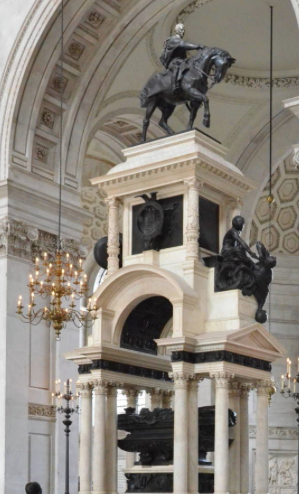
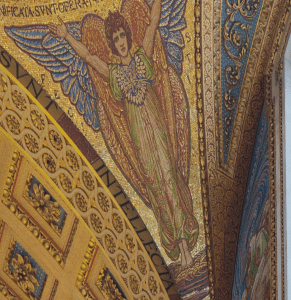
In the dome is a mural with scenes from the life of St. Paul. It was painted in muted colors—a departure from the colorful decoration in Catholic churches. Statues and imagery of saints and angels is limited, in keeping with Protestant philosophy. Instead, statesmen like the Duke of Wellington and Admiral Lord Nelson are ensconced in huge lavish crypts. St. Paul’s remained a more somber looking place until the 1890’s, when Queen Victoria declared that it was dreary and uninspiring and asked to have mosaics installed.
The influence of politics is evident in the lavish decor, which speaks of wealth and power of the monarchs, the Church of England, and England itself. It’s also obvious in the inclusion of statues of political figures instead of religious figures.
I dislike the dichotomy and wish it could simply be an inspiring place of worship. But then I recall the way thousands of people flocked to St. Paul Cathedral at the end of World War II and realize that for many ordinary people, the cathedral is a spiritual place as well as a national symbol.
God in the Details?
Then I focus on the decorative details and think of the craftsmen who spent years setting tiny tiles to create the mosaics. Or the woodcarvers who labored and fussed over the leaves in the choir stall borders. Or the metalsmiths and artists who made the Tijou gates and the chalices. Hundreds of artisans throughout the church’s history worked to create something important and lasting. I want to believe that devoting years and years of their lives to the work was an expression of their faith. Thinking of the craftsmen restores my appreciation for the cathedral.
Photo by DAVID ILIFF. License: CC-BY-SA 3.0 Detail of quire (choir) mosaics.
Photo by DAVID ILIFF. License: CC-BY-SA 3.0. Detail of wood carving in choir stalls.