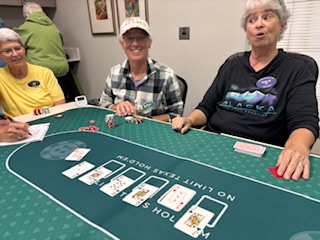
What a twelve-year-old learns to survive sometimes becomes the skill she uses decades later at a poker table.
Lying didn’t come naturally to me. I was twelve when I realized, quite suddenly, that I wouldn’t survive my family’s chaos if I didn’t learn how.
I stood in front of the assistant principal, heat climbing up my neck and into my face. I could feel the redness spreading across my cheeks. The corners of my mouth twitched. My eyes kept sliding away from his.
He asked the question again.
I tried to answer, but the truth was written all over me. My breathing had changed. My hands shifted at my sides. My face burned like a signal light.
I remember thinking: This is a problem.
That afternoon, when I got home, I went straight into the bathroom and closed the door behind me. I turned on the light and stood in front of the mirror. I shut the household noise off and stared at my reflection.
I knew exactly what to do.
I looked into my own eyes and said the words out loud.
“I didn’t do it.
I wasn’t there.
It wasn’t me.
I don’t know how that happened.”
My face flushed immediately. My mouth tightened. My eyes shifted away.
So I tried again.
And again.
I practiced until the red stopped rising in my face. Until my breathing stayed steady. Until I could hold my own gaze without flinching. I practiced until my shoulders relaxed and my voice sounded ordinary.
I practiced until my body stopped betraying me.
That was the day I learned that unless someone actually saw me do something, I could lie convincingly.
When I was nineteen, I had a different realization.
I was mowing the lawn on a nice summer day. I paused, looked to the sky, and watched the clouds drift.
And it hit me.
I was exactly where I had said I would be.
No excuses.
No stories.
No explanations.
Just the truth.
There was freedom in that.
A lightness.
I remember thinking: This is better. I have no reason to lie anymore. I’m safe.
I went back to the mirror. I stood there looking at myself and said, quietly at first, “I love me.”
My eyes slid away from my own reflection.
So I said it again.
“I love me.”
I stayed there repeating it until I could look myself straight in the eyes without my gaze moving off the mirror.
“I love me.
I love me.
I love me.”
It felt strange. Uncomfortable.
Slowly the words settled.
I believed me.
Today, I still practice with a mirror.
Before a poker tournament starts, I give myself the same quiet talk.
“I love me.
I’ve beaten everyone at this table before.
I can beat them today.
Play my cards.
Trust myself.”
Poker is about many things—math, probability, timing—but there is another part of it people don’t always talk about.
Control.
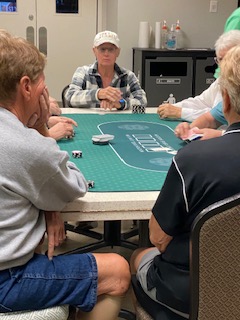
At the poker table, I can keep my emotions exactly the same whether I’m holding a seven and a two or a pair of aces. My breathing stays steady. My hands rest in the same place. My face doesn’t give anything away.
No tells.
Sometimes I think about that twelve-year-old girl standing in the bathroom mirror, practicing how not to show the truth on her face. She didn’t know it then, but she was learning something about herself, about discipline, about control, about surviving difficult moments without falling apart.
Poker uses those same muscles.
But it also asks for something more.
It asks me to stay present.
Every hand is a surprise. Every card an unknown. Sometimes the deck gives you everything. Sometimes it gives you nothing.
And when it gives me nothing, that’s okay too.
I can push my chair back, smile across the table, and say,
“Nice game, ladies.”
Because the real victory happened long before the cards were dealt.
It happened the day I learned to look at myself in the mirror and tell the truth.
