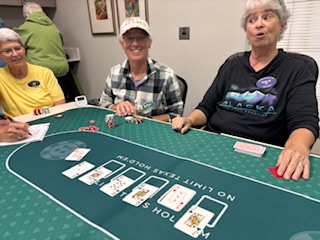
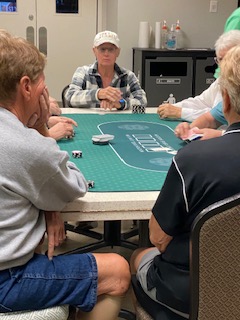
What a twelve-year-old learns to survive sometimes becomes the skill she uses decades later at a poker table.
Lying didn’t come naturally to me. I was twelve when I realized, quite suddenly, that I wouldn’t survive my family’s chaos if I didn’t learn how.
I stood in front of the assistant principal, heat climbing up my neck and into my face. I could feel the redness spreading across my cheeks. The corners of my mouth twitched. My eyes kept sliding away from his.
He asked the question again.
I tried to answer, but the truth was written all over me. My breathing had changed. My hands shifted at my sides. My face burned like a signal light.
I remember thinking: This is a problem.
That afternoon, when I got home, I went straight into the bathroom and closed the door behind me. I turned on the light and stood in front of the mirror. I shut the household noise off and stared at my reflection.
I knew exactly what to do.
I looked into my own eyes and said the words out loud.
“I didn’t do it. I wasn’t there. It wasn’t me. I don’t know how that happened.”
My face flushed immediately. My mouth tightened. My eyes shifted away.
So I tried again.
And again.
I practiced until the red stopped rising in my face. Until my breathing stayed steady. Until I could hold my own gaze without flinching. I practiced until my shoulders relaxed and my voice sounded ordinary.
I practiced until my body stopped betraying me.
That was the day I learned that unless someone actually saw me do something, I could lie convincingly.
When I was nineteen, I had a different realization.
I was mowing the lawn on a nice summer day. I paused, looked to the sky, and watched the clouds drift.
And it hit me.
I was exactly where I had said I would be.
No excuses. No stories. No explanations.
Just the truth.
There was freedom in that.
A lightness.
I remember thinking: This is better. I have no reason to lie anymore. I’m safe.
I went back to the mirror. I stood there looking at myself and said, quietly at first, “I love me.”
My eyes slid away from my own reflection.
So I said it again.
“I love me.”
I stayed there repeating it until I could look myself straight in the eyes without my gaze moving off the mirror.
“I love me. I love me. I love me.”
It felt strange. Uncomfortable.
Slowly the words settled.
I believed me.
Today, I still practice with a mirror.
Before a poker tournament starts, I give myself the same quiet talk.
“I love me. I’ve beaten everyone at this table before. I can beat them today. Play my cards. Trust myself.”
Poker is about many things—math, probability, timing—but there is another part of it people don’t always talk about.
Control.
At the poker table, I can keep my emotions exactly the same whether I’m holding a seven and a two or a pair of aces. My breathing stays steady. My hands rest in the same place. My face doesn’t give anything away.
No tells.
Sometimes I think about that twelve-year-old girl standing in the bathroom mirror, practicing how not to show the truth on her face. She didn’t know it then, but she was learning something about herself, about discipline, about control, about surviving difficult moments without falling apart.
Poker uses those same muscles.
But it also asks for something more.
It asks me to stay present.
Every hand is a surprise. Every card an unknown. Sometimes the deck gives you everything. Sometimes it gives you nothing.
And when it gives me nothing, that’s okay too.
I can push my chair back, smile across the table, and say,
“Nice game, ladies.”
Because the real victory happened long before the cards were dealt.
It happened the day I learned to look at myself in the mirror and tell the truth.
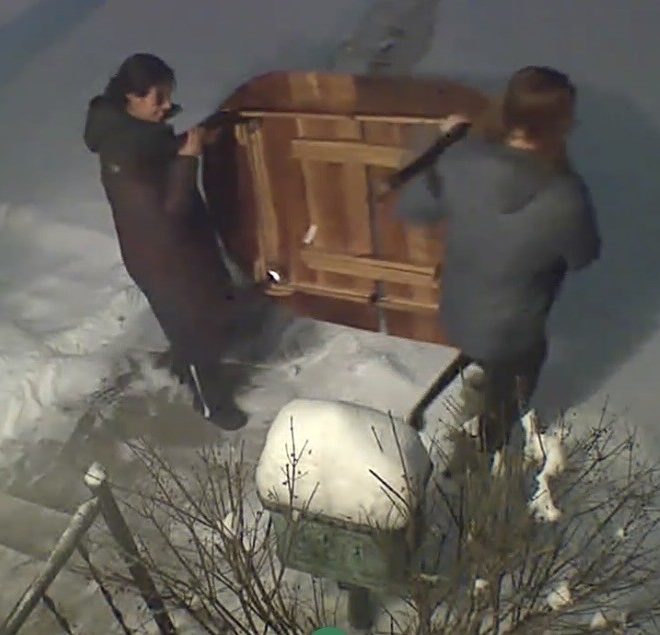
“Crystel’s carrying the dining room table out of the house!” Jody said, a note of panic in her voice. “Now the chairs!”
Quietly, I felt proud of Crystel. She was going ahead with gumption, emptying our house while we were in Florida, not asking permission, not making a fuss. Jody kept tabs on the coming and goings through the Blink footage, watching life continue without us. In what felt like solidarity with her alarm, I said, “Yeah… she could have told us before she did it.”
“Well, you did tell her to give everything away,” Jody said, somewhat accusingly.
“Yeah,” I said. “I did say that didn’t I?”
I imagined walking into our house when we returned in May and not seeing our dining room table. Juan wouldn’t be assembling a Lego set or Crystel stitching at the table. Our final board game had already happened.
The two girls turned the table sideways to fit through the door, and the leaf extension opened awkwardly.
“We better remind her to get the table leaves from the basement,” Jody said.
“You’d think she’d know that” I said, cocking my head studying the video clip. The extension fell completely open now. It was like watching a movie reel, silent, irreversible.
“Yeah,” Jody replied. “You’d think so… but.”
Later, we got a photo from Crystel. She was sitting at the table in its new home. She had gifted the table to her friend who was moving into a new apartment.
Quickly, Jody texted a list: These are the things I want from the house—do not give away.Heart-shaped end table from her mother. Charging side table in living room. Lounge chair the cats sit in.
Our house will go on the market by summer. Juan and Crystel are turning twenty-four this year still living at home. Juan has a plan to move into an apartment with his girlfriend. Crystel’s plans are fluid. It’s as if the house is still raising the kids, negotiating garbage duty, washing dishes, cleaning house.
After the house sale, Jody and I plan on living in our RV. Maybe sooner than expected, judging by how quickly our household items are leaving through the front door.
“I think it’s a good idea,” I said to Jody, “that Crystel is helping give things away. With the dining room table gone, there’s no pretending we’re not leaving.”
Twenty-five years, we lived in that house. The only home Juan and Crystel knew. They are dismantling their childhood while still living inside it. Crystel has sewn her t-shirts into a quilt; Juan is going through his sweatshirts one by one.
Maybe this is how it happens. Not with one final goodbye, but piece by piece. A table. A chair. A room that echoes a little more than it used to.
For years we filled that house with noise, laughter, birthdays, school and neighborhood parties. Arguments and apologies.
Crystel walked left on the beach. I walked right. We were done with each other for the day. Discovering the wonders of El Paredon, on Guatemala’s Pacific coast, would be done alone. I was not willing to follow her, and she was not willing to follow me. The blue ocean was anything but quiet. It roared with its own intensity, a restless turbulence wrestling against itself. Beyond the break point, surfers waited. Under my feet, the striking black volcanic sand glimmered with heat and stretched as far as I could see. Tall palms and weathered beach huts dotted the coast.
Earlier that morning at the surfboard rental hut, she had said it again, sharp and familiar, “You don’t have to talk for me.” This had become her refrain at twenty-one years old. I’d thrown up my hands, “I was just asking which board might be easier for you to surf with.” This was who we were now. Crystel couldn’t let me parent, and I couldn’t stop being her parent.
Eventually, we would circle back. We always did.
I walked toward a tangle of driftwood and chose it as my turnaround point. Somewhere between that black sand and the roaring ocean, the joy of being with her returned.
At a beachside restaurant, wooden tables were planted right into the sand. A thatched roof swayed gently above, letting the warm air carry the sound of waves through the open sides. Surfboards leaned in a tidy stack nearby. Backpackers drifted in and out: sunburned, barefoot, unhurried. Mellow music floated from a speaker behind the bar. I texted Crystel the name of the place. This time, she didn’t ghost me. When the message bubble appeared with her reply, I felt surprise first then thrill. We weren’t done with each other after all.
The next morning, I brought her a smoothie and pastry in bed. I’d been up for hours, already through my own breakfast, the typical Guatemalan spread of eggs, refried beans, plantains, tortillas, fruit and endless coffee. I lounged beside her considering our air-conditioned room. It was the exact opposite of our homestay, almost unsettling pristine. It felt new, as if someone had built it yesterday and aired it out just for us. The walls were off-white. No pictures. No nails or hooks. No sign that anyone had ever stayed here before. Fresh white towels lay folded in perfect stacks. Crystel was curled up in starched sheets, a quiet bundle in a bed that felt too clean to be real.
There was no furniture. Just the bed, the air-conditioning, and Spanish music drifting from the TV.
I had gotten what I asked for, but would it work? Would four days of salt air, sun, rest, and a spotless hotel room loosen the grip of the PTSD that held tight beneath my ribs? Would this respite from dirt, crumbling sheetrock, clutter, and questionable bedding reset my body?
At last, I had a night of sleep, my body no longer on high alert, scanning for danger. I slept, truly slept. Before we left our homestay, I folded my scratchy blankets and placed the dingy sheets beside the washer, hoping a simple wash would be enough and that somehow, I could carry this newfound tranquility forward.
Our push-pull relationship momentarily eased. From the beach, I watched Crystel battle the surf, fighting against the relentless beach break. Waves slammed in from all directions, crashing into each other. Even mounting her board was a struggle. Still, she kept at it, and ultimately, like I knew it would, determination pulled her through. We strolled the dusty streets of El Paredon, followed her restaurant recommendations, and watched the sun go down side by side.
In the taxi back to our homestay, my stomach tightened. Four and a half hours ahead of us. It started as a cringe then expanded into worry. Can I do this? Will this time away be enough? I wanted it to be. I wanted what Crystel wanted, an authentic Guatemalan home, language immersion, community, conversations around the table. But the farther we drove the more numbness seeped in. That old childhood response, the one my body learned when danger was close. Suddenly, I wasn’t sure any length of time away would be enough. As the landscape shifted outside the window, I could feel my peace slipping away.
“I put your washed bedding back on the bed,” said Maria. She pulled me in for a grandmotherly hug. A bowl of warm soup and tortillas waited for us on the table.
I went to find Crystel.
“Mama Beth,” she whispered, “I think the little boy slept in my bed while we were gone. Stuff is moved around.”
“Does that bother you?”
“No. I just ignore it. I don’t think about it.”
Crayola markings covered the wall. This was probably his room when there were no guests. When we arrived, he likely slept with his parents. I had asked Crystel before we left for El Paredon if she’d like her sheets washed too. She had declined. “I just don’t think about it,” she repeated.
That night, I spread my washed sheet back over the mattress, though it still looked unclean like it had held on to someone else’s sleep. Before I layered the heavy wool blankets, I inspected the sheet closely. I searched for any sign of fleas. If I saw a patchy shadow, I pressed my finger to it to see if it moved. On one faded spot, I found the shell of a bug, small as a seed, light as paper still clinging to the fabric.
I crawled into my extra-large sleep sack, long enough to swallow my whole body and still fold over the pillow. I slid into it feet-first and pulled it up past my shoulders. The top flap had an extra panel, meant to tuck over a pillow, but I used it like a barrier, a clean layer between me and whatever might be hiding in the bedding. I cinched the hood around my neck and pulled the pillow flap across my face like a shield. It wasn’t just something to sleep in. It was something to hide in.
Sleep would not come. My body stayed alert. Racing. Listening. Braced for danger. It felt like being sixteen again, waiting for the fight in my parents’ bedroom to turn violent. There was no fighting in this house, but the clutter, dirt and disarray were enough. They carried me back in time.
“I should be able to do this,” I kept telling myself. “It’s not so bad.” “I can handle it.”
But those were the exact words I used to survive my childhood. Back then, I had no choice.
Here I did. I wasn’t the abused girl anymore. I could choose differently now.
That realization changed everything.
The next morning, before breakfast, I started researching hotels with kitchenettes. My worry about the homestay family losing money faded, our stay had already been paid. Jody supported me leaving, she had listened to my tears too many times. I just didn’t want to disappoint Crystel. I had let her lead our days, pick restaurants, navigate cobblestone streets, but this choice was mine. I didn’t need to keep trying to make this work.
I made the reservation, and instantly, the guilt arrived. It felt like I was going to get in trouble, really in trouble. As if someone might hit me, punish me for speaking up. A part of me felt like I’d told on someone. Betrayed them. What would happen now? Would they stop talking to me? Reject me? A bad thing was coming, I could feel it.
This had happened before.
When I reported the incest in my family to the police, the same thoughts spiraled through me, What will they say? What will they do to me? Who will I lose? And all those fears came true. They did reject me. They did ostracize me. I already knew this terrain, the ground where doing the right thing still carries a cost. I’d paid this price before, and my body remembered it before my mind did.
When I told Crystel I had made a hotel reservation for us her face fell. And then I had to ask her to tell the family we wouldn’t be living there.
Punishment didn’t come. A reflex older than motherhood. Maria gathered us in for a family photo, her, her daughter, her son-in-law, their five-year-old son, and us. Crystel and I were folded seamlessly into their circle. Grief, relief, and tears rose up all at once. Once again, I was leaving family.
Of course, our last breakfast at the homestay was Crystel’s “BEST EVER” and she was slow to meet me out front.
At sixty-five, I had finally learned that caring for my mental health was not selfish, it was necessary. I honored myself, and in doing so, I preserved the part of me that could love my daughter fully.
Crystel and I stepped forward, not perfectly, but together. I couldn’t stop the waves, inside or out, but I could decide how I met them.