Tag: history

  • Finding Common Ground in the Essence of the Holidays

    Thanksgiving in Ohio a few years ago - Table set for 16 - before the  carnage
    Thanksgiving in Ohio a few years ago – Table set for 16 – before the dinner carnage

    In the class where I assist, explaining the customs surrounding Halloween and Thanksgiving to adult immigrants who are learning English is challenging. Understanding American customs helps immigrants fit in, even if they aren’t likely to celebrate the holidays the exact same way long-time Americans do. However, Halloween and Thanksgiving have evolved so much from their original meanings that often it’s hard to make sense of our current practices.

    When I try to explain Halloween, it sounds absurd.

    In class, I hear myself say, “Halloween” comes from “All Hallowed’s Eve.” “Hallowed” refers to people who have died—their souls are “hallowed” or “holy,” and Christians believe good souls go to heaven after they die . . . .”

    I write the words on the board and think, How can I possibly explain the history? I try this, “Hundreds of years ago the Celts—people who lived in Great Britain and northern Europe—believed that October 31st was the end of one year and November 1st was the start of a new year. At that time of year, dead souls could visit earth. People dressed in costumes to trick the returning spirits, so the spirits or ghosts couldn’t harm them.” Wow. That sounds completely bizarre. Why is this still a holiday?

    ghosts
    Image from http://www.hdwallpapers.in/halloween_ghosts-wallpapers.html

    I say, “Most people don’t really worry about ghosts, but people still enjoy dressing in costumes.” I pause after that semi-lame comment. Moving along, I start to describe how trick or treating works, but falter when explaining the reasons why that custom is acceptable. Give me a treat or else I’ll play a trick on you? On the face of it, that custom sounds like blackmail. Umm, in America, that how we do things??

    Given the language barrier, I’m not sure how much the students understand.

    cemetary
    Photo from traditionscustoms.com

    The students from Mexico and Central America see the connection between American Halloween and Dia de Muertos (Day of the Dead) in which families visit cemeteries with food and mementoes, and they picnic at the gravesites. At best, the students from Africa and Asia look baffled by Halloween and Dia de Muertos, and at worst, they look repelled.
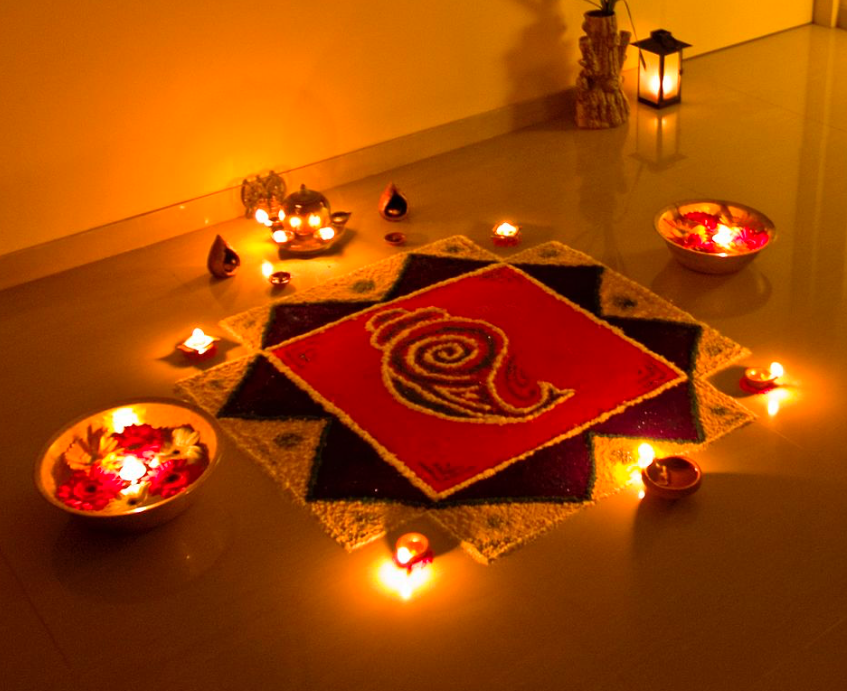
    Photo by Subharnab Majumdar - originally posted to Flickr as The Rangoli of Lights
    Photo by Subharnab Majumdar – originally posted to Flickr as The Rangoli of Lights (Diwali)

    I extend our discussion to describe Diwali (also called Deepavali). It’s a Hindu festival of lights that’s celebrated in late autumn in parts of India, Sri Lanka, Nepal, Malaysia, and other countries in the region. People light candles and lamps, create intricate decorations called “rangoli” using colored powder, and families exchange small gifts to celebrate the triumph of light over darkness and knowledge over ignorance.

    The Muslim Africans and Buddhists from Asia and begin to nod. They see that in countries across the world, celebrations take place in late autumn when the days grow shorter and darker. They understand that people need light, to gather together, and to celebrate with special food.

    When we discuss Thanksgiving, I feel a different sort of disconnect.

    The official story of Thanksgiving is that Native Americans selflessly rescued starving Pilgrims by teaching them about North American foods—how to grow corn and squash and how to hunt local game and fish. To show gratitude after the first harvest, the Pilgrims prepared a feast and shared it with the local tribe. That’s the version I learned years ago in school, and it’s still favored today in many public schools.
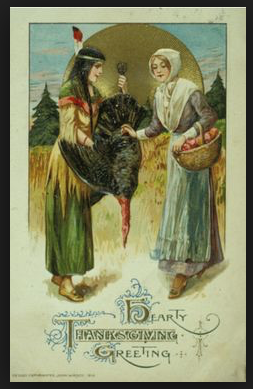
    Fairy tale version of the first Thanksgiving
    Fairy tale version of the first Thanksgiving Historical postcard c. 1910 from Plimoth Plantation collection

    But, I think, it’s only half of the story. European settlers also introduced smallpox and other diseases to Native Americans, who had no resistance to them. Thousands died. Often the Pilgrims’ interactions with local Indian tribes were disrespectful. Native Americans were seen as “savages” who had no religion of their own. For a long while after the Pilgrims claimed New England for their own, the invading European settlers and Native Americans engaged in raids and massacres. Millions were killed.

    How far do I delve into the historical details? After the trouble explaining Halloween customs, I decide to mention, but only summarize, the difficulties between the Native Americans and the Pilgrims. Perhaps it’s wrong to round off history’s sharp edges, but I decide to focus on what connects people of different cultures. I describe the current meaning of Thanksgiving—to be grateful for what you have and to share a good meal (of whatever cuisine) with family and friends. When put in the simplest terms, the students understand the point of Thanksgiving.

    By focusing on the essence of these customs—remembering the dead, pushing back darkness, being grateful for a plentiful harvest, and sharing a good meal with family and friends—students who come from Mexico, Venezuela, Colombia, Cambodia, Sri Lanka, Russia, Somalia, Ethiopia, Eritrea, and Vietnam find common ground with each other and with Americans.

  • Great Cathedrals: Power, Greed and Inspiration

    When my husband and I travel in the United Kingdom or Europe, we always visit some of the great cathedrals. That may seem odd, since neither of us is very religious. But cathedrals like St. Paul’s in London embody history, politics, and faith in a very visceral way and I’m very interested in history. The experience encompasses the best and worst of human nature.

    The Shock and Awe of Churches

    The architects and benefactors of great cathedrals intended to create a dramatic impact. And St. Paul’s does. The cathedral is an architectural marvel. The main aisle of cathedral goes on and on—while standing at one end of the church, I can see the other end, but just barely. The arched ceiling and dome soar high above the seats. Everywhere I look there are intricate decorations and many are covered with gold. I immediately feel small and insignificant in face of all the space and history, but that feeling gives way to a faint unease.

    Photo by DAVID ILIFF. License: CC-BY-SA 3.0. Wikimedia Commons furnished this photo of the nave. Tourist photography isn’t permitted in the church.
    Photo by DAVID ILIFF. License: CC-BY-SA 3.0. Wikimedia Commons furnished this photo of the nave. Tourist photography isn’t permitted in the church.

    Sightseeing in a Place of Worship

    Though I’m no longer a practicing Catholic, that upbringing is ingrained in me. It feels odd to see the whole gamut of tourists wandering around snapping photos (where permitted), peering at inscriptions on statues, ducking into alcoves, zigzagging across aisles in front of the pulpit and behind the altar, talking and pointing. There’s something distasteful about it, although obviously, I’m a tourist doing the same thing.

    The premise of sightseeing in church is complicated. Many cathedrals charge admission and I assume the money helps maintain the building. Perhaps the religious authorities are also trying to give ordinary people access to a beautiful and potentially inspiring place.

    Tijou gates - Photo by DAVID ILIFF. License: CC-BY-SA 3.0. Wikimedia Commons
    Tijou gates – Photo by DAVID ILIFF. License: CC-BY-SA 3.0. Wikimedia Commons

    Incredible Excess

    Cathedrals like St. Paul’s, the duomos in Florence and Siena, and St. Peter’s in Rome, all contain elaborate decorations—intricate mosaics, detailed wood and stone carvings, painted frescoes, golden candlesticks, chalices encrusted with jewels, lavishly embroidered altar cloths. The excess is fascinating but off-putting. I think about all of the money invested, perhaps for the glory of God but also as a demonstration of the power and wealth of the church, whether Anglican like St. Paul’s or Catholic like St. Peter’s in Rome. At first I am awed by the gilt and filigree, but then reminded of the greed, intolerance, and corruption that religious institutions have displayed historically.

    Politics and Religion Are Intertwined in St. Paul’s

    St. Paul’s was originally built as a Catholic church in 604. In 1087, it was demolished by fire. Rebuilding began in 1087 and the church was reconsecrated as a Catholic church in 1300. The Protestant Reformation, begun by Martin Luther in 1517, in response to the corruption in the Catholic Church, swept through Europe. In 1534, King Henry VIII split from the Catholic Church and established himself as head of the Church of England, so he could marry Anne Boleyn.

    Politics and religion remained intertwined and turbulence continued in England until the 1660’s. During this period, St. Paul’s fell into disrepair and was used for a variety of things, including a marketplace. In 1666, King Charles II commissioned architect Christopher Wren to rebuild St. Paul’s, but the Great London fire destroyed the church and work was delayed until 1669. The church was completed in 1710. Now an Anglican church, the new St. Paul’s reflected the politics of the day.

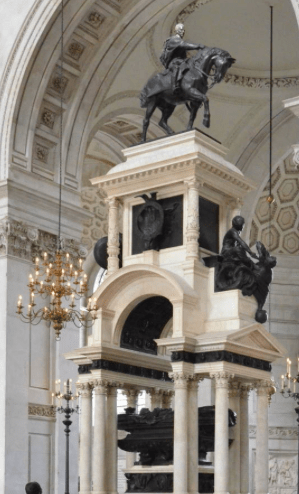
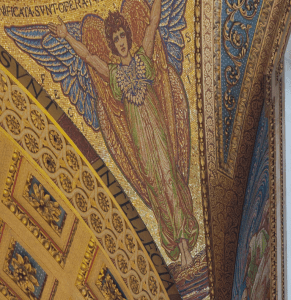
    In the dome is a mural with scenes from the life of St. Paul. It was painted in muted colors—a departure from the colorful decoration in Catholic churches. Statues and imagery of saints and angels is limited, in keeping with Protestant philosophy. Instead, statesmen like the Duke of Wellington and Admiral Lord Nelson are ensconced in huge lavish crypts. St. Paul’s remained a more somber looking place until the 1890’s, when Queen Victoria declared that it was dreary and uninspiring and asked to have mosaics installed.

    wellington
    Wellington monument – Photograph by George P. Landow (http://www.victorianweb.org/ sculpture/ stevens/29.html)

    The influence of politics is evident in the lavish decor, which speaks of wealth and power of the monarchs, the Church of England, and England itself. It’s also obvious in the inclusion of statues of political figures instead of religious figures.

    I dislike the dichotomy and wish it could simply be an inspiring place of worship. But then I recall the way thousands of people flocked to St. Paul Cathedral at the end of World War II and realize that for many ordinary people, the cathedral is a spiritual place as well as a national symbol.

    God in the Details?

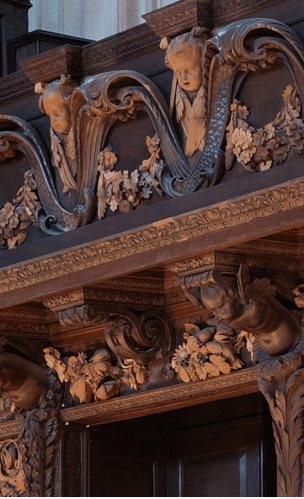
    Then I focus on the decorative details and think of the craftsmen who spent years setting tiny tiles to create the mosaics. Or the woodcarvers who labored and fussed over the leaves in the choir stall borders. Or the metalsmiths and artists who made the Tijou gates and the chalices. Hundreds of artisans throughout the church’s history worked to create something important and lasting. I want to believe that devoting years and years of their lives to the work was an expression of their faith. Thinking of the craftsmen restores my appreciation for the cathedral.

    mosaic-2
    Photo by DAVID ILIFF. License: CC-BY-SA 3.0 Detail of quire (choir) mosaics.
    Wood Carving closeup.png
    Photo by DAVID ILIFF. License: CC-BY-SA 3.0. Detail of wood carving in choir stalls.