I wake up to the cluck, cluck of chickens. The patio door is open to the outside and their fussing is distinct. I feel safe enough to leave the door ajar each night and let the breeze waft in off of Lake Atitlan. I can’t explain why or how it feels safe … but it does. It is the same knowing as when I know that something isn’t safe.
I wouldn’t keep my door open in my hometown of Richfield, Minnesota.
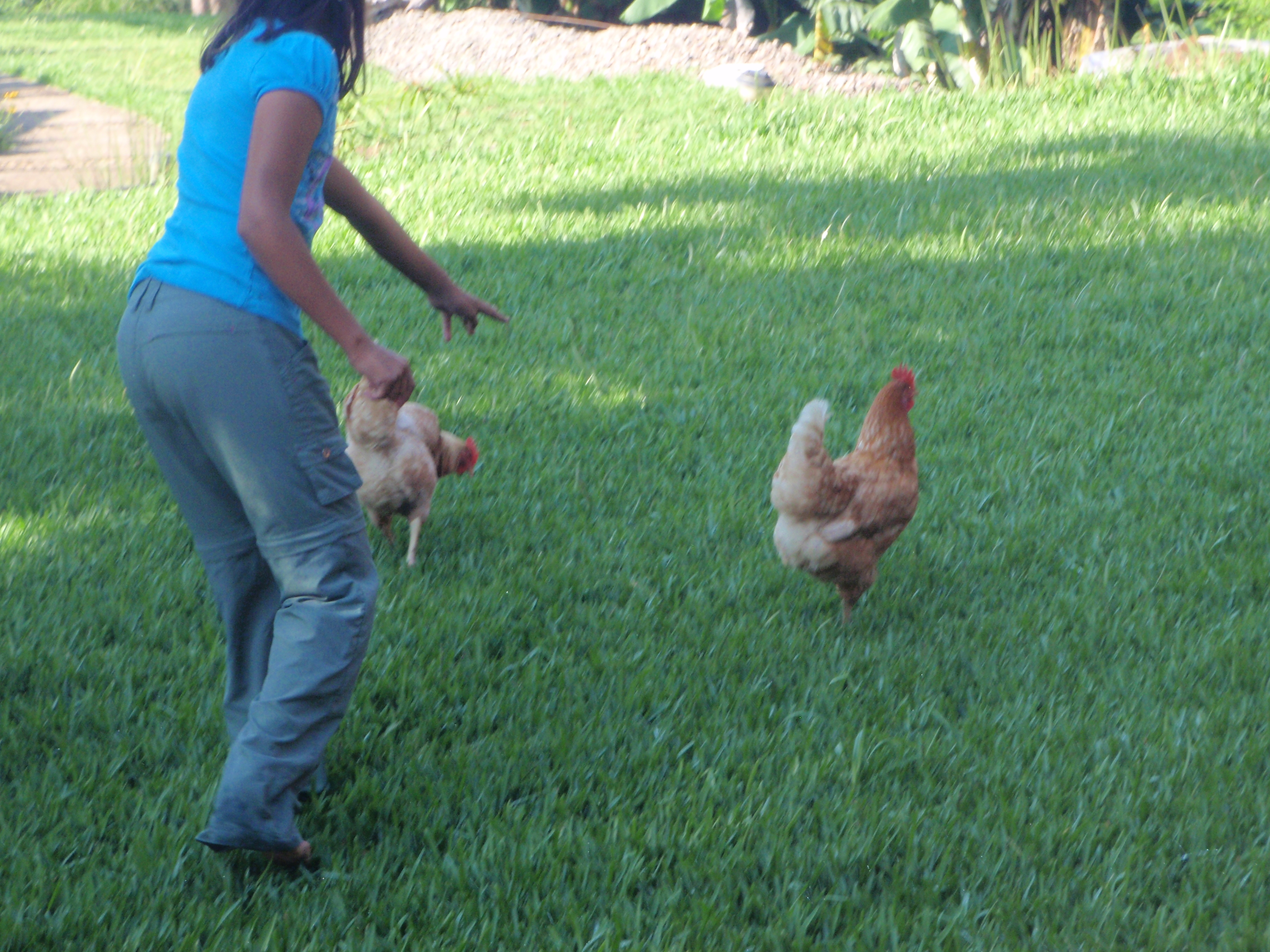 Soon Jody is frying fresh eggs from these same chickens and Antonio is urging Crystel to catch one. She does. Antonio finds enjoyment in Crystel doing what he himself won’t do.
After breakfast we meet our guide Sam who by the end of the day will feel like family.
 Because of our experience with Sam, Jody and I know we will always request a guide when visiting Lake Atitlan. Sam is knowledgeable and bilingual, but even more than that, he knows how to relate to two nine-year-olds. He becomes their companion. For Antonio and Crystel, it is the slow melding of being around another Guatemalan. Antonio and

Crystel can think, when I am older maybe I will be a little like him.
Being around a person of the same ethnic origin, someone who they like, allows Antonio and Crystel to intuit that being Guatemalan is a good thing. This is something Jody and I can’t give them. All the words that we have can’t compare to spending time with others of their own culture.
Antonio and Crystel are around many Hispanics in Minnesota and the Spanish dual language school that they attend in Richfield. They never have to feel alone or at odds with their skin tone. Still, there is a difference in being in your birth country and knowing that everyone you see is Guatemalan and not Mexican, El Salvadoran, Peruvian, Ecuadorian, or a mix of the former.
In the days to come Jody and I will witness our children’s growing sense of pride in their ethnicity.

Sam helps us carry our kayaks down to the water. Los Elementos Adventure Center has kayaks that fit the children. All of us are happy that we can each have our own. This is the first time I have ever seen Antonio and Crystel navigate on the water under their own power. They don’t have any hesitancy jumping into their kayaks and pushing off.
Included in our lodging at Los Elementos is access to the kayaks during our stay. Jody, Antonio, and Crystel will take them out again. I am content to sit and look at the volcanos from the patio, but I also know that I am missing out on that special feeling of being in the water surrounded by vast outcroppings.

After our morning we head off to San Pedro la Laguna in a launch for a horse ride. Once we arrive at San Pedro, we decide that we are hungry. Sam assures us that the restaurant Shanti Shanti is open even though it is still early. This sets the tone for our day. We don’t have set times that we have to be any place. Horseback riding will come but not quite yet.
Having Sam with us makes Jody and me more adventurous in choosing our lunch and more inclined to say ‘yes’ to milk shakes and other drinks.
When our family traveled to Guatemala in 2010 we didn’t try a lot of things because we didn’t want to become ill. In 2003 when we had brought Antonio and Crystel home we all got terribly sick with a gastrointestinal bug. Not the homecoming any of us wanted.
Sam, Jody and I order curry, Antonio orders his regular staple of pasta with just butter and Crystel has a cheese quesadilla.
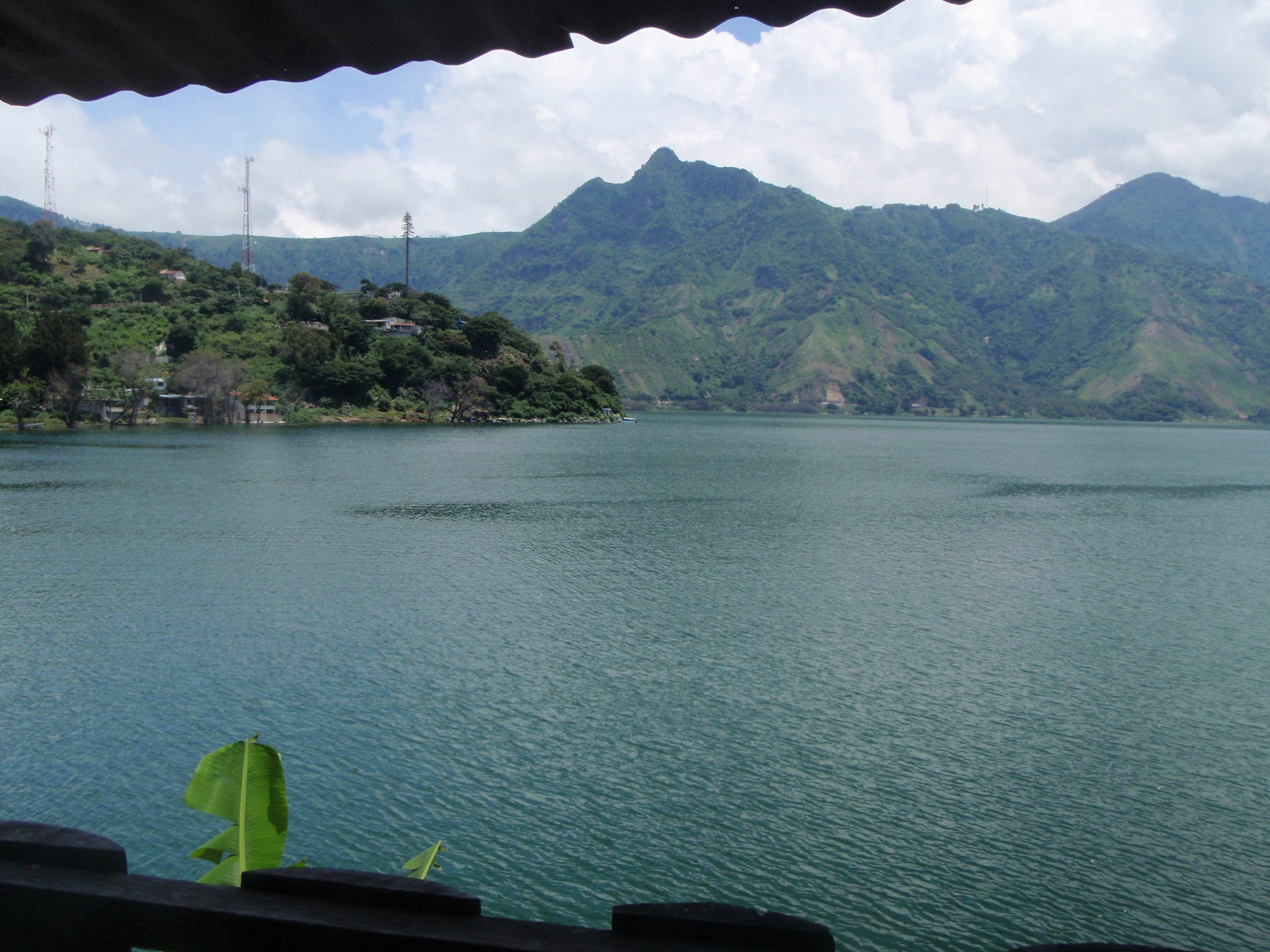
Our view from the restaurant looks right out over Lake Atitlan and Indian Nose, a unique mountain formation that resembles the face of a Mayan Indian in repose.

A Mayan woman and her son approach us while we are waiting for lunch. She is from San Antonio la Laguna but comes to San Pedro every day to sell her handicrafts.It is nice to be able to ask Sam if her asking price is good and to have his help in negotiating.
In 2010 when we traveled to Guatemala, Antonio and Crystel hated when I did any bargaining. Especially, if it was children with whom I was haggling. Even though I explained to them that that is the way it was. “Just give them the money,” they insisted. Now, I wanted to poke them and say, See?

Sam let us know that negotiating also puts him in an uncomfortable spot because he understands that the woman is trying to make a living and yet he knows what a good price would be.
San Antonio is named after Saint Antonio, Sam says. We smile at Antonio. He lets us know that he wants San Antonio to be a destination on our next trip to Guatemala.

San Antonio is known for their hair ribbons. The Mayan woman demonstrates how to put a ribbon on Crystel. It seems fairly complex and we ask if we can video her doing it.
We aren’t planning on buying handicrafts but it feels good to do so. It seems as if the money will go directly to her and her family.

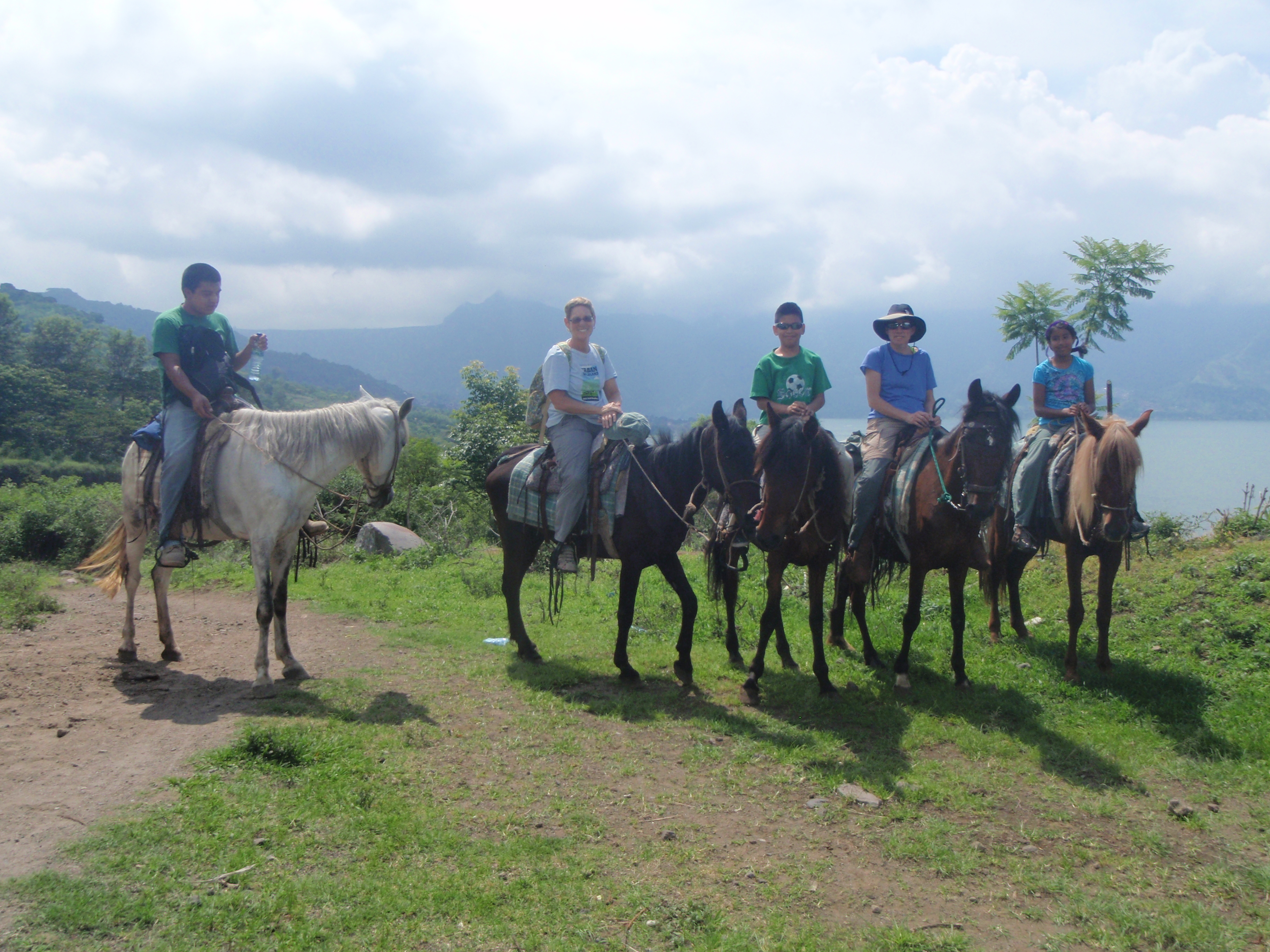
Lee Beal had told us in the morning that we could have Sam go horseback riding with us or we could go alone. We opted for Sam to join us especially, when we found out that he had never been on a horse before.
Horseback riding seems like the thing to do in Guatemala. It has become one of our must-do things.
We took a horse ride in 2010 and it was a remarkable way to see a village. You go slowly, you are up high, you can observe your surroundings, and there is excitement involved because you don’t know what your horse is going to do. Invariably, at some point in your trek the horse will start trotting, which leads to uncontrollable, scared, excited laughing.
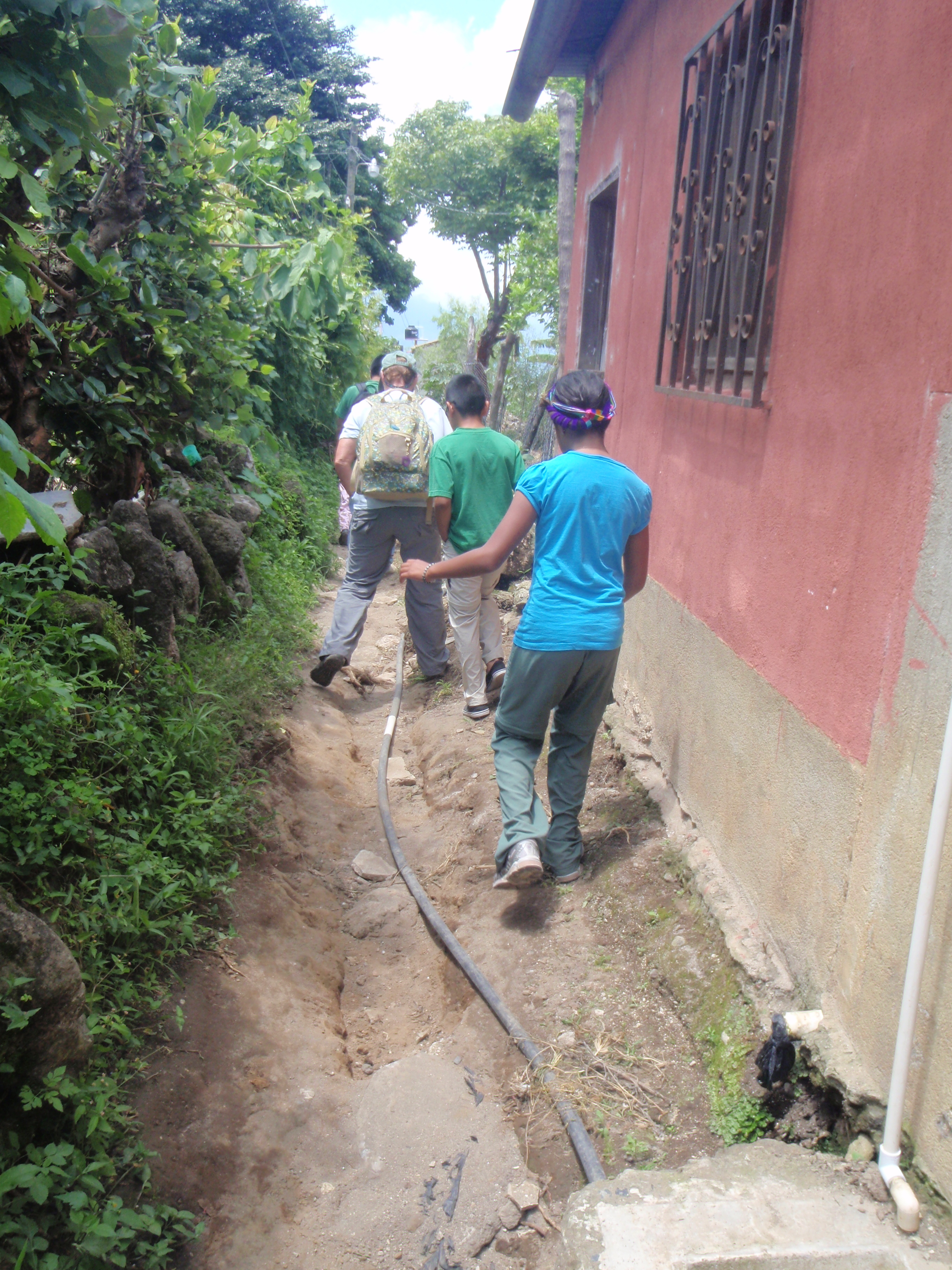
Getting to the horses in itself is an adventure in San Pedro. We were led down narrow paths, past people working in small plots, and in-between buildings. Finally when we arrive it’s like the farm moved to the city.
A dded to the excitement is an occasional BOOM. San Pedro is celebrating their Festival of San Pedro with fireworks, carnival, and games.
After our horse ride we stopped for lunch again. There are many Spanish language schools in San Pedro, so we stopped at a restaurant frequented by students. Jody and I had very good nachos with fresh tomatoes.
Before taking a Tuk Tuk to the dock, which Saint Antonio was all for, we walked through the main part of the village where the carnival was set up.
Sam called Lee and told him that our first weaving class would need to be delayed by one day. We weren’t quite ready to leave San Pedro.